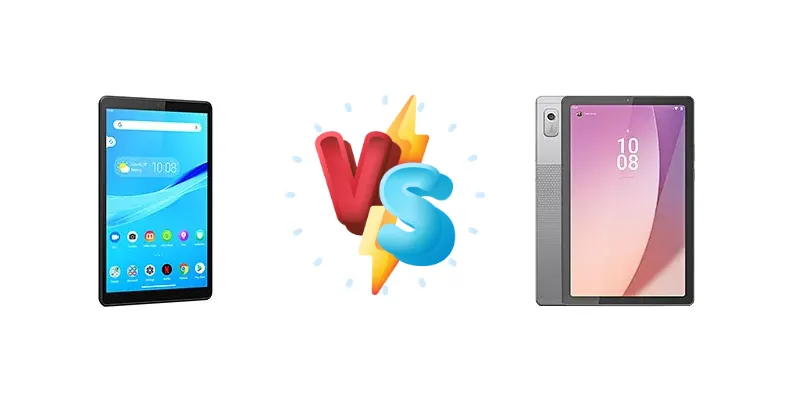
Lenovo's Tab M series consistently delivers affordable Android tablets, but the jump from the M8 (HD) to the M9 represents a significant internal shift. While both tablets target the budget-conscious consumer, the M9 boasts a newer, more powerful chipset. This comparison dissects the key differences to determine which tablet offers the best value for your money.
🏆 Quick Verdict
For most users, the Lenovo Tab M9 is the superior choice. Its Helio G80 chipset provides a substantial performance uplift over the M8 (HD)'s Helio A22, making it better suited for multitasking, streaming, and light gaming. While the M8 (HD) remains a viable option for basic tasks, the M9's improved processing power justifies the price difference.
| Network |
|---|
| 2G bands | GSM 850 / 900 / 1800 / 1900 | GSM 850 / 900 / 1800 / 1900 |
| 3G bands | HSDPA 850 / 900 / 1900 / 2100 | HSDPA 850 / 900 / 1700(AWS) / 1900 / 2100 |
| 4G bands | 1, 2, 3, 4, 5, 7, 8, 19, 20, 38, 40 | 1, 2, 3, 4, 5, 7, 8, 18, 19, 20, 26, 28, 38, 40, 41, 66 |
| Speed | HSPA, LTE - cellular model only | HSPA, LTE - cellular model only |
| Technology | GSM / HSPA / LTE | GSM / HSPA / LTE |
| | 1, 3, 5, 7, 8, 19, 34, 38, 39, 40, 41 | - |
| Launch |
|---|
| Announced | 2019, September. Released 2019, October | 2022, December 20 |
| Status | Discontinued | Available. Released 2023, March 14 |
| Body |
|---|
| Build | Glass front, aluminum back, aluminum frame | - |
| Dimensions | 199.1 x 121.8 x 8.2 mm (7.84 x 4.80 x 0.32 in) | 215.4 x 136.8 x 8 mm (8.48 x 5.39 x 0.31 in) |
| SIM | Nano-SIM (cellular model only) | Nano-SIM (cellular model only) |
| Weight | 305 g (10.76 oz) | 344 g (12.13 oz) |
| Display |
|---|
| Resolution | 800 x 1280 pixels, 16:10 ratio (~189 ppi density) | 800 x 1340 pixels, 5:3 ratio (~173 ppi density) |
| Size | 8.0 inches, 185.6 cm2 (~76.5% screen-to-body ratio) | 9.0 inches, 230.0 cm2 (~78.1% screen-to-body ratio) |
| Type | IPS LCD | IPS LCD, 400 nits (typ) |
| Platform |
|---|
| CPU | Quad-core 2.0 GHz Cortex-A53 | Octa-core (2x2.0 GHz Cortex-A75 & 6x1.8 GHz Cortex-A55) |
| Chipset | Mediatek MT6761 Helio A22 (12 nm) | Mediatek MT6769V/CU Helio G80 (12 nm) |
| GPU | PowerVR GE8320 | Mali-G52 MC2 |
| OS | Android 9.0 (Pie) | Android 12 |
| Memory |
|---|
| Card slot | microSDXC (dedicated slot) | microSDXC (dedicated slot) |
| Internal | 16GB 2GB RAM, 32GB 3GB RAM | 32GB 3GB RAM, 64GB 4GB RAM, 128GB 4GB RAM |
| | eMMC 5.1 | eMMC 5.1 |
| Main Camera |
|---|
| Single | 5 MP, AF | 8 MP, AF |
| Video | 1080p | 1080p |
| Selfie camera |
|---|
| Single | 2 MP | 2 MP |
| Video | 720p | 720p |
| Sound |
|---|
| 3.5mm jack | Yes | Yes |
| 35mm jack | Yes | Yes |
| Loudspeaker | Yes | Yes, with dual speakers |
| Comms |
|---|
| Bluetooth | 5.0, A2DP, LE | 5.1, A2DP, LE |
| NFC | No | No |
| Positioning | GPS, GLONASS, BDS - cellular model only | GPS, GLONASS, GALILEO - cellular model only |
| Radio | FM radio | Unspecified |
| USB | microUSB 2.0, OTG | USB Type-C 2.0 |
| WLAN | Wi-Fi 802.11 a/b/g/n/ac, dual-band, Wi-Fi Direct | Wi-Fi 802.11 a/b/g/n/ac, dual-band, Wi-Fi Direct |
| Features |
|---|
| Sensors | Accelerometer, proximity | Accelerometer, proximity |
| Battery |
|---|
| Charging | - | 10W wired |
| Type | Li-Po 5000 mAh, non-removable | Li-Po 5100 mAh |
| Misc |
|---|
| Colors | Iron Grey, Platinum Grey | Arctic Grey, Frost Blue |
| Models | TB-8505X, TB-8505F, TB-8505FS | TB310FU |
| Price | About 140 EUR | About 180 EUR |
Lenovo Tab M8 (HD)
- Extremely affordable price point
- Sufficient for basic tasks like reading and browsing
- Potentially longer battery life during minimal use
- Slow performance with multitasking
- Struggles with demanding apps and games
- Outdated chipset architecture
Lenovo Tab M9
- Significantly faster performance with Helio G80
- Improved multitasking and app responsiveness
- Better suited for streaming and casual gaming
- Higher price than the Tab M8 (HD)
- 10W charging is relatively slow
- Battery life may be slightly shorter under heavy load
Display Comparison
Both tablets utilize a 12nm process, suggesting similar display power draw. However, detailed display specs (resolution, panel type, brightness) are missing. Given the M8 (HD)'s name, we can infer a 720p resolution, while the M9 likely offers a similar or slightly improved panel. The M9's potential for a higher peak brightness, even marginally, would improve outdoor visibility. Without specific data, it's difficult to assess color accuracy or viewing angles, but the M9's newer design may incorporate slight improvements in these areas.
Camera Comparison
Camera performance is unlikely to be a deciding factor for either tablet, given their budget positioning. Detailed camera specs are unavailable, but it's safe to assume both feature basic sensors. The M9 *may* benefit from slightly improved image processing capabilities due to the more powerful chipset, but don't expect flagship-level photography. Focusing on the chipset difference, the G80's ISP (Image Signal Processor) is more advanced, potentially leading to better noise reduction and dynamic range in photos and videos.
Performance
The core difference lies in the chipsets. The Lenovo Tab M8 (HD) is powered by the Mediatek Helio A22, a quad-core processor built on a Cortex-A53 architecture. This is a basic processor designed for light workloads. The Tab M9, however, features the Helio G80, an octa-core chip with a more sophisticated architecture – two Cortex-A75 cores for performance and six Cortex-A55 cores for efficiency. This translates to a significantly faster and more responsive experience. The G80's architecture allows for better multitasking and handling of demanding applications. While both are 12nm, the G80's design is optimized for gaming, offering a noticeable advantage in graphics performance. The M9 will handle streaming services and social media apps with far less lag.
Battery Life
Battery capacity details are missing for both devices. However, the M9's 10W wired charging is a known specification. The Helio G80, while more powerful, is also designed with efficiency in mind. The M8 (HD)'s Helio A22 will likely offer slightly longer battery life during *very* light use, but the M9's faster processor will complete tasks quicker, potentially reducing overall screen-on time and negating some of that advantage. The 10W charging on the M9 is relatively slow, but adequate for overnight charging.
Buying Guide
Buy the Lenovo Tab M8 (HD) if you need a strictly basic tablet for simple tasks like reading ebooks, browsing the web with few tabs open, or video calls. It's ideal for users prioritizing extreme affordability and minimal feature requirements. Buy the Lenovo Tab M9 if you prefer a smoother, more responsive experience for everyday use, including streaming video, social media, and casual gaming. The M9 is the better choice for anyone who anticipates using their tablet for more than just the most fundamental functions.
Frequently Asked Questions
❓ Will the Lenovo Tab M9 handle popular streaming apps like Netflix and YouTube smoothly?
Yes, the Helio G80 chipset in the Tab M9 is more than capable of handling streaming apps like Netflix and YouTube without significant lag or buffering. The improved CPU and GPU provide a much smoother experience compared to the M8 (HD)'s Helio A22.
❓ Is the Lenovo Tab M9 suitable for playing mobile games?
The Tab M9 is suitable for *casual* mobile gaming. While it won't run demanding titles at maximum settings, the Helio G80 offers a noticeable improvement over the M8 (HD) for games like PUBG Mobile or Call of Duty: Mobile at medium settings. Expect playable frame rates, but don't anticipate a high-end gaming experience.
❓ How much faster is the Lenovo Tab M9 compared to the M8 (HD) in real-world use?
The Tab M9 feels significantly faster in everyday tasks. App launch times are quicker, multitasking is smoother, and web browsing is more responsive. The difference is most noticeable when switching between apps or performing more demanding tasks. The Helio G80's octa-core architecture provides a substantial performance boost.
❓ Does the Lenovo Tab M9 support expandable storage?
Unfortunately, detailed storage specifications are missing. However, based on Lenovo's typical offerings in this price range, it's likely the Tab M9 includes a microSD card slot for expandable storage, allowing you to add more space for apps, photos, and videos. Check the product listing for confirmation.