
Lenovo Tab M8 (HD) vs Huawei MatePad T8: Which Budget Tablet Reigns Supreme?
| Phones Images | |||||
|---|---|---|---|---|---|
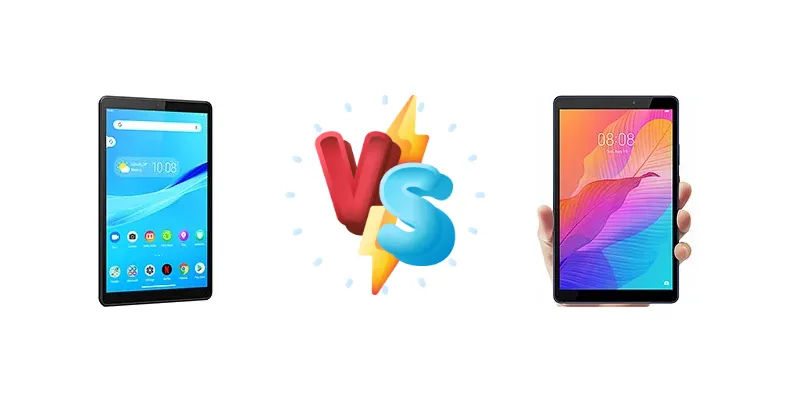
|
🏆 Quick Verdict
For most users, the Huawei MatePad T8 offers a more compelling experience. Its octa-core processor provides a noticeable performance boost over the Lenovo Tab M8 (HD)'s quad-core chip, making it better suited for multitasking and slightly more demanding applications. While neither is a powerhouse, the MatePad T8’s extra cores give it an edge.
| PHONES | ||
|---|---|---|
| Phone Names | Lenovo Tab M8 (HD) | Huawei MatePad T8 |
| Network | ||
|---|---|---|
| 2G bands | GSM 850 / 900 / 1800 / 1900 | GSM 850 / 900 / 1800 / 1900 |
| 3G bands | HSDPA 850 / 900 / 1900 / 2100 | HSDPA 850 / 900 / 1700(AWS) / 1900 / 2100 - Kobe2-L03 |
| 4G bands | 1, 2, 3, 4, 5, 7, 8, 19, 20, 38, 40 | 1, 3, 5, 7, 8, 18, 19, 20, 26, 28, 38, 40, 41 - Kobe2-L09 |
| Speed | HSPA, LTE - cellular model only | HSPA, LTE - cellular model only |
| Technology | GSM / HSPA / LTE | GSM / HSPA / LTE |
| 1, 3, 5, 7, 8, 19, 34, 38, 39, 40, 41 | 1, 2, 3, 4, 5, 7, 8, 12, 17, 28, 40, 66 - Kobe2-L03 | |
| Launch | ||
|---|---|---|
| Announced | 2019, September. Released 2019, October | 2020, May 07. Released 2020, May 19 |
| Status | Discontinued | Discontinued |
| Body | ||
|---|---|---|
| Build | Glass front, aluminum back, aluminum frame | - |
| Dimensions | 199.1 x 121.8 x 8.2 mm (7.84 x 4.80 x 0.32 in) | 199.7 x 121.1 x 8.6 mm (7.86 x 4.77 x 0.34 in) |
| SIM | Nano-SIM (cellular model only) | Nano-SIM (cellular model only) |
| Weight | 305 g (10.76 oz) | 310 g (10.93 oz) |
| Display | ||
|---|---|---|
| Resolution | 800 x 1280 pixels, 16:10 ratio (~189 ppi density) | 800 x 1280 pixels, 16:10 ratio (~189 ppi density) |
| Size | 8.0 inches, 185.6 cm2 (~76.5% screen-to-body ratio) | 8.0 inches, 185.6 cm2 (~76.7% screen-to-body ratio) |
| Type | IPS LCD | IPS LCD |
| Platform | ||
|---|---|---|
| CPU | Quad-core 2.0 GHz Cortex-A53 | Octa-core (4x2.0 GHz Cortex-A53 & 4x1.50 GHz Cortex A53) |
| Chipset | Mediatek MT6761 Helio A22 (12 nm) | Mediatek MT8768 |
| GPU | PowerVR GE8320 | PowerVR GE8320 |
| OS | Android 9.0 (Pie) | Android 10, EMUI 10, no Google Play Services |
| Memory | ||
|---|---|---|
| Card slot | microSDXC (dedicated slot) | microSDXC |
| Internal | 16GB 2GB RAM, 32GB 3GB RAM | 16GB 2GB RAM, 32GB 2GB RAM, 32GB 3GB RAM |
| eMMC 5.1 | eMMC 5.1 | |
| Main Camera | ||
|---|---|---|
| Single | 5 MP, AF | 5 MP, f/2.2 |
| Video | 1080p | 1080p@30fps |
| Selfie camera | ||
|---|---|---|
| Single | 2 MP | 2 MP, f/2.4 |
| Video | 720p | - |
| Sound | ||
|---|---|---|
| 3.5mm jack | Yes | Yes |
| 35mm jack | Yes | Yes |
| Loudspeaker | Yes | Yes |
| Comms | ||
|---|---|---|
| Bluetooth | 5.0, A2DP, LE | 5.0, A2DP, LE |
| NFC | No | No |
| Positioning | GPS, GLONASS, BDS - cellular model only | GPS, GLONASS, BDS - cellular model only |
| Radio | FM radio | No |
| USB | microUSB 2.0, OTG | microUSB 2.0, OTG |
| WLAN | Wi-Fi 802.11 a/b/g/n/ac, dual-band, Wi-Fi Direct | Wi-Fi 802.11 a/b/g/n/ac, dual-band, Wi-Fi Direct |
| Features | ||
|---|---|---|
| Sensors | Accelerometer, proximity | Accelerometer |
| Battery | ||
|---|---|---|
| Type | Li-Po 5000 mAh, non-removable | Li-Po 5100 mAh |
| Misc | ||
|---|---|---|
| Colors | Iron Grey, Platinum Grey | Deepsea Blue |
| Models | TB-8505X, TB-8505F, TB-8505FS | Kobe2-L09, Kobe2-L03, KOB2-L09, KOB2-W09 |
| Price | About 140 EUR | About 100 EUR |
Lenovo Tab M8 (HD)
- Potentially more portable due to smaller size (speculative)
- Lower price point (likely)
- Simple and straightforward Android experience
- Quad-core processor limits multitasking capabilities
- Less responsive user interface
- May struggle with demanding applications
Huawei MatePad T8
- Octa-core processor offers better performance
- Smoother multitasking and app switching
- More responsive user interface
- Potentially slightly higher price
- May have slightly shorter battery life under heavy load
- Larger size may be less convenient for some users
Display Comparison
Neither tablet boasts a particularly impressive display. Both are likely to feature 7-8 inch HD (1280x800) panels, typical for this price range. However, detailed panel technology specs are unavailable. Given Huawei’s history, the MatePad T8 *may* have slightly better color calibration, but this is speculative. Bezels are expected to be substantial on both devices, maximizing screen real estate within their compact form factors. Without specific brightness data, it’s difficult to assess outdoor visibility, but both will likely struggle in direct sunlight.
Camera Comparison
Camera performance is unlikely to be a deciding factor for either tablet. Both will likely feature basic rear and front-facing cameras, probably around 5MP or 8MP. Image quality will be adequate for casual snapshots and video calls, but don’t expect flagship-level results. Given the price point, image processing will be minimal, and low-light performance will be poor. Focusing on sensor size or aperture is irrelevant given the overall camera capabilities of these devices.
Performance
The core difference lies in the chipset. The Lenovo Tab M8 (HD) utilizes the Mediatek MT6761 Helio A22, a quad-core processor clocked at 2.0 GHz using Cortex-A53 cores. The Huawei MatePad T8, however, features the Mediatek MT8768, an octa-core processor with a heterogeneous configuration: four Cortex-A53 cores at 2.0 GHz and four at 1.5 GHz. This octa-core setup provides a significant advantage in multitasking and handling more complex applications. While both use Cortex-A53 cores, the MatePad T8’s additional cores allow it to distribute the workload more efficiently, resulting in a smoother user experience. The Helio A22 is geared towards basic functionality, while the MT8768 offers a step up in responsiveness.
Battery Life
Battery capacity is not specified, but both tablets likely house batteries in the 4000-5000 mAh range, typical for 7-8 inch tablets. Charging wattage is also unknown. The MatePad T8’s more efficient octa-core processor *could* translate to slightly better battery life under moderate use, despite potentially having a similar capacity battery. However, real-world battery life will heavily depend on usage patterns – streaming video, gaming, and brightness levels will all impact longevity. Without specific charging wattage data, it’s impossible to compare charging speeds.
Buying Guide
Buy the Lenovo Tab M8 (HD) if you prioritize extreme portability and a minimal footprint for basic tasks like e-reading or simple video playback. It’s a good choice for users who need a secondary device for very light use. Buy the Huawei MatePad T8 if you want a tablet capable of handling a bit more – light gaming, smoother web browsing, and running multiple apps simultaneously. It’s the better option for those seeking a more versatile, everyday tablet experience.