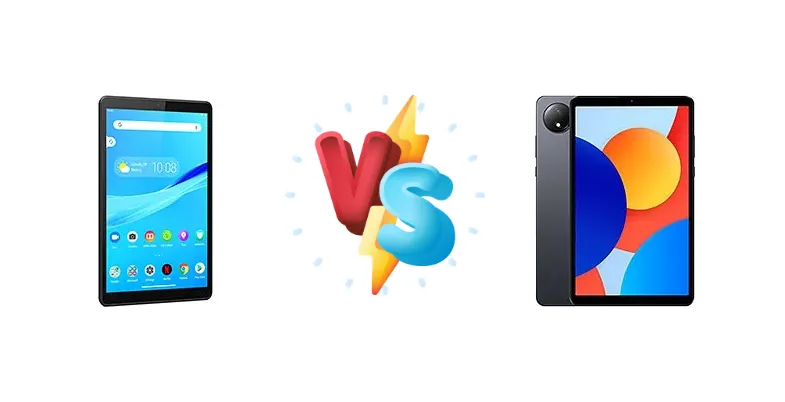
The sub-$150 tablet market is fiercely competitive, and the Lenovo Tab M8 (FHD) and Xiaomi Redmi Pad SE 8.7 are two strong contenders. While both aim to deliver an affordable Android experience, they take different approaches to performance and features. This comparison dives deep into the specifications to determine which tablet offers the best value for your money.
🏆 Quick Verdict
For most users, the Xiaomi Redmi Pad SE 8.7 emerges as the better choice. Its Helio G85 chipset, featuring more modern CPU cores, provides a noticeable performance uplift over the Lenovo Tab M8 (FHD)'s Helio P22T, making it more suitable for gaming and multitasking. The inclusion of 18W (International) or 10W (India) charging is also a plus.
| Network |
|---|
| 2G bands | GSM 850 / 900 / 1800 / 1900 | GSM 850 / 900 / 1800 / 1900 |
| 3G bands | HSDPA 850 / 900 / 1900 / 2100 | HSDPA 800 / 850 / 900 / 1700(AWS) / 1900 / 2100 |
| 4G bands | 1, 2, 3, 4, 5, 7, 8, 19, 20, 38, 40 | 1, 2, 3, 4, 5, 7, 8, 13, 18, 19, 20, 26, 28, 38, 40, 41, 66 |
| Speed | HSPA, LTE - cellular model only | HSPA, LTE - cellular model only |
| Technology | GSM / HSPA / LTE | GSM / HSPA / LTE |
| | 1, 3, 5, 7, 8, 19, 34, 38, 39, 40, 41 | - |
| Launch |
|---|
| Announced | 2019, September. Released 2019, October | 2024, July 29 |
| Status | Discontinued | Available. Released 2024, August 08 |
| Body |
|---|
| Build | Glass front, aluminum back, aluminum frame | Glass front (Gorilla Glass 3) |
| Dimensions | 198.2 x 122.6 x 8.2 mm (7.80 x 4.83 x 0.32 in) | 211.6 x 125.5 x 8.8 mm (8.33 x 4.94 x 0.35 in) |
| SIM | Nano-SIM (cellular model only) | Nano-SIM + Nano-SIM (cellular model only) |
| Weight | 305 g (10.76 oz) | 370 / 373 / 375 g (13.05 oz) |
| Display |
|---|
| Protection | - | Corning Gorilla Glass 3 |
| Resolution | 1200 x 1920 pixels, 16:10 ratio (~283 ppi density) | 800 x 1340 pixels, 5:3 ratio (~179 ppi density) |
| Size | 8.0 inches, 185.6 cm2 (~76.4% screen-to-body ratio) | 8.7 inches, 214.9 cm2 (~80.9% screen-to-body ratio) |
| Type | IPS LCD, 350 nits (typ) | IPS LCD, 1B colors, 90Hz, 600 nits (HBM) |
| Platform |
|---|
| CPU | Octa-core 2.3 GHz Cortex-A53 | Octa-core (2x2.0 GHz Cortex-A75 & 6x1.8 GHz Cortex-A55) |
| Chipset | Mediatek MT6762 Helio P22T (12 nm) | Mediatek Helio G85 (12 nm) |
| GPU | PowerVR GE8320 | Mali-G52 MC2 |
| OS | Android 9.0 (Pie), upgradable to Android 10 | Android 14, HyperOS |
| Memory |
|---|
| Card slot | microSDXC (dedicated slot) | microSDXC (dedicated slot) |
| Internal | 16GB 2GB RAM, 32GB 3GB RAM | 64GB 4GB RAM, 128GB 4GB RAM, 128GB 6GB RAM |
| | eMMC 5.1 | - |
| Main Camera |
|---|
| Features | LED flash | LED flash |
| Single | 13 MP, AF | 8 MP, f/2.0, (wide), 1/4.0", 1.12µm |
| Video | 1080p | 1080p@30fps |
| Selfie camera |
|---|
| Single | 5 MP | 5 MP, f/2.2, (wide), 1/5.0", 1.12µm |
| Video | 1080p | 1080p@30fps |
| Sound |
|---|
| 3.5mm jack | Yes | - |
| 35mm jack | Yes | Yes |
| Loudspeaker | Yes | Yes, with stereo speakers |
| Comms |
|---|
| Bluetooth | 5.0, A2DP, LE | 5.3, A2DP, LE |
| Infrared port | - | Yes |
| NFC | No | No |
| Positioning | GPS, GLONASS, BDS, GALILEO - cellular model only | GPS, GALILEO, GLONASS, BDS - cellular model only |
| Radio | FM radio | FM radio |
| USB | microUSB 2.0, OTG | USB Type-C 2.0 |
| WLAN | Wi-Fi 802.11 a/b/g/n/ac, dual-band, Wi-Fi Direct | Wi-Fi 802.11 a/b/g/n/ac, dual-band |
| Features |
|---|
| Sensors | Accelerometer, proximity | Accelerometer, proximity (accessories only), compass |
| Battery |
|---|
| Charging | - | 18W wired (Int'l)
10W wired (India) |
| Type | Li-Po 5100 mAh, non-removable | 6650 mAh |
| Misc |
|---|
| Colors | Iron Grey, Platinum Grey | Aurora Green (Forest Green), Sky Blue (Ocean Blue), Graphite Gray (Urban Grey) |
| Models | - | 220233L2G |
| Price | About 160 EUR | About 120 EUR |
| SAR | - | 0.90 W/kg (head) 0.65 W/kg (body) |
| SAR EU | - | 0.40 W/kg (head) 0.99 W/kg (body) |
Lenovo Tab M8 (FHD)
- Potentially lower price point
- Stable performance for basic tasks
- Compact and portable design
- Outdated Helio P22T chipset
- Slower performance in demanding apps
- Likely slower charging speeds
Xiaomi Redmi Pad SE 8.7
- More powerful Helio G85 chipset
- Faster charging (18W/10W)
- Slightly larger display (8.7 inches)
- May be slightly more expensive
- Performance gains may not be noticeable for very basic use
- Software experience can vary
Display Comparison
Both tablets feature an 8-inch display with FHD+ resolution, but details beyond that are scarce. Without knowing panel type (IPS, TFT) or peak brightness, it's difficult to declare a clear winner. However, the Redmi Pad SE's slightly larger 8.7-inch screen offers a marginally more immersive viewing experience. Bezels are likely comparable given the price bracket, and color accuracy is expected to be standard for this segment.
Camera Comparison
Camera performance is unlikely to be a deciding factor for either tablet. Both are expected to feature basic camera setups primarily intended for video calls. Without specific sensor details, it’s safe to assume image quality will be adequate in good lighting conditions but suffer in low light. Focusing on megapixel counts alone would be misleading; image processing and sensor size are far more important, and data on these is unavailable.
Performance
The core difference lies in the chipsets. The Xiaomi Redmi Pad SE 8.7’s Mediatek Helio G85 is a significant upgrade over the Lenovo Tab M8 (FHD)’s Helio P22T. The G85 utilizes a combination of 2x 2.0 GHz Cortex-A75 and 6x 1.8 GHz Cortex-A55 cores, while the P22T relies solely on 8x 2.3 GHz Cortex-A53 cores. The A75 cores in the G85 offer substantially better single-core performance, crucial for responsive app launches and smoother UI navigation. While both are 12nm chips, the architectural improvements in the G85 translate to a more fluid user experience, particularly noticeable during multitasking and gaming. The Redmi Pad SE will handle graphically intensive games with more ease.
Battery Life
Battery capacity is not specified for either device. However, the Redmi Pad SE’s charging capabilities offer a clear advantage. The inclusion of 18W wired charging (International markets) or 10W (India) allows for significantly faster top-ups compared to the likely 5W-10W charging on the Lenovo Tab M8 (FHD). While a larger mAh battery is always preferable, faster charging mitigates the impact of a smaller capacity, ensuring less downtime.
Buying Guide
Buy the Lenovo Tab M8 (FHD) if you prioritize a consistently stable, if slower, experience for basic tasks like reading, web browsing, and light video streaming, and are on a very tight budget. Buy the Xiaomi Redmi Pad SE 8.7 if you want a tablet capable of handling more demanding applications, occasional gaming, and appreciate faster charging speeds, even if it comes at a slightly higher price point.
Frequently Asked Questions
❓ Will the Redmi Pad SE 8.7 handle popular mobile games like PUBG Mobile or Call of Duty Mobile?
The Helio G85 in the Redmi Pad SE 8.7 is capable of running PUBG Mobile and Call of Duty Mobile, but you'll likely need to use medium or low graphics settings for a smooth experience. The Helio P22T in the Lenovo Tab M8 (FHD) will struggle with these titles, even on the lowest settings.
❓ Is the difference in performance between the Helio G85 and Helio P22T noticeable for everyday tasks like browsing and video streaming?
For basic tasks like web browsing and video streaming, the difference might not be immediately apparent. However, the Redmi Pad SE 8.7 will feel more responsive when switching between apps or loading complex web pages due to the more modern CPU architecture of the Helio G85.
❓ Does the Redmi Pad SE 8.7 support fast charging, and how long does it take to fully charge?
The Redmi Pad SE 8.7 supports 18W fast charging in international markets, and 10W in India. Using an 18W charger (sold separately) will significantly reduce charging time compared to a standard 5W charger. A full charge from 0% to 100% with an 18W charger is estimated to take around 2-3 hours, while 10W charging will take considerably longer.