
Lenovo Tab M8 (FHD) vs. Samsung Galaxy Tab A9+: Which Budget Tablet Reigns Supreme?
| Phones Images | |||||
|---|---|---|---|---|---|
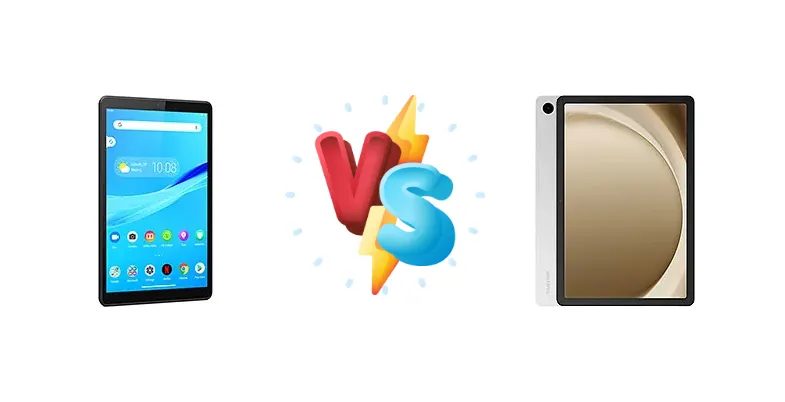
|
🏆 Quick Verdict
For most users, the Samsung Galaxy Tab A9+ is the clear winner. Its Snapdragon 695 5G chipset provides a substantial performance boost over the Lenovo Tab M8 (FHD)'s Helio P22T, translating to smoother multitasking and a more responsive user experience. While the M8 remains a viable option for extremely light use, the A9+'s future-proofing and added features justify the price difference.
| PHONES | ||
|---|---|---|
| Phone Names | Lenovo Tab M8 (FHD) | Samsung Galaxy Tab A9+ |
| Network | ||
|---|---|---|
| 2G bands | GSM 850 / 900 / 1800 / 1900 | GSM 850 / 900 / 1800 / 1900 |
| 3G bands | HSDPA 850 / 900 / 1900 / 2100 | HSDPA 850 / 900 / 1700(AWS) / 1900 / 2100 |
| 4G bands | 1, 2, 3, 4, 5, 7, 8, 19, 20, 38, 40 | 1, 2, 3, 4, 5, 7, 8, 12, 13, 17, 20, 26, 28, 38, 40, 41, 66 |
| 5G bands | - | 1, 3, 5, 7, 8, 20, 28, 38, 40, 41, 66, 77, 78 SA/NSA/Sub6 |
| Speed | HSPA, LTE - cellular model only | HSPA, LTE, 5G - cellular model only |
| Technology | GSM / HSPA / LTE | GSM / HSPA / LTE / 5G |
| 1, 3, 5, 7, 8, 19, 34, 38, 39, 40, 41 | - | |
| Launch | ||
|---|---|---|
| Announced | 2019, September. Released 2019, October | 2023, October 05 |
| Status | Discontinued | Available. Released 2023, October 17 |
| Body | ||
|---|---|---|
| Build | Glass front, aluminum back, aluminum frame | - |
| Dimensions | 198.2 x 122.6 x 8.2 mm (7.80 x 4.83 x 0.32 in) | 257.1 x 168.7 x 6.9 mm (10.12 x 6.64 x 0.27 in) |
| SIM | Nano-SIM (cellular model only) | Nano-SIM + eSIM (cellular model only) |
| Weight | 305 g (10.76 oz) | 480 g or 492 g (1.06 lb) |
| Display | ||
|---|---|---|
| Resolution | 1200 x 1920 pixels, 16:10 ratio (~283 ppi density) | 1200 x 1920 pixels, 16:10 ratio (~206 ppi density) |
| Size | 8.0 inches, 185.6 cm2 (~76.4% screen-to-body ratio) | 11.0 inches, 350.9 cm2 (~80.9% screen-to-body ratio) |
| Type | IPS LCD, 350 nits (typ) | TFT LCD, 90Hz |
| Platform | ||
|---|---|---|
| CPU | Octa-core 2.3 GHz Cortex-A53 | Octa-core (2x2.2 GHz Kryo 660 Gold & 6x1.8 GHz Kryo 660 Silver) |
| Chipset | Mediatek MT6762 Helio P22T (12 nm) | Qualcomm SM6375 Snapdragon 695 5G (6 nm) |
| GPU | PowerVR GE8320 | Adreno 619 |
| OS | Android 9.0 (Pie), upgradable to Android 10 | Android 13, upgradable to Android 15, One UI 7 |
| Memory | ||
|---|---|---|
| Card slot | microSDXC (dedicated slot) | microSDXC (dedicated slot) |
| Internal | 16GB 2GB RAM, 32GB 3GB RAM | 64GB 4GB RAM, 128GB 4GB RAM, 128GB 8GB RAM, 256GB 8GB RAM |
| eMMC 5.1 | - | |
| Main Camera | ||
|---|---|---|
| Features | LED flash | - |
| Single | 13 MP, AF | 8 MP, AF |
| Video | 1080p | 1080p@30fps |
| Selfie camera | ||
|---|---|---|
| Single | 5 MP | 5 MP |
| Video | 1080p | 1080p@30fps |
| Sound | ||
|---|---|---|
| 3.5mm jack | Yes | - |
| 35mm jack | Yes | Yes |
| Loudspeaker | Yes | Yes, with stereo speakers (4 speakers) |
| Comms | ||
|---|---|---|
| Bluetooth | 5.0, A2DP, LE | 5.1, A2DP, LE |
| NFC | No | No |
| Positioning | GPS, GLONASS, BDS, GALILEO - cellular model only | GPS, GLONASS, GALILEO, BDS, QZSS - cellular model only |
| Radio | FM radio | No |
| USB | microUSB 2.0, OTG | USB Type-C 2.0 |
| WLAN | Wi-Fi 802.11 a/b/g/n/ac, dual-band, Wi-Fi Direct | Wi-Fi 802.11 a/b/g/n/ac, dual-band, Wi-Fi Direct |
| Features | ||
|---|---|---|
| Sensors | Accelerometer, proximity | Accelerometer, gyro, proximity (accessories only), compass |
| Battery | ||
|---|---|---|
| Charging | - | 15W wired |
| Type | Li-Po 5100 mAh, non-removable | Li-Po 7040 mAh |
| Misc | ||
|---|---|---|
| Colors | Iron Grey, Platinum Grey | Graphite, Silver, Navy |
| Models | - | SM-X210, SM-X215, SM-X216B |
| Price | About 160 EUR | $ 199.99 |
| SAR | - | 0.42 W/kg (body) |
| SAR EU | - | 1.19 W/kg (body) |
Lenovo Tab M8 (FHD)
- Lower price point makes it very accessible.
- Compact and lightweight design for easy portability.
- Adequate for basic tasks like reading and web browsing.
- Outdated Helio P22T chipset struggles with multitasking.
- Likely limited RAM and storage options.
- Inferior camera performance compared to the A9+.
Samsung Galaxy Tab A9+
- Significantly faster Snapdragon 695 5G chipset.
- 5G connectivity for on-the-go access.
- More vibrant display with better color accuracy.
- Higher price compared to the Lenovo Tab M8 (FHD).
- 15W charging is relatively slow.
- May be slightly heavier than the M8.
Display Comparison
Both tablets feature an 8-inch display, but details beyond that are scarce for the M8. The Tab A9+ boasts a 1920x1200 resolution, providing a sharp image. Crucially, the Snapdragon 695's ISP likely supports a wider color gamut than the Helio P22T can manage, resulting in more vibrant visuals on the A9+. While neither is expected to have high peak brightness, the A9+'s more modern panel technology likely offers better viewing angles and contrast. The M8's display tech is a known weak point in reviews, lacking the vibrancy of competitors.
Camera Comparison
Neither tablet is a photography powerhouse, but the A9+ likely holds an advantage. While specific camera specs are unavailable for the M8, Samsung typically equips its A-series tablets with more capable sensors. The A9+'s image signal processor (ISP), integrated within the Snapdragon 695, will deliver superior image processing compared to the M8's Helio P22T-based ISP. Expect better dynamic range and noise reduction on the A9+. The M8's camera is likely to produce washed-out images in less-than-ideal lighting conditions.
Performance
This is where the A9+ truly shines. The Qualcomm Snapdragon 695 (6nm) is a significant leap forward from the MediaTek Helio P22T (12nm) in the M8. The 6nm process node inherently offers better power efficiency and thermal performance. The A9+'s CPU, with its Kryo 660 Gold and Silver cores, provides a more balanced and responsive experience than the M8's homogenous Cortex-A53 cores. The A9+'s GPU will handle graphically intensive tasks, like gaming, far more effectively. The M8's Helio P22T is adequate for basic tasks, but struggles with multitasking and demanding applications. The A9+ also benefits from potentially faster RAM speeds (LPDDR4x vs. likely LPDDR3 in the M8).
Battery Life
Battery life will depend heavily on usage, but the A9+'s more efficient Snapdragon 695 chipset gives it an edge. While the A9+ includes 15W wired charging, the M8's charging speed is unknown. The Snapdragon 695's power efficiency means the A9+ can maintain performance for longer periods without significant throttling, while the M8's Helio P22T will likely experience more noticeable performance drops under sustained load. The A9+'s 5G connectivity will impact battery life, but the efficiency gains of the chipset should mitigate this to some extent.
Buying Guide
Buy the Lenovo Tab M8 (FHD) if you need a basic, ultra-portable tablet for simple tasks like reading ebooks, light web browsing, and occasional video playback, and your budget is extremely limited. Buy the Samsung Galaxy Tab A9+ if you prioritize performance for multitasking, streaming, light gaming, and want the added benefit of 5G connectivity for on-the-go access, even if it means spending a bit more.