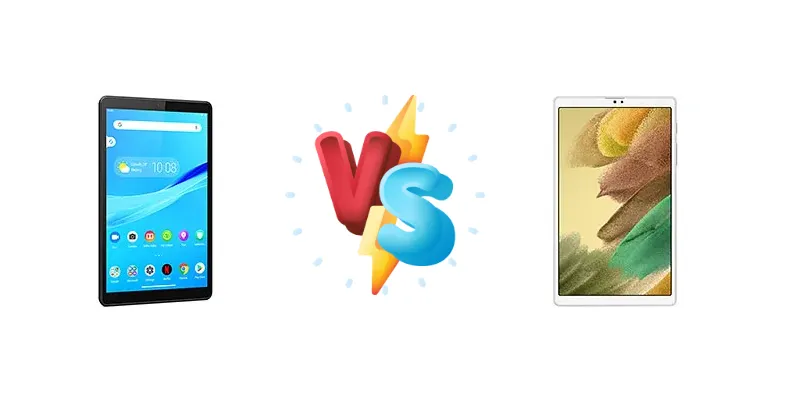
The sub-$200 Android tablet market is fiercely competitive, and the Lenovo Tab M8 (FHD) and Samsung Galaxy Tab A7 Lite are two of the leading contenders. Both aim to deliver a functional tablet experience without breaking the bank, but they achieve this with slightly different approaches. This comparison dives deep into their specifications and performance to determine which tablet offers the best value.
🏆 Quick Verdict
For most users, the Samsung Galaxy Tab A7 Lite is the better choice. While both tablets share the same Mediatek Helio P22T chipset, the A7 Lite’s optimized software and 15W charging provide a smoother, more convenient experience. The Tab M8 FHD is still a viable option, particularly for those prioritizing a slightly lower price point.
| Network |
|---|
| 2G bands | GSM 850 / 900 / 1800 / 1900 | GSM 850 / 900 / 1800 / 1900 |
| 3G bands | HSDPA 850 / 900 / 1900 / 2100 | HSDPA 850 / 900 / 1700(AWS) / 1900 / 2100 |
| 4G bands | 1, 2, 3, 4, 5, 7, 8, 19, 20, 38, 40 | 1, 2, 3, 4, 5, 7, 8, 12, 17, 20, 28, 38, 40, 66 |
| Speed | HSPA, LTE - cellular model only | HSPA, LTE - cellular model only |
| Technology | GSM / HSPA / LTE | GSM / HSPA / LTE |
| | 1, 3, 5, 7, 8, 19, 34, 38, 39, 40, 41 | - |
| Launch |
|---|
| Announced | 2019, September. Released 2019, October | 2021, May 27 |
| Status | Discontinued | Available. Released 2021, June 18 |
| Body |
|---|
| Build | Glass front, aluminum back, aluminum frame | Glass front, aluminum back, aluminum frame, plastic ends |
| Dimensions | 198.2 x 122.6 x 8.2 mm (7.80 x 4.83 x 0.32 in) | 212.5 x 124.7 x 8 mm (8.37 x 4.91 x 0.31 in) |
| SIM | Nano-SIM (cellular model only) | Nano-SIM (cellular model only) |
| Weight | 305 g (10.76 oz) | 366 g (Wi-Fi), 371 g (LTE) (12.91 oz) |
| Display |
|---|
| Resolution | 1200 x 1920 pixels, 16:10 ratio (~283 ppi density) | 800 x 1340 pixels, 5:3 ratio (~179 ppi density) |
| Size | 8.0 inches, 185.6 cm2 (~76.4% screen-to-body ratio) | 8.7 inches, 214.9 cm2 (~81.1% screen-to-body ratio) |
| Type | IPS LCD, 350 nits (typ) | TFT LCD |
| Platform |
|---|
| CPU | Octa-core 2.3 GHz Cortex-A53 | Octa-core (4x2.3 GHz Cortex-A53 & 4x1.8 GHz Cortex-A53) |
| Chipset | Mediatek MT6762 Helio P22T (12 nm) | Mediatek MT8768T Helio P22T (12 nm) |
| GPU | PowerVR GE8320 | PowerVR GE8320 |
| OS | Android 9.0 (Pie), upgradable to Android 10 | Android 11, upgradable to Android 14, One UI 6.1 |
| Memory |
|---|
| Card slot | microSDXC (dedicated slot) | microSDXC (dedicated slot) |
| Internal | 16GB 2GB RAM, 32GB 3GB RAM | 32GB 2GB RAM, 32GB 3GB RAM, 64GB 4GB RAM |
| | eMMC 5.1 | eMMC 5.1 |
| Main Camera |
|---|
| Features | LED flash | - |
| Single | 13 MP, AF | 8 MP, AF |
| Video | 1080p | 1080p@30fps |
| Selfie camera |
|---|
| Single | 5 MP | 2 MP |
| Video | 1080p | - |
| Sound |
|---|
| 3.5mm jack | Yes | Yes |
| 35mm jack | Yes | Yes |
| Loudspeaker | Yes | Yes, with stereo speakers |
| Comms |
|---|
| Bluetooth | 5.0, A2DP, LE | 5.0, A2DP, LE |
| NFC | No | No |
| Positioning | GPS, GLONASS, BDS, GALILEO - cellular model only | GPS, GLONASS, BDS, GALILEO - cellular model only |
| Radio | FM radio | No |
| USB | microUSB 2.0, OTG | USB Type-C 2.0 |
| WLAN | Wi-Fi 802.11 a/b/g/n/ac, dual-band, Wi-Fi Direct | Wi-Fi 802.11 a/b/g/n/ac, dual-band, Wi-Fi Direct |
| Features |
|---|
| Sensors | Accelerometer, proximity | Accelerometer, compass |
| Battery |
|---|
| Charging | - | 15W wired |
| Type | Li-Po 5100 mAh, non-removable | Li-Po 5100 mAh |
| Misc |
|---|
| Colors | Iron Grey, Platinum Grey | Gray, Silver |
| Models | - | SM-T225, SM-T220, SM-T225N, SM-T227U |
| Price | About 160 EUR | About 140 EUR |
| SAR | - | 0.68 W/kg (body) |
| SAR EU | - | 0.64 W/kg (head) 0.99 W/kg (body) |
Lenovo Tab M8 (FHD)
- Potentially sharper display due to FHD resolution
- Likely more affordable price point
- Compact and portable design
- Potentially slower charging speeds
- Less optimized software experience
- Unknown battery capacity
Samsung Galaxy Tab A7 Lite
- Faster 15W charging
- More optimized software (One UI)
- Slightly improved CPU configuration for multitasking
- Potentially lower display resolution
- Slightly higher price
- Samsung’s software bloat (though generally well-managed)
Display Comparison
Both tablets feature an 8-inch display, but detailed specifications beyond size are unavailable. Given the 'FHD' designation, the Lenovo Tab M8 (FHD) likely boasts a 1920x1080 resolution, offering a sharper image than the standard resolution typically found on the Tab A7 Lite. However, without knowing the panel technology (IPS, TFT) or brightness levels of the A7 Lite, it’s difficult to definitively declare a winner. The Tab M8 FHD’s higher resolution will be most noticeable when viewing detailed images or text, benefitting users who read extensively or work with documents.
Camera Comparison
Camera performance is unlikely to be a deciding factor for either tablet. Both are equipped with basic camera setups geared towards video calls rather than photography. Without specific sensor details, it’s safe to assume image quality will be similar – adequate for casual snapshots but lacking in detail and dynamic range. The focus should be on video call quality, and both tablets should suffice for basic video conferencing.
Performance
Both the Lenovo Tab M8 (FHD) and Samsung Galaxy Tab A7 Lite are powered by the Mediatek MT8768T Helio P22T (12 nm) chipset, featuring an octa-core CPU. However, the Galaxy Tab A7 Lite’s CPU configuration is slightly different: 4x2.3 GHz Cortex-A53 & 4x1.8 GHz Cortex-A53, while the Tab M8 FHD utilizes a uniform 2.3 GHz Cortex-A53 configuration across all eight cores. This suggests the A7 Lite may offer slightly better multi-tasking performance, as the higher-clocked cores can handle demanding tasks more efficiently. While the chipset is identical, Samsung’s One UI software is generally more optimized than Lenovo’s stock Android experience, potentially leading to smoother performance and fewer stutters on the A7 Lite. RAM configurations are not specified, but this will be a key factor in real-world performance.
Battery Life
Battery capacity is not specified for the Lenovo Tab M8 (FHD). The Samsung Galaxy Tab A7 Lite features 15W wired charging, a significant advantage over potentially slower charging speeds on the Tab M8 FHD. While a larger battery capacity doesn’t always translate to longer battery life (software optimization plays a crucial role), the A7 Lite’s faster charging allows for quicker top-ups, minimizing downtime. Users who frequently use their tablets on the go will appreciate the convenience of the A7 Lite’s 15W charging.
Buying Guide
Buy the Lenovo Tab M8 (FHD) if you need a basic tablet for light tasks like reading ebooks, browsing the web, and occasional video streaming, and are extremely price-sensitive. Buy the Samsung Galaxy Tab A7 Lite if you prefer a more polished software experience, faster charging, and a brand with a stronger track record of software updates, even if it means spending a little more.
Frequently Asked Questions
❓ Will the Mediatek Helio P22T struggle with demanding games on the Galaxy Tab A7 Lite?
The Helio P22T is an entry-level chipset and will not deliver a high-end gaming experience. While it can handle less demanding 2D games and older 3D titles, expect to play most games on low settings with reduced frame rates. The A7 Lite’s software optimization may provide a slight edge, but don’t expect to run graphically intensive games smoothly.
❓ Does the Samsung Galaxy Tab A7 Lite receive regular software updates?
Samsung generally provides more consistent software updates than Lenovo for its tablets. While the A7 Lite isn’t guaranteed to receive the same level of support as flagship devices, it’s likely to receive security patches and potentially one or two major Android version updates, extending its lifespan and improving security.
❓ Is the difference in CPU core configuration (4x2.3GHz & 4x1.8GHz vs 8x2.3GHz) on the A7 Lite and M8 FHD noticeable in everyday use?
The difference is subtle but can be noticeable during multitasking. The A7 Lite’s configuration allows it to dedicate more processing power to foreground apps while efficiently handling background tasks. This results in a smoother experience when switching between apps or running multiple applications simultaneously.