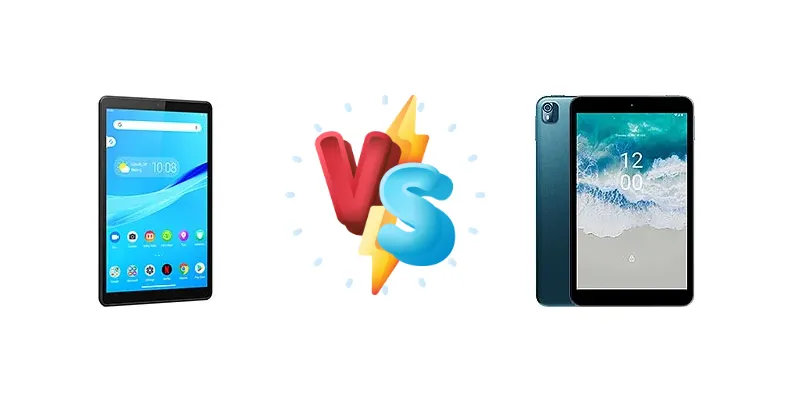
The sub-$150 tablet market is fiercely competitive, offering options for casual users, students, and families. The Lenovo Tab M8 (FHD) and Nokia T10 represent compelling choices, but cater to slightly different priorities. The Lenovo focuses on a sharper display, while the Nokia emphasizes a more modern CPU architecture. This comparison dives deep into the specifications to determine which tablet delivers the best overall experience.
🏆 Quick Verdict
For most users, the Nokia T10 emerges as the better choice. While the Lenovo Tab M8 (FHD) boasts a Full HD display, the Nokia T10’s Unisoc T606 chipset, with its Cortex-A75 cores, provides a noticeable performance advantage in everyday tasks and light multitasking, making it more responsive and future-proof.
| Network |
|---|
| 2G bands | GSM 850 / 900 / 1800 / 1900 | GSM 850 / 900 / 1800 / 1900 |
| 3G bands | HSDPA 850 / 900 / 1900 / 2100 | HSDPA 850 / 900 / 2100 |
| 4G bands | 1, 2, 3, 4, 5, 7, 8, 19, 20, 38, 40 | 1, 3, 5, 7, 8, 20, 28, 38, 40, 41 |
| Speed | HSPA, LTE - cellular model only | HSPA 42.2/5.76 Mbps, LTE Cat4 150/50 Mbps |
| Technology | GSM / HSPA / LTE | GSM / HSPA / LTE |
| | 1, 3, 5, 7, 8, 19, 34, 38, 39, 40, 41 | - |
| Launch |
|---|
| Announced | 2019, September. Released 2019, October | 2022, July 12 |
| Status | Discontinued | Available. Released 2022, August 20 |
| Body |
|---|
| Build | Glass front, aluminum back, aluminum frame | Glass front, plastic back, plastic frame |
| Dimensions | 198.2 x 122.6 x 8.2 mm (7.80 x 4.83 x 0.32 in) | 208 x 123.2 x 9 mm (8.19 x 4.85 x 0.35 in) |
| SIM | Nano-SIM (cellular model only) | Nano-SIM |
| Weight | 305 g (10.76 oz) | 375 g (13.23 oz) |
| | - | Splash resistant |
| Display |
|---|
| Resolution | 1200 x 1920 pixels, 16:10 ratio (~283 ppi density) | 800 x 1280 pixels, 16:10 ratio (~189 ppi density) |
| Size | 8.0 inches, 185.6 cm2 (~76.4% screen-to-body ratio) | 8.0 inches, 185.6 cm2 (~72.4% screen-to-body ratio) |
| Type | IPS LCD, 350 nits (typ) | IPS LCD, 360 nits (typ), 450 nits (peak) |
| Platform |
|---|
| CPU | Octa-core 2.3 GHz Cortex-A53 | Octa-core (2x1.6 GHz Cortex-A75 & 6x1.6 GHz Cortex-A55) |
| Chipset | Mediatek MT6762 Helio P22T (12 nm) | Unisoc T606 (12 nm) |
| GPU | PowerVR GE8320 | Mali-G57 MP1 |
| OS | Android 9.0 (Pie), upgradable to Android 10 | Android 12, upgradable to Android 13 |
| Memory |
|---|
| Card slot | microSDXC (dedicated slot) | microSDXC |
| Internal | 16GB 2GB RAM, 32GB 3GB RAM | 32GB 3GB RAM, 64GB 4GB RAM |
| | eMMC 5.1 | - |
| Main Camera |
|---|
| Features | LED flash | LED flash |
| Single | 13 MP, AF | 8 MP, 1/4.0", 1.12µm, AF |
| Video | 1080p | 1080p |
| Selfie camera |
|---|
| Single | 5 MP | 2 MP, 1/5.0", 1.65µm |
| Video | 1080p | 720p |
| Sound |
|---|
| 3.5mm jack | Yes | Yes |
| 35mm jack | Yes | Yes |
| Loudspeaker | Yes | Yes, with stereo speakers |
| Comms |
|---|
| Bluetooth | 5.0, A2DP, LE | 5.0, A2DP, LE |
| NFC | No | No |
| Positioning | GPS, GLONASS, BDS, GALILEO - cellular model only | GPS, GLONASS, GALILEO |
| Radio | FM radio | No |
| USB | microUSB 2.0, OTG | USB Type-C 2.0, OTG |
| WLAN | Wi-Fi 802.11 a/b/g/n/ac, dual-band, Wi-Fi Direct | Wi-Fi 802.11 a/b/g/n/ac, dual-band |
| Features |
|---|
| Sensors | Accelerometer, proximity | Accelerometer, proximity |
| Battery |
|---|
| Charging | - | 10W wired |
| Type | Li-Po 5100 mAh, non-removable | Li-Po 5250 mAh |
| Misc |
|---|
| Colors | Iron Grey, Platinum Grey | Ocean Blue |
| Models | - | TA-1503, TA-1472, TA-1462, TA-1457 |
| Price | About 160 EUR | About 160 EUR |
| SAR | - | 1.19 W/kg (body) |
| SAR EU | - | 0.27 W/kg (head) 1.57 W/kg (body) |
Lenovo Tab M8 (FHD)
- Full HD display offers sharper visuals.
- Potentially lower price point (depending on retailer).
- Compact and portable design.
- Older Helio P22T chipset offers less performance.
- Likely slower app loading and multitasking.
- Charging speed is unknown.
Nokia T10
- More modern Unisoc T606 chipset for smoother performance.
- Cortex-A75 cores improve responsiveness.
- 10W wired charging for faster top-ups.
- Display resolution is likely HD+, not Full HD.
- May be slightly more expensive than the Lenovo.
- Unisoc chipset may have less software optimization.
Display Comparison
Both tablets utilize 12nm process technology, but diverge significantly in display characteristics. The Lenovo Tab M8 (FHD) delivers on its name with a Full HD resolution, offering a sharper image compared to the Nokia T10’s likely HD+ resolution (spec not provided, but typical for this price point). This difference is most noticeable when viewing detailed content or reading text. However, without knowing the peak brightness or color gamut coverage of either display, it’s difficult to assess overall image quality beyond resolution. The Nokia T10’s display size is 8 inches, while the Lenovo Tab M8 (FHD) is also 8 inches, so size isn’t a differentiator.
Camera Comparison
Camera performance is unlikely to be a deciding factor for either tablet. Both are positioned as budget devices, and camera specs are typically minimal. Without specific details on sensor size or aperture, it’s safe to assume image quality will be adequate for basic snapshots in good lighting conditions. Focusing on camera specs would be a misdirection given the target audience.
Performance
The core difference lies in the chipsets. The Lenovo Tab M8 (FHD) is powered by the MediaTek MT6762 Helio P22T, featuring eight Cortex-A53 cores clocked at 2.3 GHz. This is a relatively older architecture. The Nokia T10, however, utilizes the Unisoc T606, which employs a more modern big.LITTLE configuration with two Cortex-A75 cores at 1.6 GHz and six Cortex-A55 cores, also at 1.6 GHz. The Cortex-A75 cores provide a significant performance boost in single-threaded tasks and responsiveness compared to the older Cortex-A53. While the clock speed is similar, the architectural improvements in the Unisoc T606 translate to a smoother user experience, especially when switching between apps. Neither tablet is a gaming powerhouse, but the Nokia T10 will handle casual games more effectively.
Battery Life
Battery capacity is not provided for either device, making a direct comparison difficult. However, the Nokia T10 supports 10W wired charging, while the Lenovo Tab M8 (FHD)’s charging speed is unknown. Given the similar likely battery capacities (around 5000mAh is typical for this segment), the Nokia T10’s 10W charging will likely result in a slightly faster 0-100% charge time. Real-world battery life will depend heavily on usage patterns, but the more efficient Unisoc T606 in the Nokia T10 may contribute to slightly longer runtimes.
Buying Guide
Buy the Lenovo Tab M8 (FHD) if a sharper, more detailed display is paramount for media consumption and you primarily engage in static tasks like reading or watching videos. Buy the Nokia T10 if you prioritize a smoother, more responsive user experience for general use, multitasking, and light gaming, and value a more modern processor architecture for longevity.
Frequently Asked Questions
❓ Will the Nokia T10 struggle with multiple apps open simultaneously?
The Unisoc T606 chipset in the Nokia T10, with its Cortex-A75 cores, is significantly better equipped for multitasking than the Helio P22T in the Lenovo Tab M8 (FHD). While it won’t replace a high-end tablet, the Nokia T10 should handle 2-3 apps running concurrently without significant slowdowns.
❓ Is the Lenovo Tab M8 (FHD) a good choice for extended reading sessions?
The Full HD display on the Lenovo Tab M8 (FHD) is well-suited for reading ebooks and articles, offering sharper text rendering. However, without knowing the display’s blue light filter capabilities, it’s difficult to assess its suitability for prolonged use. Consider a screen protector with blue light filtering if you plan on extensive reading.
❓ Can the Nokia T10 handle basic mobile games like Candy Crush or Angry Birds?
Yes, the Nokia T10 should handle casual mobile games like Candy Crush or Angry Birds without issue. The Unisoc T606 chipset provides sufficient power for these types of games, although you shouldn’t expect high frame rates or demanding graphics settings.