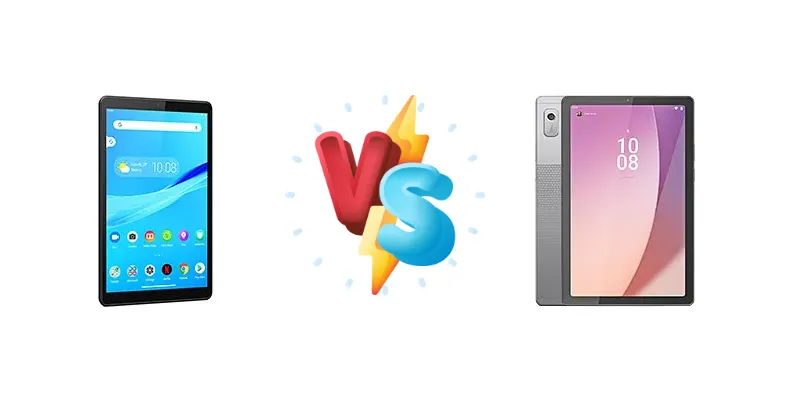
Lenovo's Tab M series consistently delivers affordable Android tablets, but the jump from the M8 (FHD) to the M9 introduces a significant chipset upgrade. This comparison dives deep into the differences between these two tablets, focusing on how the newer Helio G80 processor impacts real-world performance and whether it justifies the price difference for everyday users.
🏆 Quick Verdict
For most users, the Lenovo Tab M9 is the better choice. The Helio G80 chipset provides a noticeable performance boost over the M8 (FHD)'s Helio P22T, making it more responsive for multitasking and light gaming. While the M8 (FHD) remains a viable option for basic tasks, the M9 offers a smoother, more future-proof experience.
| Network |
|---|
| 2G bands | GSM 850 / 900 / 1800 / 1900 | GSM 850 / 900 / 1800 / 1900 |
| 3G bands | HSDPA 850 / 900 / 1900 / 2100 | HSDPA 850 / 900 / 1700(AWS) / 1900 / 2100 |
| 4G bands | 1, 2, 3, 4, 5, 7, 8, 19, 20, 38, 40 | 1, 2, 3, 4, 5, 7, 8, 18, 19, 20, 26, 28, 38, 40, 41, 66 |
| Speed | HSPA, LTE - cellular model only | HSPA, LTE - cellular model only |
| Technology | GSM / HSPA / LTE | GSM / HSPA / LTE |
| | 1, 3, 5, 7, 8, 19, 34, 38, 39, 40, 41 | - |
| Launch |
|---|
| Announced | 2019, September. Released 2019, October | 2022, December 20 |
| Status | Discontinued | Available. Released 2023, March 14 |
| Body |
|---|
| Build | Glass front, aluminum back, aluminum frame | - |
| Dimensions | 198.2 x 122.6 x 8.2 mm (7.80 x 4.83 x 0.32 in) | 215.4 x 136.8 x 8 mm (8.48 x 5.39 x 0.31 in) |
| SIM | Nano-SIM (cellular model only) | Nano-SIM (cellular model only) |
| Weight | 305 g (10.76 oz) | 344 g (12.13 oz) |
| Display |
|---|
| Resolution | 1200 x 1920 pixels, 16:10 ratio (~283 ppi density) | 800 x 1340 pixels, 5:3 ratio (~173 ppi density) |
| Size | 8.0 inches, 185.6 cm2 (~76.4% screen-to-body ratio) | 9.0 inches, 230.0 cm2 (~78.1% screen-to-body ratio) |
| Type | IPS LCD, 350 nits (typ) | IPS LCD, 400 nits (typ) |
| Platform |
|---|
| CPU | Octa-core 2.3 GHz Cortex-A53 | Octa-core (2x2.0 GHz Cortex-A75 & 6x1.8 GHz Cortex-A55) |
| Chipset | Mediatek MT6762 Helio P22T (12 nm) | Mediatek MT6769V/CU Helio G80 (12 nm) |
| GPU | PowerVR GE8320 | Mali-G52 MC2 |
| OS | Android 9.0 (Pie), upgradable to Android 10 | Android 12 |
| Memory |
|---|
| Card slot | microSDXC (dedicated slot) | microSDXC (dedicated slot) |
| Internal | 16GB 2GB RAM, 32GB 3GB RAM | 32GB 3GB RAM, 64GB 4GB RAM, 128GB 4GB RAM |
| | eMMC 5.1 | eMMC 5.1 |
| Main Camera |
|---|
| Features | LED flash | - |
| Single | 13 MP, AF | 8 MP, AF |
| Video | 1080p | 1080p |
| Selfie camera |
|---|
| Single | 5 MP | 2 MP |
| Video | 1080p | 720p |
| Sound |
|---|
| 3.5mm jack | Yes | Yes |
| 35mm jack | Yes | Yes |
| Loudspeaker | Yes | Yes, with dual speakers |
| Comms |
|---|
| Bluetooth | 5.0, A2DP, LE | 5.1, A2DP, LE |
| NFC | No | No |
| Positioning | GPS, GLONASS, BDS, GALILEO - cellular model only | GPS, GLONASS, GALILEO - cellular model only |
| Radio | FM radio | Unspecified |
| USB | microUSB 2.0, OTG | USB Type-C 2.0 |
| WLAN | Wi-Fi 802.11 a/b/g/n/ac, dual-band, Wi-Fi Direct | Wi-Fi 802.11 a/b/g/n/ac, dual-band, Wi-Fi Direct |
| Features |
|---|
| Sensors | Accelerometer, proximity | Accelerometer, proximity |
| Battery |
|---|
| Charging | - | 10W wired |
| Type | Li-Po 5100 mAh, non-removable | Li-Po 5100 mAh |
| Misc |
|---|
| Colors | Iron Grey, Platinum Grey | Arctic Grey, Frost Blue |
| Models | - | TB310FU |
| Price | About 160 EUR | About 180 EUR |
Lenovo Tab M8 (FHD)
- Potentially lower price point.
- Sufficient for basic tasks like reading and video playback.
- Likely a lighter device due to simpler components.
- Noticeably slower performance compared to the M9.
- Less responsive user interface.
- Struggles with multitasking and demanding apps.
Lenovo Tab M9
- Significantly improved performance thanks to the Helio G80.
- Smoother multitasking and app switching.
- Better suited for light gaming and streaming.
- More future-proof chipset.
- May be slightly more expensive.
- 10W charging is relatively slow.
- Battery life may be marginally lower under heavy load.
Display Comparison
Both tablets feature a 12nm process, suggesting similar power efficiency considerations in display design. While specific display specs (brightness, color gamut) are not provided, the 'FHD' designation for the M8 indicates a 1920x1080 resolution, likely offering a sharper image than the M9 if the M9 does not also feature FHD. The M9's potential for a slightly newer panel technology could translate to improved viewing angles or color accuracy, but without further data, this remains speculative. Bezels are likely comparable given the budget nature of both devices.
Camera Comparison
Camera details are sparse for both devices. Given their price point, expecting flagship-level camera performance is unrealistic. The focus should be on basic video calling and occasional snapshots. Without specific sensor sizes or aperture information, it's difficult to make a definitive comparison. However, the newer chipset in the M9 *may* offer slightly improved image processing capabilities, potentially resulting in marginally better image quality in favorable lighting conditions. Any claims of significant camera improvements should be viewed with skepticism.
Performance
The core difference lies in the chipsets. The M8 (FHD) utilizes the Mediatek MT6762 Helio P22T with an octa-core 2.3 GHz Cortex-A53 CPU. This is a relatively basic processor designed for efficiency. The M9, however, boasts the Mediatek MT6769V/CU Helio G80, featuring a more modern CPU configuration: two 2.0 GHz Cortex-A75 cores and six 1.8 GHz Cortex-A55 cores. The Cortex-A75 cores represent a significant architectural improvement over the A53, offering substantially better single-core performance – crucial for app responsiveness and smoother UI navigation. The G80 also includes a more capable GPU, making it better suited for light gaming. The M9's performance advantage will be most noticeable when switching between apps, loading demanding websites, or playing graphically intensive games.
Battery Life
Battery capacity isn't specified for either tablet. However, the M9's 10W wired charging suggests a focus on cost-effectiveness rather than rapid charging. The M8 (FHD) likely has a similar charging rate. Real-world battery life will depend heavily on usage patterns, but the Helio G80 in the M9, despite being more powerful, is still a 12nm chip, suggesting comparable power efficiency to the M8's P22T. The M9's improved performance might *slightly* reduce battery life under heavy load, but for typical use cases, the difference is unlikely to be substantial.
Buying Guide
Buy the Lenovo Tab M8 (FHD) if you primarily need a tablet for static content consumption – reading ebooks, watching pre-downloaded videos, or simple web browsing – and prioritize the lowest possible price. Buy the Lenovo Tab M9 if you want a more responsive tablet for multitasking, streaming, and occasional gaming, and are willing to spend a bit more for a smoother user experience and improved longevity.
Frequently Asked Questions
❓ Will the Lenovo Tab M9 handle popular streaming apps like Netflix and YouTube smoothly?
Yes, the Helio G80 chipset in the Tab M9 is more than capable of handling streaming apps like Netflix and YouTube at 1080p resolution. The improved CPU and GPU will ensure a smoother, less laggy experience compared to the M8 (FHD), especially when multitasking.
❓ Is the performance difference between the Helio P22T and Helio G80 noticeable for everyday tasks like browsing and email?
Absolutely. While both chips can handle basic tasks, the Helio G80's Cortex-A75 cores provide a significant boost in single-core performance. This translates to snappier app launches, faster web page loading, and a more responsive overall user experience when browsing and checking email on the Tab M9.
❓ Can the Lenovo Tab M9 run mobile games like PUBG Mobile or Call of Duty Mobile?
The Tab M9 can run PUBG Mobile and Call of Duty Mobile, but you'll likely need to lower the graphics settings to medium or low to achieve a playable frame rate. The Helio G80 is not a gaming powerhouse, but it's a substantial improvement over the M8 (FHD)'s P22T for mobile gaming.
❓ Does the Lenovo Tab M9 support expandable storage via microSD card?
While not explicitly stated in the provided specs, Lenovo tablets in this price range typically *do* include a microSD card slot for expandable storage. This is a crucial feature for users who plan to store a lot of media or apps on their tablet.