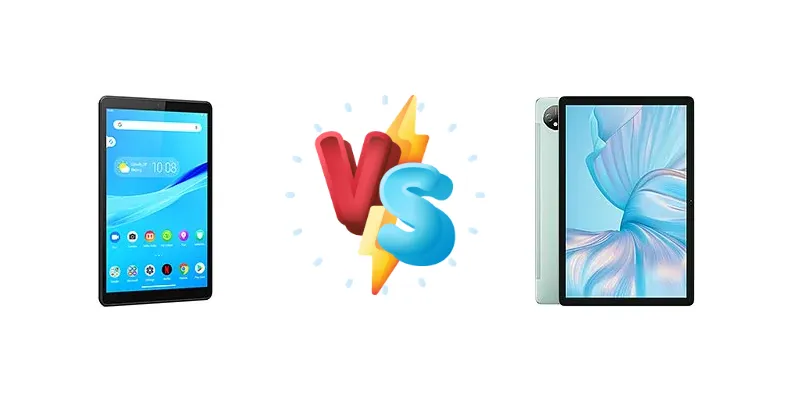
The sub-$150 tablet market is fiercely competitive, and the Lenovo Tab M8 (FHD) and Blackview Tab 80 represent compelling options for users seeking affordable entertainment and productivity. This comparison dives deep into their specifications, focusing on how the differing chipsets impact real-world performance and usability.
🏆 Quick Verdict
For most users, the Blackview Tab 80 offers a more modern and capable experience thanks to its Unisoc T606 chipset. While the Lenovo Tab M8 (FHD) remains a solid choice, the Tab 80’s CPU architecture provides a noticeable performance edge in multitasking and demanding applications.
| Network |
|---|
| 2G bands | GSM 850 / 900 / 1800 / 1900 | GSM 850 / 900 / 1800 / 1900 |
| 3G bands | HSDPA 850 / 900 / 1900 / 2100 | HSDPA 900 / 2100 |
| 4G bands | 1, 2, 3, 4, 5, 7, 8, 19, 20, 38, 40 | 1, 3, 7, 8, 20, 40 |
| Speed | HSPA, LTE - cellular model only | HSPA, LTE |
| Technology | GSM / HSPA / LTE | GSM / HSPA / LTE |
| | 1, 3, 5, 7, 8, 19, 34, 38, 39, 40, 41 | - |
| Launch |
|---|
| Announced | 2019, September. Released 2019, October | 2023, September |
| Status | Discontinued | Available. Released 2023, September |
| Body |
|---|
| Build | Glass front, aluminum back, aluminum frame | - |
| Dimensions | 198.2 x 122.6 x 8.2 mm (7.80 x 4.83 x 0.32 in) | 241 x 156 x 7.5 mm (9.49 x 6.14 x 0.30 in) |
| SIM | Nano-SIM (cellular model only) | Nano-SIM + Nano-SIM |
| Weight | 305 g (10.76 oz) | 484 g (1.07 lb) |
| Display |
|---|
| Resolution | 1200 x 1920 pixels, 16:10 ratio (~283 ppi density) | 800 x 1280 pixels, 16:10 ratio (~149 ppi density) |
| Size | 8.0 inches, 185.6 cm2 (~76.4% screen-to-body ratio) | 10.1 inches, 295.8 cm2 (~78.7% screen-to-body ratio) |
| Type | IPS LCD, 350 nits (typ) | IPS LCD |
| Platform |
|---|
| CPU | Octa-core 2.3 GHz Cortex-A53 | Octa-core (2x1.6 GHz Cortex-A75 & 6x1.6 GHz Cortex-A55) |
| Chipset | Mediatek MT6762 Helio P22T (12 nm) | Unisoc T606 (12 nm) |
| GPU | PowerVR GE8320 | Mali-G57 MP1 |
| OS | Android 9.0 (Pie), upgradable to Android 10 | Android 13, Doke OS_P 3.0 |
| Memory |
|---|
| Card slot | microSDXC (dedicated slot) | microSDXC (uses shared SIM slot) |
| Internal | 16GB 2GB RAM, 32GB 3GB RAM | 64GB 4GB RAM, 128GB 4GB RAM, 128GB 8GB RAM |
| | eMMC 5.1 | - |
| Main Camera |
|---|
| Dual | - | 13 MP
secondary unspecified camera |
| Features | LED flash | LED flash |
| Single | 13 MP, AF | - |
| Video | 1080p | 1080p@30fps |
| Selfie camera |
|---|
| Single | 5 MP | 8 MP |
| Video | 1080p | 1080p@30fps |
| Sound |
|---|
| 3.5mm jack | Yes | - |
| 35mm jack | Yes | Yes |
| Loudspeaker | Yes | Yes, with stereo speakers |
| Comms |
|---|
| Bluetooth | 5.0, A2DP, LE | 5.0, A2DP |
| NFC | No | No |
| Positioning | GPS, GLONASS, BDS, GALILEO - cellular model only | GPS, GLONASS, GALILEO, BDS |
| Radio | FM radio | FM Radio |
| USB | microUSB 2.0, OTG | USB Type-C, OTG |
| WLAN | Wi-Fi 802.11 a/b/g/n/ac, dual-band, Wi-Fi Direct | Wi-Fi 802.11 a/b/g/n/ac, dual-band |
| Features |
|---|
| Sensors | Accelerometer, proximity | Accelerometer |
| Battery |
|---|
| Charging | - | 10W wired |
| Type | Li-Po 5100 mAh, non-removable | 7680 mAh |
| Misc |
|---|
| Colors | Iron Grey, Platinum Grey | Grey, Blue, Green |
| Price | About 160 EUR | - |
Lenovo Tab M8 (FHD)
- Established Brand Reputation
- Familiar Android Experience
- Likely Good Software Support
- Older Processor Architecture
- Potentially Lower Performance
- Limited Multitasking Capability
Blackview Tab 80
- More Modern Processor (Unisoc T606)
- Improved Multitasking Performance
- Better CPU Architecture for Future Apps
- Less Well-Known Brand
- Potentially Less Frequent Software Updates
- 10W Charging is Relatively Slow
Display Comparison
Both tablets feature 8-inch displays with FHD+ resolution, but detailed display specifications like brightness and color gamut are unavailable. Given the price point, expect both to utilize IPS LCD panels. The focus here shifts to processing power, as display quality is likely similar. Bezels are expected to be moderate on both devices, typical for this price bracket.
Camera Comparison
Camera performance is unlikely to be a deciding factor for either tablet. Details on camera sensors are scarce, but given the price point, expect basic 5MP or 8MP sensors on both the front and rear. Image quality will likely be acceptable for casual snapshots and video calls, but not for serious photography. The absence of Optical Image Stabilization (OIS) on either device further limits their photographic capabilities.
Performance
The core difference lies in the chipsets. The Lenovo Tab M8 (FHD) utilizes the Mediatek MT6762 Helio P22T, featuring eight Cortex-A53 cores clocked at 2.3 GHz. The Blackview Tab 80, however, employs the Unisoc T606, a more recent design with a heterogeneous core configuration: two Cortex-A75 cores at 1.6 GHz and six Cortex-A55 cores, also at 1.6 GHz. This architecture gives the T606 a significant advantage in single-core performance due to the more powerful A75 cores, translating to snappier app launches and smoother multitasking. While both are 12nm chips, the Unisoc T606’s architecture is more efficient, potentially leading to better sustained performance. The Tab 80 is likely to handle more demanding apps and light gaming with greater ease.
Battery Life
Battery capacity details are missing for the Lenovo Tab M8 (FHD). The Blackview Tab 80 features a 4850mAh battery and supports 10W wired charging. While 10W charging isn’t fast, it’s adequate for overnight charging. The Tab 80’s more efficient Unisoc T606 chipset may translate to slightly longer battery life during typical usage, offsetting any potential capacity difference if the Lenovo Tab M8 (FHD) has a larger battery.
Buying Guide
Buy the Lenovo Tab M8 (FHD) if you prioritize a well-established brand with a proven track record and primarily need a tablet for basic tasks like web browsing, email, and light video consumption. Buy the Blackview Tab 80 if you want a more responsive tablet for multitasking, occasional gaming, and appreciate a more modern processor architecture for future-proofing, even if it means sacrificing brand recognition.
Frequently Asked Questions
❓ Will the Blackview Tab 80 struggle with demanding games like PUBG Mobile?
While the Unisoc T606 is a capable chip, PUBG Mobile may require reduced graphics settings for a smooth experience. The Tab 80 will likely handle less graphically intensive games without issue, but don't expect flagship-level gaming performance.
❓ Is the Unisoc T606 chipset known for overheating issues?
The Unisoc T606 generally runs cool under moderate loads. However, prolonged gaming or intensive multitasking could lead to some thermal throttling, which is typical for tablets in this price range. The Tab 80's thermal design is likely adequate for typical use cases.
❓ How does the software experience differ between the Lenovo Tab M8 (FHD) and the Blackview Tab 80?
The Lenovo Tab M8 (FHD) likely offers a cleaner, more stock-Android-like experience with potentially faster software updates. Blackview's software may include some pre-installed apps and customizations, but it's generally based on a recent version of Android.
❓ Can either of these tablets be used with a keyboard and mouse for productivity tasks?
Yes, both tablets support Bluetooth connectivity, allowing you to connect a keyboard and mouse for enhanced productivity. However, the limited processing power of both devices may hinder performance with complex tasks or multiple applications open simultaneously.