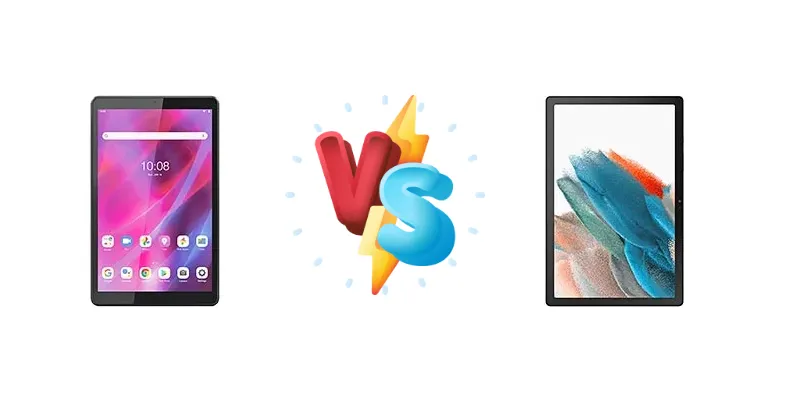
The sub-$200 tablet market is fiercely competitive, and the Lenovo Tab M8 (3rd Gen) and Samsung Galaxy Tab A8 10.5 (2021) are two of the leading contenders. While both aim to deliver an affordable Android experience, they take different approaches to performance and usability. This comparison dives deep into their specifications to determine which tablet offers the best value for your money.
🏆 Quick Verdict
For most users, the Samsung Galaxy Tab A8 10.5 emerges as the better choice. Its Unisoc Tiger T618 chipset, featuring Cortex-A75 cores, provides a noticeable performance uplift over the Lenovo Tab M8’s Helio P22T, making it more suitable for multitasking and light gaming. The larger 10.5-inch display also enhances the overall user experience.
| Network |
|---|
| 2G bands | GSM 850 / 900 / 1800 / 1900 | GSM 850 / 900 / 1800 / 1900 |
| 3G bands | HSDPA 850 / 900 / 1700(AWS) / 1900 / 2100 - International | HSDPA 850 / 900 / 1700(AWS) / 1900 / 2100 |
| 4G bands | 1, 2, 3, 4, 5, 19, 7, 8, 20, 26, 28, 38, 40, 41 - International | 1, 2, 3, 4, 5, 7, 8, 12, 17, 20, 28, 38, 40, 41, 66 |
| Speed | HSPA, LTE - cellular model only | HSPA, LTE - cellular model only |
| Technology | GSM / CDMA / HSPA / LTE | GSM / HSPA / LTE |
| | 1, 3, 5, 7, 8, 34, 38, 39, 40, 41 - China | - |
| Launch |
|---|
| Announced | 2021, June 28 | 2021, December 15 |
| Status | Available. Released 2022, February | Available. Released 2022, January 17 |
| Body |
|---|
| Build | Glass front, aluminum back, aluminum frame | - |
| Dimensions | 199.1 x 121.8 x 8.2 mm (7.84 x 4.80 x 0.32 in) | 246.8 x 161.9 x 6.9 mm (9.72 x 6.37 x 0.27 in) |
| SIM | Nano-SIM (cellular model only) | Nano-SIM (cellular model only) |
| Weight | 305 g (10.76 oz) | 508 g (1.12 lb) |
| Display |
|---|
| Resolution | 800 x 1280 pixels, 16:10 ratio (~189 ppi density) | 1200 x 1920 pixels, 16:10 ratio (~216 ppi density) |
| Size | 8.0 inches, 185.6 cm2 (~76.5% screen-to-body ratio) | 10.5 inches, 319.7 cm2 (~80.0% screen-to-body ratio) |
| Type | TDDI IPS LCD, 350 nits (typ) | TFT LCD |
| Platform |
|---|
| CPU | Octa-core (4x2.3 GHz Cortex-A53 & 4x1.8 GHz Cortex-A53) | Octa-core (2x2.0 GHz Cortex-A75 & 6x2.0 GHz Cortex-A55) |
| Chipset | Mediatek MT8768T Helio P22T (12 nm) | Unisoc Tiger T618 (12 nm) |
| GPU | PowerVR GE8320 | Mali G52 MP2 |
| OS | Android 11 (Go edition) - 2 GB RAM versionAndroid 11 - 3 GB RAM version | Android 11, upgradable to Android 14, One UI 6 |
| Memory |
|---|
| Card slot | microSDXC (dedicated slot) | microSDXC (dedicated slot) |
| Internal | 32GB 2GB RAM, 32GB 3GB RAM | 32GB 2GB RAM, 32GB 3GB RAM, 64GB 2GB RAM, 64GB 3GB RAM, 64GB 4GB RAM, 128GB 3GB RAM, 128GB 4GB RAM |
| | eMMC 5.1 | - |
| Main Camera |
|---|
| Single | 5 MP, AF | 8 MP, AF |
| Video | 1080p | 1080p@30fps |
| Selfie camera |
|---|
| Single | 2 MP | 5 MP |
| Video | 720p | 1080p@30fps |
| Sound |
|---|
| 3.5mm jack | Yes | Yes |
| 35mm jack | Yes | Yes |
| Loudspeaker | Yes | Yes, with stereo speakers (4 speakers) |
| Comms |
|---|
| Bluetooth | 5.0, A2DP, LE | 5.0, A2DP, LE |
| NFC | No | No |
| Positioning | GPS, GLONASS, BDS - cellular model only | GPS, GLONASS, BDS, GALILEO, QZSS - cellular model only |
| Radio | FM radio | No |
| USB | USB Type-C 2.0, OTG | USB Type-C 2.0 |
| WLAN | Wi-Fi 802.11 a/b/g/n, dual-band, Wi-Fi Direct | Wi-Fi 802.11 a/b/g/n/ac, dual-band, Wi-Fi Direct |
| Features |
|---|
| Sensors | Accelerometer, proximity | Accelerometer, gyro, proximity, compass |
| Battery |
|---|
| Charging | - | 15W wired |
| Type | Li-Po 5100 mAh | Li-Po 7040 mAh |
| Misc |
|---|
| Colors | Iron Grey, Platinum Grey | Gray, Silver, Pink Gold |
| Models | - | SM-X200, SM-X205 |
| Price | - | About 230 EUR |
| SAR EU | - | 0.92 W/kg (body) |
Lenovo Tab M8 (3rd Gen)
- More portable due to its 8-inch screen.
- Generally more affordable.
- Sufficient for basic tasks like reading and web browsing.
- Less powerful processor limits multitasking and gaming.
- Smaller screen may feel cramped for some users.
- Likely slower charging speeds.
Samsung Galaxy Tab A8 10.5 (2021)
- More powerful Unisoc Tiger T618 chipset for smoother performance.
- Larger 10.5-inch display for enhanced media consumption.
- 15W fast charging for quicker top-ups.
- Less portable than the Tab M8.
- Slightly higher price point.
- May not be ideal for one-handed use.
Display Comparison
The Samsung Galaxy Tab A8 10.5 boasts a significantly larger 10.5-inch display compared to the Lenovo Tab M8’s 8-inch panel. While both utilize IPS LCD technology, the larger screen real estate on the Tab A8 is a clear advantage for media consumption and productivity. Specific brightness nits are not provided, but Samsung typically delivers brighter displays in this segment. Bezels are likely comparable, given the price points, but the larger screen size inherently means more overall screen area. Color accuracy is expected to be standard for both, geared towards general use rather than professional color work.
Camera Comparison
Camera performance is unlikely to be a deciding factor for either tablet. Both are positioned as budget devices, and camera quality is typically sacrificed. Details on sensor sizes and apertures are unavailable, but it’s safe to assume both feature basic cameras suitable for casual snapshots. Focusing on the chipset difference, the T618’s image signal processor (ISP) may offer slightly better image processing capabilities, but the overall quality will remain limited by the sensor hardware.
Performance
The core difference lies in the chipsets. The Lenovo Tab M8 utilizes the Mediatek MT8768T Helio P22T, featuring four Cortex-A53 cores clocked at 2.3 GHz and another four at 1.8 GHz. This is a relatively older architecture. The Samsung Galaxy Tab A8, however, is powered by the Unisoc Tiger T618, which incorporates two Cortex-A75 cores at 2.0 GHz and six Cortex-A55 cores, also at 2.0 GHz. The Cortex-A75 cores represent a substantial architectural improvement, offering significantly better single-core performance, crucial for responsive app launching and smoother multitasking. While both are 12nm chips, the architectural advantage of the T618 translates to a more fluid user experience. RAM configurations are not specified, but the T618’s superior CPU will be the limiting factor less often.
Battery Life
Battery capacity is not specified for the Lenovo Tab M8, but given its smaller size, it’s likely smaller than the Tab A8’s. The Samsung Galaxy Tab A8 supports 15W wired charging, a significant advantage over the likely slower charging speeds of the Tab M8. While a larger mAh capacity doesn’t always equate to longer battery life (software optimization plays a role), the combination of potentially larger capacity and faster charging gives the Tab A8 an edge. The more efficient Unisoc T618 may also contribute to better battery endurance during typical usage.
Buying Guide
Buy the Lenovo Tab M8 (3rd Gen) if you prioritize extreme portability and a lower price point, and your usage is limited to basic tasks like web browsing and video streaming. Buy the Samsung Galaxy Tab A8 10.5 (2021) if you prefer a larger, more immersive display, smoother performance for multitasking and occasional gaming, and the added convenience of 15W fast charging.
Frequently Asked Questions
❓ Will the Unisoc Tiger T618 in the Galaxy Tab A8 handle demanding games like PUBG Mobile?
While the T618 isn't a gaming powerhouse, it's capable of running PUBG Mobile at medium settings with acceptable frame rates. Expect some occasional stuttering during intense firefights. The Helio P22T in the Tab M8 will struggle with even lower settings, making the Tab A8 the better choice for casual gaming.
❓ Is the difference in processor speed between the Helio P22T and the Unisoc T618 noticeable in everyday tasks?
Yes, the difference is quite noticeable. The Cortex-A75 cores in the T618 provide a significant boost in single-core performance, which directly impacts app launch times, web browsing speed, and overall system responsiveness. The Tab A8 will feel snappier and more fluid during everyday use.
❓ Does the Samsung Galaxy Tab A8 support expandable storage via microSD card?
Yes, the Samsung Galaxy Tab A8 10.5 (2021) does support expandable storage via a microSD card, allowing you to increase the storage capacity beyond the internal options. This is a valuable feature for users who plan to store a lot of media files or apps.