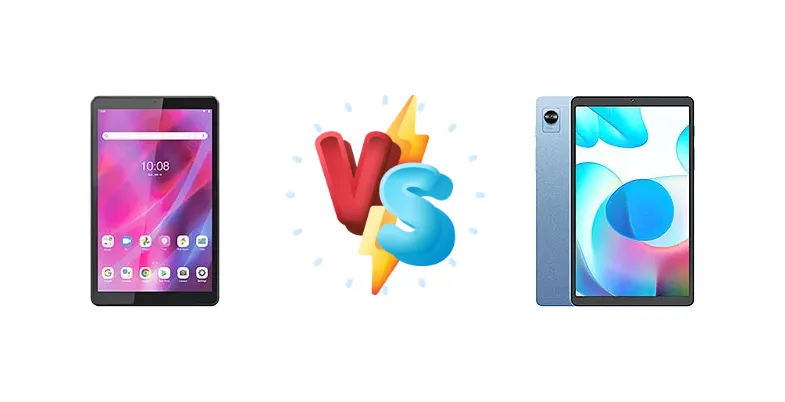
The sub-$150 tablet market is fiercely competitive, offering options for casual users, students, and anyone needing a portable media consumption device. The Lenovo Tab M8 (3rd Gen) and Realme Pad Mini represent two compelling choices, but diverge significantly in their core hardware. This comparison dives deep into their strengths and weaknesses to determine which tablet delivers the best experience for your needs.
🏆 Quick Verdict
For most users, the Realme Pad Mini emerges as the better choice. Its Unisoc Tiger T616 chipset, featuring Cortex-A75 performance cores, provides a noticeable performance uplift over the Lenovo Tab M8’s Helio P22T, translating to smoother multitasking and a more responsive user experience. The inclusion of 18W charging is also a significant advantage.
| Network |
|---|
| 2G bands | GSM 850 / 900 / 1800 / 1900 | GSM 850 / 900 / 1800 / 1900 |
| 3G bands | HSDPA 850 / 900 / 1700(AWS) / 1900 / 2100 - International | HSDPA 850 / 900 / 2100 |
| 4G bands | 1, 2, 3, 4, 5, 19, 7, 8, 20, 26, 28, 38, 40, 41 - International | 1, 3, 5, 7, 8, 20, 28, 38, 40, 41 |
| Speed | HSPA, LTE - cellular model only | HSPA, LTE - cellular model only |
| Technology | GSM / CDMA / HSPA / LTE | GSM / HSPA / LTE |
| | 1, 3, 5, 7, 8, 34, 38, 39, 40, 41 - China | - |
| Launch |
|---|
| Announced | 2021, June 28 | 2022, April 04 |
| Status | Available. Released 2022, February | Available. Released 2022, April 08 |
| Body |
|---|
| Build | Glass front, aluminum back, aluminum frame | - |
| Dimensions | 199.1 x 121.8 x 8.2 mm (7.84 x 4.80 x 0.32 in) | 211.8 x 124.5 x 7.6 mm (8.34 x 4.90 x 0.30 in) |
| SIM | Nano-SIM (cellular model only) | Nano-SIM (cellular model only) |
| Weight | 305 g (10.76 oz) | 372 g (13.12 oz) |
| Display |
|---|
| Resolution | 800 x 1280 pixels, 16:10 ratio (~189 ppi density) | 800 x 1340 pixels, 5:3 ratio (~179 ppi density) |
| Size | 8.0 inches, 185.6 cm2 (~76.5% screen-to-body ratio) | 8.7 inches, 214.9 cm2 (~81.5% screen-to-body ratio) |
| Type | TDDI IPS LCD, 350 nits (typ) | IPS LCD |
| Platform |
|---|
| CPU | Octa-core (4x2.3 GHz Cortex-A53 & 4x1.8 GHz Cortex-A53) | Octa-core (2x2.0 GHz Cortex-A75 & 6x1.8 GHz Cortex-A55) |
| Chipset | Mediatek MT8768T Helio P22T (12 nm) | Unisoc Tiger T616 (12 nm) |
| GPU | PowerVR GE8320 | Mali-G57 MP1 |
| OS | Android 11 (Go edition) - 2 GB RAM versionAndroid 11 - 3 GB RAM version | Android 11 |
| Memory |
|---|
| Card slot | microSDXC (dedicated slot) | microSDXC (uses shared SIM slot) |
| Internal | 32GB 2GB RAM, 32GB 3GB RAM | 32GB 3GB RAM, 64GB 4GB RAM, 128GB 6GB RAM |
| | eMMC 5.1 | UFS 2.1 |
| Main Camera |
|---|
| Single | 5 MP, AF | 8 MP, f/2.0 |
| Video | 1080p | 1080p@30fps |
| Selfie camera |
|---|
| Single | 2 MP | 5 MP, f/2.2 |
| Video | 720p | - |
| Sound |
|---|
| 3.5mm jack | Yes | Yes |
| 35mm jack | Yes | Yes |
| Loudspeaker | Yes | Yes, with stereo speakers |
| Comms |
|---|
| Bluetooth | 5.0, A2DP, LE | 5.0, A2DP, LE |
| NFC | No | No |
| Positioning | GPS, GLONASS, BDS - cellular model only | GPS, GLONASS, BDS - cellular model only |
| Radio | FM radio | No |
| USB | USB Type-C 2.0, OTG | USB Type-C 2.0, OTG |
| WLAN | Wi-Fi 802.11 a/b/g/n, dual-band, Wi-Fi Direct | Wi-Fi 802.11 a/b/g/n/ac, dual-band, Wi-Fi Direct |
| Features |
|---|
| Sensors | Accelerometer, proximity | Accelerometer, proximity |
| Battery |
|---|
| Charging | - | 18W wired
5W reverse wired |
| Type | Li-Po 5100 mAh | 6400 mAh |
| Misc |
|---|
| Colors | Iron Grey, Platinum Grey | Gray, Blue |
| Models | - | RMP2105, RMP2106 |
| Price | - | About 180 EUR |
Lenovo Tab M8 (3rd Gen)
- Extremely portable and lightweight design.
- Potentially lower price point (depending on retailer).
- Simple and straightforward Android experience.
- Outdated Mediatek Helio P22T chipset limits performance.
- Likely slow charging speeds.
- Limited multitasking capabilities.
Realme Pad Mini
- More powerful Unisoc Tiger T616 chipset for smoother performance.
- 18W fast charging for reduced downtime.
- Slightly larger display for a more immersive experience.
- May be slightly more expensive than the Lenovo Tab M8.
- Build quality may not be significantly better than the M8.
- Software support longevity is uncertain.
Display Comparison
Neither tablet boasts a particularly impressive display. Both are likely utilizing IPS LCD panels, given their price point. However, detailed specifications regarding resolution, brightness, and color gamut are missing. The Realme Pad Mini’s slightly larger screen size (8.7 inches vs 8 inches) may offer a marginally more immersive viewing experience. Bezels are expected to be substantial on both devices, reflecting their budget nature. Without specific display calibration data, it’s difficult to definitively declare a winner; however, the larger canvas of the Realme Pad Mini is a slight advantage.
Camera Comparison
Camera quality is unlikely to be a deciding factor for either tablet. Both are equipped with basic camera setups primarily intended for video calls. Detailed sensor information is unavailable, but it’s safe to assume both feature low-resolution sensors. Focusing on megapixel counts would be misleading; image processing and sensor size are far more critical, and data is lacking for both. The cameras should be considered functional for basic video conferencing, but not for serious photography.
Performance
This is where the Realme Pad Mini pulls ahead. The Unisoc Tiger T616 utilizes a more modern CPU architecture than the Lenovo Tab M8’s Helio P22T. The T616’s 2x2.0 GHz Cortex-A75 cores offer significantly higher single-core performance compared to the M8’s 4x2.3 GHz Cortex-A53 cores. While both chips are 12nm, the A75 architecture is more efficient and capable. The M8 relies solely on Cortex-A53 cores for all tasks, which will struggle with demanding applications. The Realme Pad Mini will provide a smoother experience with multitasking, web browsing, and light gaming. The M8’s GPU is also less capable, further widening the performance gap.
Battery Life
Battery capacity is not specified for either device. However, the Realme Pad Mini’s 18W wired charging is a clear advantage over the Lenovo Tab M8, which likely supports a much slower charging rate. Faster charging translates to less downtime and quicker top-ups, especially important for a portable device. While a larger mAh capacity is always preferable, the faster charging speed of the Realme Pad Mini mitigates the impact of a potentially smaller battery.
Buying Guide
Buy the Lenovo Tab M8 (3rd Gen) if you prioritize extreme portability and a minimal footprint for basic tasks like ebook reading and light web browsing. Buy the Realme Pad Mini if you value a more responsive user experience, better multitasking capabilities, and faster charging, making it ideal for streaming video, casual gaming, and general productivity.
Frequently Asked Questions
❓ Will the Realme Pad Mini handle demanding games like PUBG Mobile?
While the Unisoc Tiger T616 is a step up from the Helio P22T, PUBG Mobile will likely require reduced graphics settings and frame rates for a playable experience. Expect medium settings at 30fps as a reasonable target. The M8 will struggle significantly with even low settings.
❓ Is the Realme Pad Mini a good choice for reading ebooks?
Yes, the Realme Pad Mini’s 8.7-inch display is well-suited for reading ebooks. While the display specifications are unknown, IPS LCD technology generally provides comfortable viewing angles. The slightly larger screen size compared to the M8 offers more text on each page.
❓ How does the software experience differ between the two tablets?
Both tablets run Android, but Realme UI (on the Pad Mini) and Lenovo’s custom Android skin (on the M8) offer different user interfaces and pre-installed apps. Realme UI is generally considered more feature-rich and customizable, while Lenovo’s skin is often more minimalist. Software update support is a concern for both, but Realme has a slightly better track record.