
Lenovo Tab M8 (3rd Gen) vs. Tab M8 (FHD): Which Tablet Reigns Supreme?
| Phones Images | |||||
|---|---|---|---|---|---|
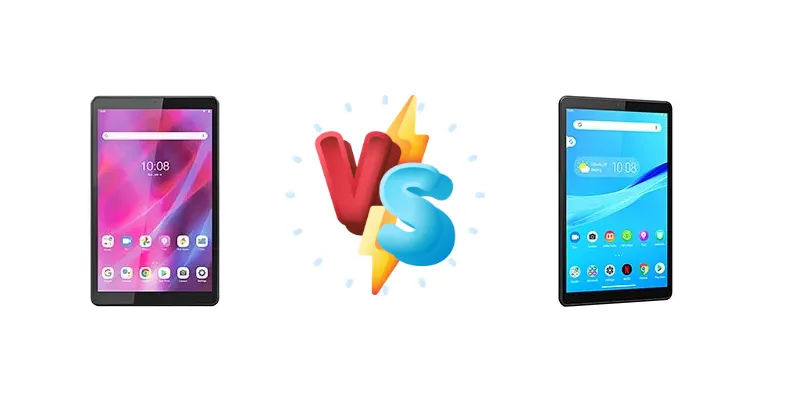
|
🏆 Quick Verdict
The Lenovo Tab M8 (FHD) generally wins thanks to its significantly better display resolution. While both offer similar performance, the FHD's sharper screen makes it a more enjoyable experience for media consumption and general use. The 3rd Gen might be slightly more affordable, but the FHD's visual upgrade is worth the extra cost.
| PHONES | ||
|---|---|---|
| Phone Names | Lenovo Tab M8 (3rd Gen) | Lenovo Tab M8 (FHD) |
| Network | ||
|---|---|---|
| 2G bands | GSM 850 / 900 / 1800 / 1900 | GSM 850 / 900 / 1800 / 1900 |
| 3G bands | HSDPA 850 / 900 / 1700(AWS) / 1900 / 2100 - International | HSDPA 850 / 900 / 1900 / 2100 |
| 4G bands | 1, 2, 3, 4, 5, 19, 7, 8, 20, 26, 28, 38, 40, 41 - International | 1, 2, 3, 4, 5, 7, 8, 19, 20, 38, 40 |
| Speed | HSPA, LTE - cellular model only | HSPA, LTE - cellular model only |
| Technology | GSM / CDMA / HSPA / LTE | GSM / HSPA / LTE |
| 1, 3, 5, 7, 8, 34, 38, 39, 40, 41 - China | 1, 3, 5, 7, 8, 19, 34, 38, 39, 40, 41 | |
| Launch | ||
|---|---|---|
| Announced | 2021, June 28 | 2019, September. Released 2019, October |
| Status | Available. Released 2022, February | Discontinued |
| Body | ||
|---|---|---|
| Build | Glass front, aluminum back, aluminum frame | Glass front, aluminum back, aluminum frame |
| Dimensions | 199.1 x 121.8 x 8.2 mm (7.84 x 4.80 x 0.32 in) | 198.2 x 122.6 x 8.2 mm (7.80 x 4.83 x 0.32 in) |
| SIM | Nano-SIM (cellular model only) | Nano-SIM (cellular model only) |
| Weight | 305 g (10.76 oz) | 305 g (10.76 oz) |
| Display | ||
|---|---|---|
| Resolution | 800 x 1280 pixels, 16:10 ratio (~189 ppi density) | 1200 x 1920 pixels, 16:10 ratio (~283 ppi density) |
| Size | 8.0 inches, 185.6 cm2 (~76.5% screen-to-body ratio) | 8.0 inches, 185.6 cm2 (~76.4% screen-to-body ratio) |
| Type | TDDI IPS LCD, 350 nits (typ) | IPS LCD, 350 nits (typ) |
| Platform | ||
|---|---|---|
| CPU | Octa-core (4x2.3 GHz Cortex-A53 & 4x1.8 GHz Cortex-A53) | Octa-core 2.3 GHz Cortex-A53 |
| Chipset | Mediatek MT8768T Helio P22T (12 nm) | Mediatek MT6762 Helio P22T (12 nm) |
| GPU | PowerVR GE8320 | PowerVR GE8320 |
| OS | Android 11 (Go edition) - 2 GB RAM versionAndroid 11 - 3 GB RAM version | Android 9.0 (Pie), upgradable to Android 10 |
| Memory | ||
|---|---|---|
| Card slot | microSDXC (dedicated slot) | microSDXC (dedicated slot) |
| Internal | 32GB 2GB RAM, 32GB 3GB RAM | 16GB 2GB RAM, 32GB 3GB RAM |
| eMMC 5.1 | eMMC 5.1 | |
| Main Camera | ||
|---|---|---|
| Features | - | LED flash |
| Single | 5 MP, AF | 13 MP, AF |
| Video | 1080p | 1080p |
| Selfie camera | ||
|---|---|---|
| Single | 2 MP | 5 MP |
| Video | 720p | 1080p |
| Sound | ||
|---|---|---|
| 3.5mm jack | Yes | Yes |
| 35mm jack | Yes | Yes |
| Loudspeaker | Yes | Yes |
| Comms | ||
|---|---|---|
| Bluetooth | 5.0, A2DP, LE | 5.0, A2DP, LE |
| NFC | No | No |
| Positioning | GPS, GLONASS, BDS - cellular model only | GPS, GLONASS, BDS, GALILEO - cellular model only |
| Radio | FM radio | FM radio |
| USB | USB Type-C 2.0, OTG | microUSB 2.0, OTG |
| WLAN | Wi-Fi 802.11 a/b/g/n, dual-band, Wi-Fi Direct | Wi-Fi 802.11 a/b/g/n/ac, dual-band, Wi-Fi Direct |
| Features | ||
|---|---|---|
| Sensors | Accelerometer, proximity | Accelerometer, proximity |
| Battery | ||
|---|---|---|
| Type | Li-Po 5100 mAh | Li-Po 5100 mAh, non-removable |
| Misc | ||
|---|---|---|
| Colors | Iron Grey, Platinum Grey | Iron Grey, Platinum Grey |
| Price | - | About 160 EUR |
Lenovo Tab M8 (3rd Gen)
- More affordable
- Decent performance for basic tasks
- Compact and portable
- Lower resolution display
- Limited multitasking
- Basic camera quality
Lenovo Tab M8 (FHD)
- Full HD display for sharper visuals
- Improved media consumption experience
- Slightly faster CPU
- More expensive
- Still limited by 2GB RAM
- Basic camera quality
Display Comparison
The most significant difference lies in the display. The Tab M8 (3rd Gen) typically features an 800x1280 resolution display, while the Tab M8 (FHD) boasts a Full HD (1920x1080) resolution. This results in a noticeably sharper and more detailed image on the FHD model, making it superior for media consumption. Both have an 8-inch screen size, but the FHD's pixel density is considerably higher.
Camera Comparison
Camera quality on both tablets is generally unremarkable. Expect basic 2MP front and rear cameras suitable for video calls and occasional snapshots. Image quality will be adequate in well-lit conditions, but struggles in low light. Don't purchase either tablet solely for its camera capabilities.
Performance
Both tablets utilize a Mediatek Helio P22T chipset, but the 3rd Gen has a slightly faster CPU clock speed (2.3 GHz vs 2.3 GHz). However, the difference in real-world performance is minimal. Expect adequate performance for everyday tasks, but don't expect to run demanding games or applications smoothly on either device. RAM is likely 2GB on both models, further limiting multitasking capabilities.
Battery Life
Battery capacity is likely around 5000mAh on both models, suggesting similar battery life. Expect around 8-10 hours of mixed usage. Actual battery life will depend on usage patterns and screen brightness.
Buying Guide
The Lenovo Tab M8 (3rd Gen) is ideal for budget-conscious users who prioritize affordability and basic tablet functionality like web browsing and light gaming. The Lenovo Tab M8 (FHD) is a better choice for those who value a sharper, more vibrant display for watching videos, browsing photos, and enjoying a more immersive visual experience.