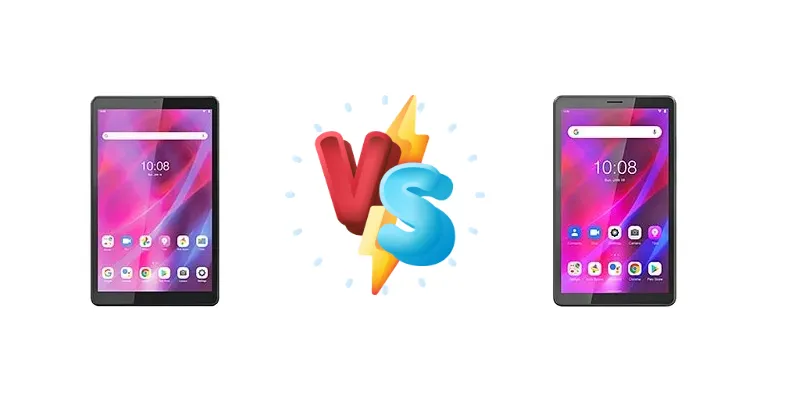
Lenovo's Tab M series offers affordable Android tablets, but choosing between the M8 (3rd Gen) and M7 (3rd Gen) requires careful consideration. Both target the budget-conscious user, but diverge in processing power and potential use cases. This comparison dives deep into the specifications to determine which tablet delivers the best value.
🏆 Quick Verdict
For most users, the Lenovo Tab M8 (3rd Gen) is the better choice. Its Mediatek MT8768T Helio P22T chipset, featuring a more modern architecture and higher clock speeds, provides a noticeably smoother experience for multitasking, gaming, and demanding applications compared to the Tab M7's MT8166/MT8766.
| Network |
|---|
| 2G bands | GSM 850 / 900 / 1800 / 1900 | GSM 850 / 900 / 1800 / 1900 |
| 3G bands | HSDPA 850 / 900 / 1700(AWS) / 1900 / 2100 - International | HSDPA 850 / 900 / 1900 / 2100 |
| 4G bands | 1, 2, 3, 4, 5, 19, 7, 8, 20, 26, 28, 38, 40, 41 - International | 1, 2, 3, 4, 5, 7, 8, 19, 20, 28, 38, 40, 41 |
| Speed | HSPA, LTE - cellular model only | HSPA, LTE - cellular model only |
| Technology | GSM / CDMA / HSPA / LTE | GSM / HSPA / LTE |
| | 1, 3, 5, 7, 8, 34, 38, 39, 40, 41 - China | - |
| Launch |
|---|
| Announced | 2021, June 28 | 2021, June 28 |
| Status | Available. Released 2022, February | Available. Released 2021, June 31 |
| Body |
|---|
| Build | Glass front, aluminum back, aluminum frame | Glass front, aluminum back, aluminum frame |
| Dimensions | 199.1 x 121.8 x 8.2 mm (7.84 x 4.80 x 0.32 in) | 176.2 x 102.3 x 8.3 mm (6.94 x 4.03 x 0.33 in) |
| SIM | Nano-SIM (cellular model only) | Nano-SIM (cellular model only) |
| Weight | 305 g (10.76 oz) | 237 g (8.36 oz) |
| Display |
|---|
| Resolution | 800 x 1280 pixels, 16:10 ratio (~189 ppi density) | 600 x 1024 pixels, 16:9 ratio (~170 ppi density) |
| Size | 8.0 inches, 185.6 cm2 (~76.5% screen-to-body ratio) | 7.0 inches, 137.9 cm2 (~76.5% screen-to-body ratio) |
| Type | TDDI IPS LCD, 350 nits (typ) | TDDI IPS LCD, 350 nits (typ) |
| Platform |
|---|
| CPU | Octa-core (4x2.3 GHz Cortex-A53 & 4x1.8 GHz Cortex-A53) | Octa-core 2.0 GHz |
| Chipset | Mediatek MT8768T Helio P22T (12 nm) | Mediatek MT8166 - Wi-Fi versionMediatek MT8766 - LTE version |
| GPU | PowerVR GE8320 | - |
| OS | Android 11 (Go edition) - 2 GB RAM versionAndroid 11 - 3 GB RAM version | Android 11 (Go edition) |
| Memory |
|---|
| Card slot | microSDXC (dedicated slot) | microSDHC (dedicated slot) |
| Internal | 32GB 2GB RAM, 32GB 3GB RAM | 32GB 2GB RAM |
| | eMMC 5.1 | eMMC 5.1 |
| Main Camera |
|---|
| Single | 5 MP, AF | 2 MP |
| Video | 1080p | 720p |
| Selfie camera |
|---|
| Single | 2 MP | 2 MP |
| Video | 720p | 720p |
| Sound |
|---|
| 3.5mm jack | Yes | Yes |
| 35mm jack | Yes | Yes |
| Loudspeaker | Yes | Yes |
| Comms |
|---|
| Bluetooth | 5.0, A2DP, LE | 5.0, A2DP, LE |
| NFC | No | No |
| Positioning | GPS, GLONASS, BDS - cellular model only | GPS - cellular model only |
| Radio | FM radio | FM radio |
| USB | USB Type-C 2.0, OTG | microUSB 2.0, OTG |
| WLAN | Wi-Fi 802.11 a/b/g/n, dual-band, Wi-Fi Direct | Wi-Fi 802.11 a/b/g/n/ac, dual-band, Wi-Fi Direct |
| Features |
|---|
| Sensors | Accelerometer, proximity | Accelerometer |
| Battery |
|---|
| Type | Li-Po 5100 mAh | Li-Po 3750 mAh |
| Misc |
|---|
| Colors | Iron Grey, Platinum Grey | Iron Grey |
| Models | - | ZA8C0027US, TB-7306X |
| Price | - | About 120 EUR |
Lenovo Tab M8 (3rd Gen)
- More powerful processor (MT8768T)
- Larger display for better viewing
- Potentially better power efficiency
- Likely slightly higher price
- May be slightly larger and less portable
Lenovo Tab M7 (3rd Gen)
- Lower price point
- More compact and portable
- LTE option available for on-the-go connectivity
- Less powerful processor (MT8166/MT8766)
- Smaller display
- Potentially shorter battery life under load
Display Comparison
Both tablets likely feature IPS LCD panels, common in this price bracket. However, detailed display specs like resolution and brightness are missing. The M8's slightly larger screen size (8 inches vs. 7 inches) offers a more immersive viewing experience. While neither is expected to have high color accuracy, the larger canvas of the M8 is beneficial for reading and media consumption. Bezels are likely substantial on both, typical of budget tablets.
Camera Comparison
Camera performance is unlikely to be a deciding factor for either tablet. Both are expected to feature basic cameras suitable for video calls and occasional snapshots. Detailed sensor information is unavailable, but given the price point, image quality will be limited, especially in low-light conditions. Focusing on camera specs is not a productive use of time when evaluating these devices.
Performance
The core difference lies in the chipsets. The Lenovo Tab M8 (3rd Gen) utilizes the Mediatek MT8768T Helio P22T, an octa-core processor built on a 12nm process. This chipset features a heterogeneous core configuration with four Cortex-A53 cores clocked at 2.3 GHz and four at 1.8 GHz. The Tab M7 (3rd Gen) comes in two variants: one with the MT8166 (Wi-Fi only) and another with the MT8766 (LTE). Both MT8166/MT8766 chips are octa-core, clocked at 2.0 GHz. The P22T’s newer architecture and higher peak clock speeds translate to a significant performance advantage, particularly in CPU-intensive tasks. The 12nm process node also suggests better power efficiency compared to the older nodes likely used in the MT8166/MT8766.
Battery Life
Battery capacity details are missing for both tablets. However, the Tab M8’s more efficient chipset (MT8768T) could potentially offer longer battery life despite potentially having a similar capacity to the M7. Charging wattage is also unknown, but both are likely to support standard 5W charging. Real-world battery life will heavily depend on usage patterns, with video streaming and gaming consuming the most power.
Buying Guide
Buy the Lenovo Tab M8 (3rd Gen) if you prioritize a more responsive user experience, plan to engage in light gaming, or frequently multitask between apps. Its superior chipset handles these tasks with greater ease. Buy the Lenovo Tab M7 (3rd Gen) if your primary use case is basic media consumption – reading ebooks, watching videos, or browsing the web – and you're looking for the absolute lowest price point. The M7 is sufficient for these simpler tasks.
Frequently Asked Questions
❓ Will the Lenovo Tab M8 (3rd Gen) handle demanding games like PUBG Mobile?
While the MT8768T Helio P22T is capable of running PUBG Mobile, it will likely require low graphics settings and may experience occasional frame drops. It's suitable for casual gaming, but not for a high-performance gaming experience.
❓ Does the Lenovo Tab M7 (3rd Gen) have a microSD card slot for expandable storage?
Based on Lenovo's typical offerings in this price range, the Tab M7 (3rd Gen) likely includes a microSD card slot for expandable storage. This is crucial for users who plan to store a large number of media files or apps.
❓ Which tablet is better for reading ebooks and online articles?
The Lenovo Tab M8 (3rd Gen) is slightly better suited for reading due to its larger 8-inch display. The extra screen real estate reduces the need for constant scrolling and provides a more comfortable reading experience.
❓ Is the LTE version of the Lenovo Tab M7 (3rd Gen) worth the extra cost?
If you frequently travel or need internet access in areas without Wi-Fi, the LTE version of the Tab M7 (3rd Gen) is a worthwhile investment. It provides on-the-go connectivity without relying on hotspots or public Wi-Fi networks.