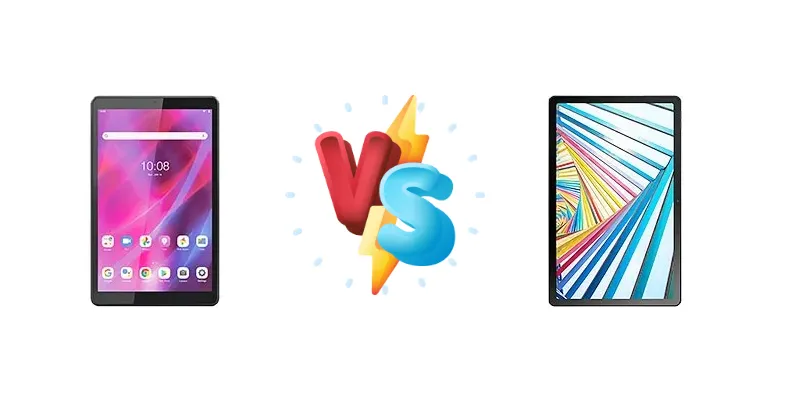
Looking for an affordable Android tablet? Lenovo offers several compelling options, and the Tab M8 (3rd Gen) and Tab M10 Plus (3rd Gen) are two popular contenders. But which one is right for you? This comprehensive comparison breaks down their key differences to help you make an informed decision.
🏆 Quick Verdict
The Lenovo Tab M10 Plus (3rd Gen) generally offers a superior experience thanks to its brighter display, more powerful processor (especially the Snapdragon model), and faster charging. While the M8 is more budget-friendly, the M10 Plus provides better overall performance and features for a slightly higher price.
| Network |
|---|
| 2G bands | GSM 850 / 900 / 1800 / 1900 | GSM 850 / 900 / 1800 / 1900 |
| 3G bands | HSDPA 850 / 900 / 1700(AWS) / 1900 / 2100 - International | HSDPA 800 / 850 / 900 / 1900 / 2100 |
| 4G bands | 1, 2, 3, 4, 5, 19, 7, 8, 20, 26, 28, 38, 40, 41 - International | 1, 2, 3, 4, 5, 7, 8, 19, 20, 26, 28, 28, 38, 40, 41 |
| Speed | HSPA, LTE - cellular model only | HSPA 42.2/5.76 Mbps, LTE Cat13 390/75 Mbps - cellular model only |
| Technology | GSM / CDMA / HSPA / LTE | GSM / HSPA / LTE |
| | 1, 3, 5, 7, 8, 34, 38, 39, 40, 41 - China | - |
| Launch |
|---|
| Announced | 2021, June 28 | 2022, May |
| Status | Available. Released 2022, February | Available. Released 2022, May |
| Body |
|---|
| Build | Glass front, aluminum back, aluminum frame | - |
| Dimensions | 199.1 x 121.8 x 8.2 mm (7.84 x 4.80 x 0.32 in) | 251.2 x 158.8 x 7.5 mm (9.89 x 6.25 x 0.30 in) |
| SIM | Nano-SIM (cellular model only) | Nano-SIM (cellular model only) |
| Weight | 305 g (10.76 oz) | 465 g (1.03 lb) |
| | - | Stylus support |
| Display |
|---|
| Resolution | 800 x 1280 pixels, 16:10 ratio (~189 ppi density) | 1200 x 2000 pixels, 5:3 ratio (~220 ppi density) |
| Size | 8.0 inches, 185.6 cm2 (~76.5% screen-to-body ratio) | 10.61 inches, 320.4 cm2 (~80.3% screen-to-body ratio) |
| Type | TDDI IPS LCD, 350 nits (typ) | IPS LCD, 400 nits (typ) |
| Platform |
|---|
| CPU | Octa-core (4x2.3 GHz Cortex-A53 & 4x1.8 GHz Cortex-A53) | Octa-core (4x2.4 GHz Kryo 265 Gold & 4x1.9 GHz Kryo 265 Silver) - LTE model Octa-core (2x2.0 GHz Cortex-A75 & 6x1.8 GHz Cortex-A55) - Wi-Fi only model |
| Chipset | Mediatek MT8768T Helio P22T (12 nm) | Qualcomm SM6225 Snapdragon 680 4G (6 nm) - LTE model Mediatek MT6769V/CU Helio G80 (12 nm) - Wi-Fi only model |
| GPU | PowerVR GE8320 | Adreno 610 - LTE model Mali-G52 MC2 - Wi-Fi only model |
| OS | Android 11 (Go edition) - 2 GB RAM versionAndroid 11 - 3 GB RAM version | Android 12 |
| Memory |
|---|
| Card slot | microSDXC (dedicated slot) | microSDXC (dedicated slot) |
| Internal | 32GB 2GB RAM, 32GB 3GB RAM | 32GB 3GB RAM, 64GB 4GB RAM, 128GB 4GB RAM, 128GB 6GB RAM |
| | eMMC 5.1 | eMCP/uMCP |
| Main Camera |
|---|
| Single | 5 MP, AF | 8 MP, AF |
| Video | 1080p | 1080p |
| Selfie camera |
|---|
| Single | 2 MP | 8 MP |
| Video | 720p | - |
| Sound |
|---|
| 3.5mm jack | Yes | Yes |
| 35mm jack | Yes | Yes |
| Loudspeaker | Yes | Yes, with stereo speakers (4 speakers) |
| Comms |
|---|
| Bluetooth | 5.0, A2DP, LE | 5.0, A2DP, LE |
| NFC | No | No |
| Positioning | GPS, GLONASS, BDS - cellular model only | GPS, GLONASS, BDS - cellular model only |
| Radio | FM radio | FM Radio |
| USB | USB Type-C 2.0, OTG | USB Type-C 2.0 |
| WLAN | Wi-Fi 802.11 a/b/g/n, dual-band, Wi-Fi Direct | Wi-Fi 802.11 a/b/g/n/ac, dual-band, Wi-Fi Direct |
| Features |
|---|
| Sensors | Accelerometer, proximity | Accelerometer, proximity, gyro |
| Battery |
|---|
| Charging | - | 20W wired |
| Type | Li-Po 5100 mAh | Li-Po 7700 mAh |
| Misc |
|---|
| Colors | Iron Grey, Platinum Grey | Storm Grey, Frost Blue |
| Price | - | About 260 EUR |
Lenovo Tab M8 (3rd Gen)
- Very affordable
- Compact and portable
- Decent for basic tasks
- Lightweight
- Lower performance
- Smaller, lower-resolution display
- No fast charging
- Can feel sluggish
Lenovo Tab M10 Plus (3rd Gen)
- Larger, higher-resolution display
- More powerful processor (especially Snapdragon model)
- Longer battery life
- 20W fast charging
- Better multitasking
- More expensive than the M8
- Slightly less portable due to larger size
Display Comparison
The Tab M10 Plus (3rd Gen) boasts a larger 10.1-inch display (vs. the M8's 8-inch) with a higher resolution (1920x1200 vs. 1280x800). This results in a sharper, more immersive viewing experience. The M10 Plus also typically has better brightness and color accuracy, making it more enjoyable for watching videos and browsing photos. The M8's display is adequate for its price point, but noticeably less impressive.
Camera Comparison
Neither tablet excels in the camera department. Both feature modest rear and front-facing cameras suitable for basic video calls and occasional snapshots. Image quality is generally acceptable in good lighting conditions, but expect noise and limited detail in low light. The M10 Plus might have a slight edge due to potentially better image processing, but the difference is minimal.
Performance
Here's where the M10 Plus shines. The Snapdragon 680 (LTE model) offers a significant performance boost over the M8's Helio P22T. Even the Wi-Fi only M10 Plus with the Helio G80 is generally faster. Apps launch quicker, multitasking is smoother, and gaming is more enjoyable on the M10 Plus. The M8 can feel sluggish at times, especially when handling demanding apps.
Battery Life
The M10 Plus, with its larger size, typically houses a larger battery (5000 mAh vs. 3500 mAh in the M8). This translates to longer battery life, especially when streaming videos or playing games. The M10 Plus also supports 20W fast charging, a feature absent in the M8, allowing for quicker top-ups.
Buying Guide
The Lenovo Tab M8 (3rd Gen) is ideal for users on a tight budget who primarily need a tablet for basic tasks like browsing, reading, and light media consumption. The Lenovo Tab M10 Plus (3rd Gen) is a better choice for those who want a smoother experience for gaming, streaming, and multitasking, and appreciate a larger, higher-quality display.
Frequently Asked Questions
❓ What is the difference between the LTE and Wi-Fi only models of the Lenovo Tab M10 Plus (3rd Gen)?
The LTE model supports cellular connectivity, allowing you to connect to the internet via a SIM card. The Wi-Fi only model relies solely on Wi-Fi for internet access.
❓ Is the Lenovo Tab M8 (3rd Gen) good for gaming?
The Tab M8 is suitable for casual games, but its lower performance may struggle with more demanding titles. The Tab M10 Plus is a better choice for a smoother gaming experience.