
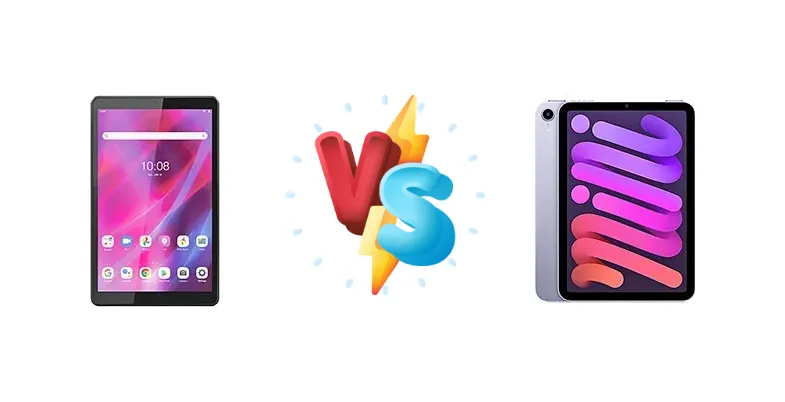
Lenovo Tab M8 (3rd Gen) vs. Apple iPad mini (2021): A Detailed Comparison
| Phones Images | |||||
|---|---|---|---|---|---|
|
🏆 Quick Verdict
For the average user prioritizing performance and a premium experience, the Apple iPad mini (2021) is the clear winner. Its A15 Bionic chip and superior display justify the higher price. However, the Lenovo Tab M8 (3rd Gen) remains a compelling option for budget-conscious users needing a basic tablet for light tasks.
| PHONES | ||
|---|---|---|
| Phone Names | Lenovo Tab M8 (3rd Gen) | Apple iPad mini (2021) |
| Network | ||
|---|---|---|
| 2G bands | GSM 850 / 900 / 1800 / 1900 | GSM 850 / 900 / 1800 / 1900 |
| 3G bands | HSDPA 850 / 900 / 1700(AWS) / 1900 / 2100 - International | HSDPA 850 / 900 / 1700(AWS) / 1900 / 2100 |
| 4G bands | 1, 2, 3, 4, 5, 19, 7, 8, 20, 26, 28, 38, 40, 41 - International | 1, 2, 3, 4, 5, 7, 8, 11, 12, 13, 14, 17, 18, 19, 20, 21, 25, 26, 28, 29, 30, 32, 34, 38, 39, 40, 41, 46, 48, 66, 71 |
| 5G bands | - | 1, 2, 3, 5, 7, 8, 12, 20, 25, 28, 29, 30, 38, 40, 41, 48, 66, 71, 77, 78, 79 SA/NSA |
| Speed | HSPA, LTE - cellular model only | HSPA, LTE, 5G - cellular model only |
| Technology | GSM / CDMA / HSPA / LTE | GSM / HSPA / LTE / 5G |
| 1, 3, 5, 7, 8, 34, 38, 39, 40, 41 - China | - | |
| Launch | ||
|---|---|---|
| Announced | 2021, June 28 | 2021, September 14 |
| Status | Available. Released 2022, February | Available. Released 2021, September 24 |
| Body | ||
|---|---|---|
| Build | Glass front, aluminum back, aluminum frame | Glass front, aluminum back, aluminum frame |
| Dimensions | 199.1 x 121.8 x 8.2 mm (7.84 x 4.80 x 0.32 in) | 195.4 x 134.8 x 6.3 mm (7.69 x 5.31 x 0.25 in) |
| SIM | Nano-SIM (cellular model only) | Nano-SIM + eSIM (cellular model only) |
| Weight | 305 g (10.76 oz) | 293 g (Wi-Fi) / 297 g (Wi-Fi + Cellular) (10.34 oz) |
| - | Stylus support (2nd gen only) | |
| Display | ||
|---|---|---|
| Protection | - | Scratch-resistant glass, oleophobic coating |
| Resolution | 800 x 1280 pixels, 16:10 ratio (~189 ppi density) | 1488 x 2266 pixels, 3:2 ratio (~327 ppi density) |
| Size | 8.0 inches, 185.6 cm2 (~76.5% screen-to-body ratio) | 8.3 inches, 203.9 cm2 (~77.4% screen-to-body ratio) |
| Type | TDDI IPS LCD, 350 nits (typ) | Liquid Retina IPS LCD, 500 nits (typ) |
| Platform | ||
|---|---|---|
| CPU | Octa-core (4x2.3 GHz Cortex-A53 & 4x1.8 GHz Cortex-A53) | Hexa-core (2x2.93 GHz + 4xX.X GHz) |
| Chipset | Mediatek MT8768T Helio P22T (12 nm) | Apple A15 Bionic (5 nm) |
| GPU | PowerVR GE8320 | Apple GPU (5-core) |
| OS | Android 11 (Go edition) - 2 GB RAM versionAndroid 11 - 3 GB RAM version | iPadOS 15, upgradable to iPadOS 26.1 |
| Memory | ||
|---|---|---|
| Card slot | microSDXC (dedicated slot) | No |
| Internal | 32GB 2GB RAM, 32GB 3GB RAM | 64GB 4GB RAM, 256GB 4GB RAM |
| eMMC 5.1 | - | |
| Main Camera | ||
|---|---|---|
| Features | - | Quad-LED dual-tone flash, HDR, panorama |
| Single | 5 MP, AF | 12 MP, f/1.8, (wide), AF |
| Video | 1080p | 4K@24/25/30/60fps, 1080p@25/30/60/120/240fps; gyro-EIS |
| Selfie camera | ||
|---|---|---|
| Features | - | HDR |
| Single | 2 MP | 12 MP, f/2.4, 122˚ (ultrawide) |
| Video | 720p | 1080p@25/30/60fps, gyro-EIS |
| Sound | ||
|---|---|---|
| 3.5mm jack | Yes | No |
| 35mm jack | Yes | No |
| Loudspeaker | Yes | Yes, with stereo speakers |
| Comms | ||
|---|---|---|
| Bluetooth | 5.0, A2DP, LE | 5.0, A2DP |
| NFC | No | No |
| Positioning | GPS, GLONASS, BDS - cellular model only | GPS, GLONASS - cellular model only |
| Radio | FM radio | No |
| USB | USB Type-C 2.0, OTG | USB Type-C 3.1, DisplayPort |
| WLAN | Wi-Fi 802.11 a/b/g/n, dual-band, Wi-Fi Direct | Wi-Fi 802.11 a/b/g/n/ac/6, dual-band, hotspot |
| Features | ||
|---|---|---|
| Sensors | Accelerometer, proximity | Fingerprint (side-mounted), accelerometer, gyro, compass, barometer |
| Battery | ||
|---|---|---|
| Type | Li-Po 5100 mAh | Li-Ion 5078 mAh (19.3 Wh) |
| Misc | ||
|---|---|---|
| Colors | Iron Grey, Platinum Grey | Space Gray, Pink, Purple, Starlight |
| Models | - | A2568, iPad14,1, iPad14,2 |
| Price | - | About 550 EUR |
| Tests | ||
|---|---|---|
| Loudspeaker | - | -29.7 LUFS (Average) |
Lenovo Tab M8 (3rd Gen)
- Significantly more affordable price point
- Compact and lightweight design for portability
- Suitable for basic tasks like web browsing and video streaming
- Substantially slower performance compared to the iPad mini
- Likely lower quality display with limited brightness and color accuracy
- Limited camera capabilities
Apple iPad mini (2021)
- Exceptional performance thanks to the A15 Bionic chip
- Vibrant and bright display with high contrast ratio
- Premium build quality and design
- Significantly higher price compared to the Lenovo Tab M8
- Smaller screen size may not be ideal for all users
- Limited storage options at base price
Display Comparison
The iPad mini (2021) boasts a significantly more advanced display, measured at 518 nits of peak brightness, compared to the Lenovo Tab M8 (3rd Gen)'s likely lower brightness (typical of budget tablets). This brightness difference translates to better visibility outdoors. While the Tab M8's resolution is likely sufficient for its screen size, the iPad mini's display technology and 1325:1 contrast ratio deliver richer colors and deeper blacks. The absence of display specifications for the Tab M8 suggests it lacks features like wide color gamut support found in the iPad mini.
Camera Comparison
Given the context data, a detailed camera comparison is limited. Both tablets likely feature modest camera setups geared towards video calls rather than photography. The iPad mini’s camera system, while not its primary selling point, benefits from Apple’s image signal processing, delivering better image quality than the Tab M8’s likely lower-resolution sensors. The absence of specific camera details for the Tab M8 suggests it prioritizes cost savings over camera performance.
Performance
The performance gap between these tablets is substantial. The Apple A15 Bionic, fabricated on a 5nm process, is a powerhouse, featuring a hexa-core CPU with two high-performance cores clocked at 2.93 GHz. This contrasts sharply with the Lenovo Tab M8’s Mediatek MT8768T Helio P22T (12nm), an octa-core processor with a split core configuration (4x2.3 GHz Cortex-A53 & 4x1.8 GHz Cortex-A53). The A15’s architectural advantages and smaller node size result in significantly faster processing speeds and improved power efficiency, making the iPad mini ideal for demanding tasks like video editing and gaming. The Tab M8 is suitable for basic tasks, but will struggle with resource-intensive applications.
Battery Life
Battery life is difficult to assess without specific mAh ratings. However, the A15 Bionic’s power efficiency, despite its performance, contributes to respectable battery life on the iPad mini. The Tab M8’s Helio P22T, while less powerful, also aims for efficiency. Charging speeds are also unknown for both devices, but the iPad mini benefits from USB-C Power Delivery, potentially enabling faster charging compared to the Tab M8’s likely slower charging capabilities.
Buying Guide
Buy the Lenovo Tab M8 (3rd Gen) if you need a highly affordable tablet for basic media consumption, e-reading, and light web browsing, primarily for children or casual use. Buy the Apple iPad mini (2021) if you prioritize performance for demanding apps, gaming, creative tasks, and appreciate a premium build quality and vibrant display, even at a higher price point.