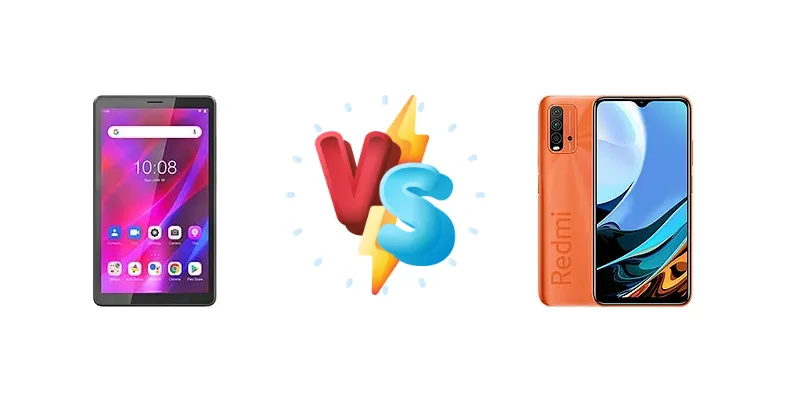
The Lenovo Tab M7 (3rd Gen) and the Xiaomi Redmi 9T represent opposite ends of the mobile spectrum – a compact, affordable tablet versus a feature-packed, budget smartphone. This comparison dives deep into their specifications to determine which device best suits your needs, considering factors like processing power, display quality, and overall value.
🏆 Quick Verdict
For users prioritizing portability and smartphone functionality, the Xiaomi Redmi 9T emerges as the better choice. Its Snapdragon 662 chipset offers a noticeable performance edge over the Tab M7’s Mediatek processor, coupled with a longer endurance rating. However, the Tab M7 remains a viable option for dedicated media consumption on a larger screen.
| Network |
|---|
| 2G bands | GSM 850 / 900 / 1800 / 1900 | GSM 850 / 900 / 1800 / 1900 |
| 3G bands | HSDPA 850 / 900 / 1900 / 2100 | HSDPA 850 / 900 / 1700(AWS) / 1900 / 2100 |
| 4G bands | 1, 2, 3, 4, 5, 7, 8, 19, 20, 28, 38, 40, 41 | 1, 2, 3, 4, 5, 7, 8, 20, 28, 38, 40, 41 |
| Speed | HSPA, LTE - cellular model only | HSPA, LTE |
| Technology | GSM / HSPA / LTE | GSM / HSPA / LTE |
| Launch |
|---|
| Announced | 2021, June 28 | 2021, January 08 |
| Status | Available. Released 2021, June 31 | Available. Released 2021, January 18 |
| Body |
|---|
| Build | Glass front, aluminum back, aluminum frame | Glass front (Gorilla Glass 3), plastic frame, plastic back |
| Dimensions | 176.2 x 102.3 x 8.3 mm (6.94 x 4.03 x 0.33 in) | 162.3 x 77.3 x 9.6 mm (6.39 x 3.04 x 0.38 in) |
| SIM | Nano-SIM (cellular model only) | Nano-SIM + Nano-SIM |
| Weight | 237 g (8.36 oz) | 198 g (6.98 oz) |
| | - | Water-repellent coating |
| Display |
|---|
| Protection | - | Corning Gorilla Glass 3 |
| Resolution | 600 x 1024 pixels, 16:9 ratio (~170 ppi density) | 1080 x 2340 pixels, 19.5:9 ratio (~395 ppi density) |
| Size | 7.0 inches, 137.9 cm2 (~76.5% screen-to-body ratio) | 6.53 inches, 104.7 cm2 (~83.4% screen-to-body ratio) |
| Type | TDDI IPS LCD, 350 nits (typ) | IPS LCD, 400 nits (typ) |
| Platform |
|---|
| CPU | Octa-core 2.0 GHz | Octa-core (4x2.0 GHz Kryo 260 Gold & 4x1.8 GHz Kryo 260 Silver) |
| Chipset | Mediatek MT8166 - Wi-Fi versionMediatek MT8766 - LTE version | Qualcomm SM6115 Snapdragon 662 (11 nm) |
| GPU | - | Adreno 610 |
| OS | Android 11 (Go edition) | Android 10, MIUI 12 |
| Memory |
|---|
| Card slot | microSDHC (dedicated slot) | microSDXC (dedicated slot) |
| Internal | 32GB 2GB RAM | 64GB 4GB RAM, 128GB 4GB RAM, 128GB 6GB RAM |
| | eMMC 5.1 | UFS 2.1 - 64GB
UFS 2.2 - 128GB |
| Main Camera |
|---|
| Features | - | LED flash, HDR, panorama |
| Quad | - | 48 MP, f/1.8, 26mm (wide), 1/2.0", 0.8µm, PDAF
8 MP, f/2.2, 120˚ (ultrawide), 1/4.0", 1.12µm
2 MP (macro)
Auxiliary lens |
| Single | 2 MP | - |
| Video | 720p | 1080p@30fps |
| Selfie camera |
|---|
| Single | 2 MP | 8 MP, f/2.1, 27mm (wide), 1/4.0", 1.12µm |
| Video | 720p | 1080p@30fps |
| Sound |
|---|
| 3.5mm jack | Yes | Yes |
| 35mm jack | Yes | Yes |
| Loudspeaker | Yes | Yes, with stereo speakers |
| | - | 24-bit/192kHz audio |
| Comms |
|---|
| Bluetooth | 5.0, A2DP, LE | 5.0, A2DP, LE |
| Infrared port | - | Yes |
| NFC | No | Yes (market/region dependent) |
| Positioning | GPS - cellular model only | GPS, GLONASS, GALILEO, BDS |
| Radio | FM radio | FM radio |
| USB | microUSB 2.0, OTG | USB Type-C 2.0, OTG |
| WLAN | Wi-Fi 802.11 a/b/g/n/ac, dual-band, Wi-Fi Direct | Wi-Fi 802.11 a/b/g/n/ac, dual-band, Wi-Fi Direct |
| Features |
|---|
| Sensors | Accelerometer | Fingerprint (side-mounted), accelerometer, proximity, compass |
| Battery |
|---|
| Charging | - | 18W wired
2.5W reverse wired |
| Type | Li-Po 3750 mAh | Li-Po 6000 mAh |
| Misc |
|---|
| Colors | Iron Grey | Carbon Gray, Twilight Blue, Sunrise Orange, Ocean Green |
| Models | ZA8C0027US, TB-7306X | J19S, M2010J19SG, M2010J19SY |
| Price | About 120 EUR | € 87.56 |
| SAR | - | 1.09 W/kg (head) 1.00 W/kg (body) |
| SAR EU | - | 0.60 W/kg (head) 0.81 W/kg (body) |
| Pricing |
|---|
| 128GB 6GB RAM | - | Rp 2,272,000 |
| 64GB 4GB RAM | - | $ 168.78 |
| Tests |
|---|
| Battery life | - |
Endurance rating 150h
|
| Camera | - |
Photo / Video |
| Display | - |
Contrast ratio: 1594:1 |
| Loudspeaker | - |
-25.6 LUFS (Very good)
|
| Performance | - |
AnTuTu: 177917 (v8)
GeekBench: 1400 (v5.1)
GFXBench: 5.8fps (ES 3.1 onscreen) |
Lenovo Tab M7 (3rd Gen)
- More portable for reading and media consumption.
- Larger screen size compared to typical smartphones.
- Potentially lower price point (depending on configuration).
- Less powerful processor than the Redmi 9T.
- Limited functionality compared to a smartphone.
- Camera likely inferior to the Redmi 9T.
Xiaomi Redmi 9T
- More powerful Snapdragon 662 processor.
- Versatile smartphone functionality (calling, texting, apps).
- Longer battery life and faster charging.
- Smaller screen size compared to the Tab M7.
- May be more expensive than the base Tab M7 model.
- Less ideal for extended reading sessions.
Display Comparison
The Xiaomi Redmi 9T boasts a measured peak brightness of 437 nits and a 1594:1 contrast ratio, providing a more vibrant and visible viewing experience, especially outdoors. The Lenovo Tab M7’s display specifications are less detailed, but as a smaller tablet, it prioritizes portability over visual fidelity. The Redmi 9T’s larger screen size (unspecified, but typical for smartphones) also offers a more immersive experience for video playback compared to the Tab M7’s 7-inch form factor. While both share the same contrast ratio, the Redmi 9T’s higher brightness is a significant advantage.
Camera Comparison
Both devices feature 'Photo / Video' capabilities, but detailed camera specifications are lacking for both. Given the Redmi 9T’s positioning as a smartphone, it’s reasonable to assume a more sophisticated camera system with features like autofocus and potentially multiple lenses. The Tab M7’s camera is likely a basic module intended for video calls and occasional snapshots. Without specific sensor details, it’s difficult to make a precise comparison, but the Redmi 9T is expected to deliver superior image quality.
Performance
The Xiaomi Redmi 9T’s Qualcomm Snapdragon 662 (11nm) chipset represents a clear advantage over the Lenovo Tab M7’s Mediatek MT8166 or MT8766. The Snapdragon 662 utilizes a Kryo CPU architecture with a combination of performance (2.0 GHz) and efficiency (1.8 GHz) cores, offering a more balanced and responsive experience. The Tab M7’s octa-core 2.0 GHz processor, while seemingly comparable in clock speed, is built on a less efficient process node and lacks the architectural refinements of the Snapdragon. This translates to better multitasking and smoother app performance on the Redmi 9T. The Redmi 9T’s 64GB/4GB or 128GB/6GB RAM options also provide more headroom for apps and data.
Battery Life
The Xiaomi Redmi 9T’s endurance rating of 150 hours suggests excellent battery life, capable of lasting a full day or more with moderate use. It also supports 18W wired charging and 2.5W reverse wired charging, offering convenient power replenishment and the ability to charge other devices. The Lenovo Tab M7’s battery capacity is unspecified, but tablets generally prioritize longer battery life for media consumption. However, the Redmi 9T’s efficient Snapdragon chipset and larger battery (implied by the endurance rating) likely provide a more consistent and reliable battery experience.
Buying Guide
Buy the Lenovo Tab M7 (3rd Gen) if you need a dedicated, portable media consumption device for reading, streaming videos, and light browsing, and don't require cellular connectivity. Buy the Xiaomi Redmi 9T if you prefer a versatile smartphone with calling capabilities, a more powerful processor for everyday tasks and gaming, and a longer-lasting battery for all-day use.
Frequently Asked Questions
❓ Does the Mediatek MT8166 in the Lenovo Tab M7 struggle with demanding apps or multitasking?
Yes, the Mediatek MT8166 is an entry-level processor. While suitable for basic tasks like web browsing and video playback, it will likely exhibit slowdowns and lag when running multiple apps simultaneously or playing graphically intensive games. The Redmi 9T’s Snapdragon 662 is significantly more capable in these scenarios.
❓ Is the 18W charging on the Redmi 9T a significant improvement over what the Tab M7 likely offers?
Absolutely. While the Tab M7’s charging speed is unspecified, it’s unlikely to match the Redmi 9T’s 18W capability. 18W charging allows for a much faster 0-100% charge time, minimizing downtime and keeping you connected for longer. The Redmi 9T also offers 2.5W reverse charging, a feature absent on the Tab M7.
❓ Given the lack of detailed camera specs, can I expect the Redmi 9T to be good for casual photography?
Yes, the Redmi 9T is expected to perform well for casual photography. Smartphones generally prioritize camera quality, and the Snapdragon 662 ISP (Image Signal Processor) is capable of producing good-quality images in well-lit conditions. While it won't compete with flagship phone cameras, it will be a substantial upgrade over the likely basic camera on the Tab M7.