
Surface Duo vs. Lenovo Tab M7: A Tale of Two Android Experiences
| Phones Images | |||||
|---|---|---|---|---|---|
|
🏆 Quick Verdict
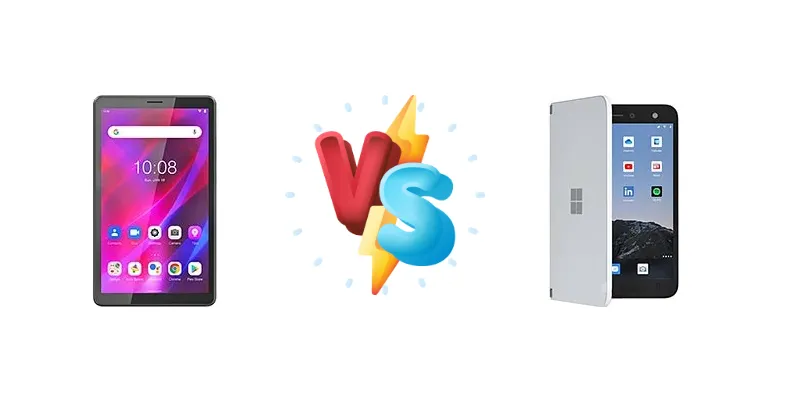
For users prioritizing performance and multitasking, the Microsoft Surface Duo is the clear winner, thanks to its Snapdragon 855 chipset and unique dual-screen capabilities. However, the Lenovo Tab M7 (3rd Gen) provides exceptional value for casual users seeking a compact and inexpensive tablet for media consumption and basic tasks.
| PHONES | ||
|---|---|---|
| Phone Names | Lenovo Tab M7 (3rd Gen) | Microsoft Surface Duo |
| Network | ||
|---|---|---|
| 2G bands | GSM 850 / 900 / 1800 / 1900 | GSM 850 / 900 / 1800 / 1900 |
| 3G bands | HSDPA 850 / 900 / 1900 / 2100 | HSDPA 850 / 900 / 1900 / 2100 |
| 4G bands | 1, 2, 3, 4, 5, 7, 8, 19, 20, 28, 38, 40, 41 | 1, 2, 3, 4, 5, 7, 8, 12, 13, 14, 19 20, 25, 26, 28, 29, 30, 38, 39, 40, 41, 46, 66 |
| Speed | HSPA, LTE - cellular model only | HSPA 42.2/5.76 Mbps, LTE Cat18 1200/150 Mbps |
| Technology | GSM / HSPA / LTE | GSM / HSPA / LTE |
| Launch | ||
|---|---|---|
| Announced | 2021, June 28 | 2020, August 12. Released 2020, September 10 |
| Status | Available. Released 2021, June 31 | Discontinued |
| Body | ||
|---|---|---|
| Build | Glass front, aluminum back, aluminum frame | Glass front (Gorilla Glass 5), glass back (Gorilla Glass 5) |
| Dimensions | 176.2 x 102.3 x 8.3 mm (6.94 x 4.03 x 0.33 in) | Unfolded: 186.9 x 145.2 x 4.8 mm Folded: 145.2 x 93.3 x 9.9 mm |
| SIM | Nano-SIM (cellular model only) | Nano-SIM + eSIM |
| Weight | 237 g (8.36 oz) | 250 g (8.82 oz) |
| - | Stylus support | |
| Display | ||
|---|---|---|
| Protection | - | Corning Gorilla Glass 5 |
| Resolution | 600 x 1024 pixels, 16:9 ratio (~170 ppi density) | 1800 x 2700 pixels, 3:2 ratio (~401 ppi density) |
| Size | 7.0 inches, 137.9 cm2 (~76.5% screen-to-body ratio) | 8.1 inches, 195.4 cm2 (~144.2% screen-to-body ratio) |
| Type | TDDI IPS LCD, 350 nits (typ) | AMOLED |
| - | Folded position display: 5.6 inches, AMOLED, 1350 x 1800 pixels (4:3) | |
| Platform | ||
|---|---|---|
| CPU | Octa-core 2.0 GHz | Octa-core (1x2.84 GHz Kryo 485 & 3x2.42 GHz Kryo 485 & 4x1.78 GHz Kryo 485) |
| Chipset | Mediatek MT8166 - Wi-Fi versionMediatek MT8766 - LTE version | Qualcomm SM8150 Snapdragon 855 (7 nm) |
| GPU | - | Adreno 640 |
| OS | Android 11 (Go edition) | Android 10, upgradable to Android 12 |
| Memory | ||
|---|---|---|
| Card slot | microSDHC (dedicated slot) | No |
| Internal | 32GB 2GB RAM | 128GB 6GB RAM, 256GB 6GB RAM |
| eMMC 5.1 | UFS 3.0 | |
| Main Camera | ||
|---|---|---|
| Features | - | HDR, panorama |
| Single | 2 MP | 11 MP, f/2.0, 23mm (wide), 1.0µm, PDAF |
| Video | 720p | 4K@30/60fps, 1080p@30/60/120/240fps, gyro-EIS, HDR |
| Selfie camera | ||
|---|---|---|
| Features | - | HDR, panorama |
| Single | 2 MP | Uses main camera |
| Video | 720p | 4K@30/60fps, 1080p@30/60fps, gyro-EIS, HDR |
| Sound | ||
|---|---|---|
| 3.5mm jack | Yes | No |
| 35mm jack | Yes | No |
| Loudspeaker | Yes | Yes |
| Comms | ||
|---|---|---|
| Bluetooth | 5.0, A2DP, LE | 5.0, A2DP, LE, aptX Adaptive |
| NFC | No | No |
| Positioning | GPS - cellular model only | GPS |
| Radio | FM radio | No |
| USB | microUSB 2.0, OTG | USB Type-C 3.1 |
| WLAN | Wi-Fi 802.11 a/b/g/n/ac, dual-band, Wi-Fi Direct | Wi-Fi 802.11 a/b/g/n/ac, dual-band, Wi-Fi Direct |
| Features | ||
|---|---|---|
| Sensors | Accelerometer | Fingerprint (side-mounted), dual accelerometer, dual gyro, proximity, dual compass |
| Battery | ||
|---|---|---|
| Charging | - | 18W wired |
| Type | Li-Po 3750 mAh | Li-Po 3577 mAh |
| Misc | ||
|---|---|---|
| Colors | Iron Grey | White |
| Models | ZA8C0027US, TB-7306X | - |
| Price | About 120 EUR | About 650 EUR |
Lenovo Tab M7 (3rd Gen)
- Extremely affordable price point
- Compact and portable design
- Suitable for basic tasks like reading and video streaming
- Limited performance with the Mediatek MT8166/MT8766 chipset
- Lower-quality display compared to the Surface Duo
- Basic camera capabilities
Microsoft Surface Duo
- Powerful Snapdragon 855 processor
- Innovative dual-screen design for enhanced multitasking
- High-quality OLED displays with excellent color accuracy
- Significantly higher price than the Lenovo Tab M7
- Smaller battery capacity compared to the Tab M7
- Unique form factor may not appeal to all users
Display Comparison
The Lenovo Tab M7 (3rd Gen) likely features a standard IPS LCD panel, typical for its price point, with a resolution around 1024x600. In contrast, the Surface Duo boasts two 5.6-inch OLED displays, offering superior contrast and color accuracy. While the Tab M7 prioritizes affordability, the Duo’s OLED panels deliver a significantly more vibrant and immersive viewing experience. The Duo’s dual-screen setup also provides a larger effective display area when unfolded, enhancing multitasking capabilities. Bezels on the Tab M7 will be noticeably larger, impacting the screen-to-body ratio compared to the Duo’s more modern design.
Camera Comparison
Camera performance is not a primary focus for either device, but the Surface Duo holds a clear advantage. While the Tab M7’s camera specifications are unknown, it likely features a basic sensor for casual snapshots. The Surface Duo includes a dual-camera setup with a 12MP main sensor and a wide-angle lens, offering better image quality and versatility. The Snapdragon 855’s image signal processor (ISP) also contributes to improved image processing, resulting in sharper, more detailed photos. Expect the Surface Duo to perform significantly better in low-light conditions.
Performance
The core difference lies in the chipsets. The Lenovo Tab M7 utilizes either the Mediatek MT8166 (Wi-Fi) or MT8766 (LTE), both featuring an octa-core 2.0 GHz CPU. This is adequate for basic tasks but will struggle with demanding applications. The Microsoft Surface Duo, however, is powered by the Qualcomm Snapdragon 855 (7nm), a flagship-level processor from 2019. This translates to significantly faster app loading times, smoother multitasking, and the ability to handle graphically intensive games. The 7nm fabrication process of the Snapdragon 855 also contributes to better thermal efficiency, reducing the likelihood of throttling during sustained workloads. The Surface Duo’s superior processing power makes it a far more capable device for productivity tasks like document editing and video conferencing.
Battery Life
The Lenovo Tab M7 (3rd Gen) likely has a battery capacity around 3500-4000 mAh, sufficient for several hours of video playback. The Surface Duo, with its dual displays and more powerful processor, has a smaller battery at 3570 mAh. However, the Snapdragon 855’s power efficiency and the Duo’s 18W wired charging capability help mitigate the impact of the smaller battery. While the Tab M7 may offer slightly longer battery life during basic usage, the Surface Duo’s faster charging allows for quicker top-ups, making it more convenient for users on the go.
Buying Guide
Buy the Lenovo Tab M7 (3rd Gen) if you need a highly portable, budget-friendly tablet for reading ebooks, streaming videos, and light web browsing. It’s ideal for families or individuals who want a secondary device without breaking the bank. Buy the Microsoft Surface Duo if you prioritize multitasking, mobile productivity, and a premium experience. Its dual screens and powerful processor make it a compelling alternative to traditional smartphones and tablets for power users.