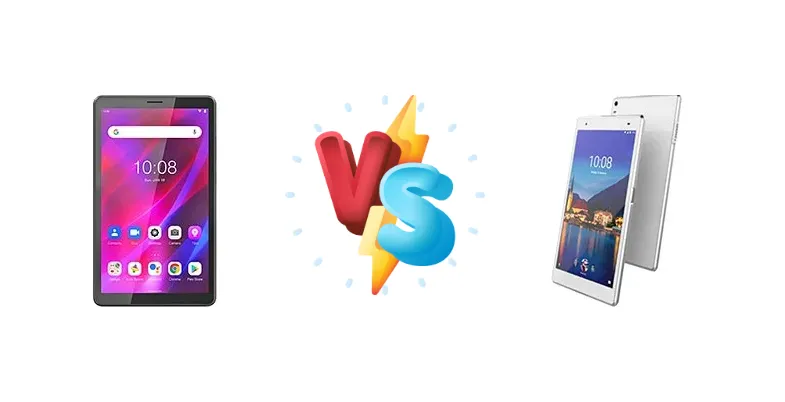
The Lenovo Tab M7 (3rd Gen) and Tab 4 8 represent Lenovo’s attempts to capture the ultra-budget tablet market. While both aim for affordability, they differ significantly in their internal hardware. The Tab M7 (3rd Gen) boasts a newer octa-core processor, while the Tab 4 8 relies on a quad-core Snapdragon. This comparison dissects these differences to determine which tablet delivers the best experience for the price.
🏆 Quick Verdict
For most users, the Lenovo Tab M7 (3rd Gen) is the better choice. Its Mediatek MT8166 (or MT8766 in LTE models) provides a substantial performance uplift over the Tab 4 8’s Snapdragon 425, making it more responsive for everyday tasks and light gaming. While the Tab 4 8 may offer slightly better software support due to its age, the M7’s processing power is a more impactful upgrade.
| Network |
|---|
| 2G bands | GSM 850 / 900 / 1800 / 1900 | GSM 850 / 900 / 1800 / 1900 - SIM 1 & SIM 2 |
| 3G bands | HSDPA 850 / 900 / 1900 / 2100 | HSDPA 850 / 900 / 1900 / 2100 |
| 4G bands | 1, 2, 3, 4, 5, 7, 8, 19, 20, 28, 38, 40, 41 | 1, 3, 5, 7, 8, 20, 38, 40 - Global |
| Speed | HSPA, LTE - cellular model only | HSPA 42.2/5.76 Mbps, LTE Cat4 150/50 Mbps |
| Technology | GSM / HSPA / LTE | GSM / CDMA / HSPA / LTE |
| Launch |
|---|
| Announced | 2021, June 28 | 2017, February 27. Released 2017, September 15 |
| Status | Available. Released 2021, June 31 | Discontinued |
| Body |
|---|
| Build | Glass front, aluminum back, aluminum frame | - |
| Dimensions | 176.2 x 102.3 x 8.3 mm (6.94 x 4.03 x 0.33 in) | 211 x 124 x 8.2 mm (8.31 x 4.88 x 0.32 in) |
| SIM | Nano-SIM (cellular model only) | Nano-SIM + Nano-SIM |
| Weight | 237 g (8.36 oz) | 310 g (10.93 oz) |
| Display |
|---|
| Resolution | 600 x 1024 pixels, 16:9 ratio (~170 ppi density) | 800 x 1280 pixels, 16:10 ratio (~189 ppi density) |
| Size | 7.0 inches, 137.9 cm2 (~76.5% screen-to-body ratio) | 8.0 inches, 185.6 cm2 (~70.9% screen-to-body ratio) |
| Type | TDDI IPS LCD, 350 nits (typ) | IPS LCD |
| Platform |
|---|
| CPU | Octa-core 2.0 GHz | Quad-core 1.4 GHz Cortex-A53 |
| Chipset | Mediatek MT8166 - Wi-Fi versionMediatek MT8766 - LTE version | Qualcomm MSM8917 Snapdragon 425 (28 nm) (Wi-Fi/LTE model)Qualcomm APQ8017 (Wi-Fi only model) |
| GPU | - | Adreno 306 |
| OS | Android 11 (Go edition) | Android 7.0 (Nougat) |
| Memory |
|---|
| Card slot | microSDHC (dedicated slot) | microSDXC (uses shared SIM slot) |
| Internal | 32GB 2GB RAM | 16GB 2GB RAM, 32GB 2GB RAM |
| | eMMC 5.1 | - |
| Main Camera |
|---|
| Single | 2 MP | 5 MP, AF |
| Video | 720p | 1080p@30fps |
| Selfie camera |
|---|
| Single | 2 MP | 2 MP |
| Video | 720p | - |
| Sound |
|---|
| 3.5mm jack | Yes | Yes |
| 35mm jack | Yes | Yes |
| Loudspeaker | Yes | Yes, dual speakers |
| Comms |
|---|
| Bluetooth | 5.0, A2DP, LE | 4.0, A2DP, LE |
| NFC | No | No |
| Positioning | GPS - cellular model only | GPS, GLONASS, BDS |
| Radio | FM radio | FM radio |
| USB | microUSB 2.0, OTG | microUSB 2.0 |
| WLAN | Wi-Fi 802.11 a/b/g/n/ac, dual-band, Wi-Fi Direct | Wi-Fi 802.11 b/g/n |
| Features |
|---|
| Sensors | Accelerometer | Accelerometer, proximity (LTE model only) |
| Battery |
|---|
| Type | Li-Po 3750 mAh | Li-Po 4850 mAh, non-removable |
| Misc |
|---|
| Colors | Iron Grey | Black, White |
| Models | ZA8C0027US, TB-7306X | TB-8504X, TB-8504F |
| Price | About 120 EUR | About 170 EUR |
Lenovo Tab M7 (3rd Gen)
- Significantly faster processor for smoother performance
- Octa-core CPU enables better multitasking
- More responsive user experience
- Limited information on display quality
- Camera performance likely subpar
Lenovo Tab 4 8
- Potentially better software support due to age
- Snapdragon 425 offers good power efficiency
- May be available at a lower price point
- Quad-core processor struggles with demanding tasks
- Slower overall performance compared to Tab M7 (3rd Gen)
Display Comparison
Both tablets feature 7-8 inch displays, but detailed display specs like resolution and panel type are not provided. However, given their price points, it's safe to assume both utilize IPS LCD panels. The Tab 4 8’s slightly larger screen size may offer a marginally more immersive viewing experience. The absence of information regarding brightness levels or color accuracy suggests neither tablet excels in this area, making them suitable for indoor use but potentially challenging in direct sunlight.
Camera Comparison
Camera performance is unlikely to be a deciding factor for either tablet. Details regarding camera sensors are scarce, but budget tablets typically feature low-resolution sensors. Focusing on the core specs, neither device is likely to produce high-quality images. The absence of features like Optical Image Stabilization (OIS) further limits their photographic capabilities. These cameras are best suited for basic video calls and quick snapshots.
Performance
The core difference lies in the chipsets. The Tab M7 (3rd Gen) utilizes either the Mediatek MT8166 (Wi-Fi) or MT8766 (LTE), featuring an octa-core CPU clocked at 2.0 GHz. This is a significant leap over the Tab 4 8’s Qualcomm Snapdragon 425, a quad-core 1.4 GHz Cortex-A53 processor. The octa-core configuration of the M7 allows for better multitasking and smoother performance in demanding applications. The Snapdragon 425, while efficient, struggles with heavier workloads. The Tab M7’s processor, while not a powerhouse, offers a noticeably more fluid user experience.
Battery Life
Battery capacity details are not provided for either device. However, given their similar size and target market, battery life is likely comparable. The Snapdragon 425 in the Tab 4 8 is known for its power efficiency, potentially offsetting the M7’s more powerful processor. Charging wattage is also unknown, meaning neither tablet is expected to offer particularly fast charging speeds. Real-world battery life will depend heavily on usage patterns, but both should provide a full day of light to moderate use.
Buying Guide
Buy the Lenovo Tab M7 (3rd Gen) if you need a tablet for general use, streaming video, and light multitasking, and prioritize responsiveness. Its newer processor handles these tasks with greater ease. Buy the Lenovo Tab 4 8 if you already have a vested interest in the older Qualcomm ecosystem, or if you find a significantly discounted unit and absolute performance isn't a concern. It's a functional, but slower, alternative.
Frequently Asked Questions
❓ Will the Mediatek MT8166 in the Tab M7 (3rd Gen) handle popular games like PUBG Mobile?
While the MT8166 isn't a gaming powerhouse, it can run PUBG Mobile at lower settings. Expect frame rate drops during intense action, but it's playable for casual gaming. The Tab 4 8’s Snapdragon 425 will struggle significantly with this title.
❓ Is the Tab 4 8 still receiving software updates?
Software update support for the Tab 4 8 is likely limited at this point, given its age. While it may have received updates in the past, it's unlikely to receive major Android version upgrades. The Tab M7 (3rd Gen) will have a longer support lifespan.
❓ Which tablet is better for video streaming?
The Tab M7 (3rd Gen) is better suited for video streaming due to its faster processor, which will result in smoother playback and less buffering, especially with higher resolution content. The Tab 4 8 may experience occasional lag or stuttering.