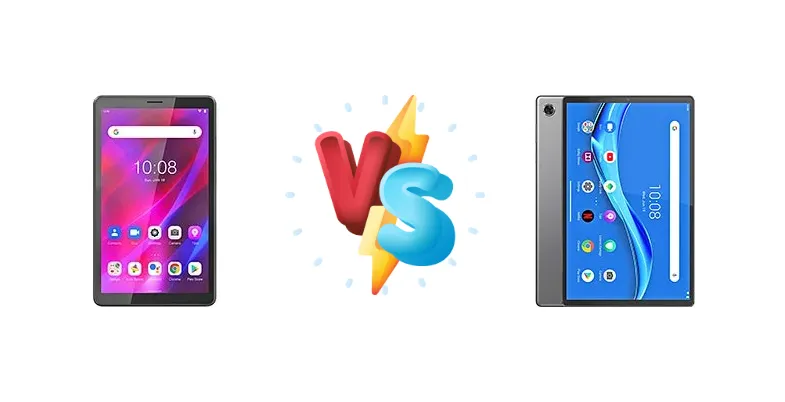
Lenovo's Tab M series offers affordable Android tablets, but choosing between the M7 (3rd Gen) and the M10 Plus requires careful consideration. The M7 prioritizes extreme portability and low cost, while the M10 Plus aims for a more balanced experience with a larger screen and a more capable processor. This comparison dives deep into the specifications to determine which tablet delivers the best value.
🏆 Quick Verdict
For most users, the Lenovo M10 Plus is the better choice. Its Mediatek Helio P22T chipset provides a noticeable performance boost over the M7's MT8166/MT8766, making it more suitable for multitasking, streaming, and light gaming. While the M7 is more portable, the M10 Plus's improved processing power justifies the slight price increase.
| Network |
|---|
| 2G bands | GSM 850 / 900 / 1800 / 1900 | N/A |
| 3G bands | HSDPA 850 / 900 / 1900 / 2100 | N/A |
| 4G bands | 1, 2, 3, 4, 5, 7, 8, 19, 20, 28, 38, 40, 41 | LTE |
| EDGE | - | No |
| GPRS | - | No |
| Speed | HSPA, LTE - cellular model only | HSPA 21.1/5.76 Mbps, LTE Cat4 150/50 Mbps - cellular model only |
| Technology | GSM / HSPA / LTE | LTE |
| Launch |
|---|
| Announced | 2021, June 28 | 2020, March 27. Released 2020, March 27 |
| Status | Available. Released 2021, June 31 | Discontinued |
| Body |
|---|
| Build | Glass front, aluminum back, aluminum frame | - |
| Dimensions | 176.2 x 102.3 x 8.3 mm (6.94 x 4.03 x 0.33 in) | 244.2 x 153.3 x 8.2 mm (9.61 x 6.04 x 0.32 in) |
| SIM | Nano-SIM (cellular model only) | Nano-SIM (cellular model only) |
| Weight | 237 g (8.36 oz) | 460 g (1.01 lb) |
| Display |
|---|
| Resolution | 600 x 1024 pixels, 16:9 ratio (~170 ppi density) | 1200 x 1920 pixels, 16:10 ratio (~220 ppi density) |
| Size | 7.0 inches, 137.9 cm2 (~76.5% screen-to-body ratio) | 10.3 inches, 307.6 cm2 (~82.2% screen-to-body ratio) |
| Type | TDDI IPS LCD, 350 nits (typ) | IPS LCD, 330 nits (typ) |
| Platform |
|---|
| CPU | Octa-core 2.0 GHz | Octa-core (4x2.3 GHz Cortex-A53 & 4x1.8 GHz Cortex-A53) |
| Chipset | Mediatek MT8166 - Wi-Fi versionMediatek MT8766 - LTE version | Mediatek MT6762 Helio P22T (12 nm) |
| GPU | - | PowerVR GE8320 |
| OS | Android 11 (Go edition) | Android 9.0 (Pie) |
| Memory |
|---|
| Card slot | microSDHC (dedicated slot) | microSDXC (dedicated slot) |
| Internal | 32GB 2GB RAM | 32GB 2GB RAM, 64GB 4GB RAM, 128GB 4GB RAM |
| | eMMC 5.1 | eMMC 5.1 |
| Main Camera |
|---|
| Single | 2 MP | 8 MP, AF |
| Video | 720p | 1080p@30fps |
| Selfie camera |
|---|
| Single | 2 MP | 5 MP |
| Video | 720p | - |
| Sound |
|---|
| 3.5mm jack | Yes | Yes |
| 35mm jack | Yes | Yes |
| Loudspeaker | Yes | Yes, with stereo speakers |
| Comms |
|---|
| Bluetooth | 5.0, A2DP, LE | 5.0, LE |
| NFC | No | No |
| Positioning | GPS - cellular model only | GPS - cellular model only |
| Radio | FM radio | No |
| USB | microUSB 2.0, OTG | USB Type-C 2.0 |
| WLAN | Wi-Fi 802.11 a/b/g/n/ac, dual-band, Wi-Fi Direct | Wi-Fi 802.11 a/b/g/n/ac, dual-band, Wi-Fi Direct |
| Features |
|---|
| Sensors | Accelerometer | Accelerometer |
| Battery |
|---|
| Charging | - | 10W wired |
| Type | Li-Po 3750 mAh | Li-Po 5000 mAh |
| Misc |
|---|
| Colors | Iron Grey | Iron Grey |
| Models | ZA8C0027US, TB-7306X | TB-X606, TB-X606F, TB-X606X, TB-X606V |
| Price | About 120 EUR | About 200 EUR |
Lenovo Tab M7 (3rd Gen)
- Ultra-portable 7-inch display
- Lower price point
- Suitable for basic tasks
- Less powerful processor
- Smaller screen size
- Limited multitasking capabilities
Lenovo M10 Plus
- Larger 10.1-inch display
- More powerful Mediatek Helio P22T chipset
- 10W wired charging
- Better for media consumption and multitasking
- Slightly higher price
- Less portable than the M7
- Still a budget device with limitations
Display Comparison
The Lenovo Tab M7 (3rd Gen) features a 7-inch display, making it exceptionally portable. The M10 Plus boasts a larger 10.1-inch screen, significantly enhancing the viewing experience for videos and web browsing. While neither Lenovo specifies panel type or brightness, the larger surface area of the M10 Plus generally translates to a more immersive visual experience. Bezels are expected to be larger on the M7 due to its smaller form factor. Color accuracy is likely similar on both, given their budget positioning, but the M10 Plus's increased size is a clear advantage.
Camera Comparison
Camera performance is unlikely to be a deciding factor for either tablet. Both are positioned as budget devices, and camera quality is typically sacrificed. Details on camera sensors are scarce, but it's safe to assume both feature basic sensors suitable for casual snapshots. Focusing on the chipset's image signal processor (ISP) capabilities, the Helio P22T in the M10 Plus likely offers slightly better image processing than the MT8166/MT8766 in the M7, but the difference will be minimal. Expect similar limitations in low-light conditions.
Performance
The core difference lies in the chipsets. The Tab M7 utilizes either the Mediatek MT8166 (Wi-Fi) or MT8766 (LTE), both featuring an octa-core 2.0 GHz CPU. The M10 Plus, however, is powered by the Mediatek MT6762 Helio P22T, a 12nm process chip with an octa-core CPU clocked up to 2.3 GHz. This represents a significant architectural advantage; the P22T's Cortex-A53 cores are more efficient and offer higher peak performance than the cores found in the MT8166/MT8766. The 12nm manufacturing process further contributes to better power efficiency. This translates to snappier app launches, smoother multitasking, and a more responsive user experience on the M10 Plus. While both tablets likely feature similar RAM configurations, the superior chipset in the M10 Plus will be the bottleneck for performance.
Battery Life
Battery capacity details are not provided. However, the M10 Plus benefits from 10W wired charging, a feature not explicitly mentioned for the M7. Given the larger display and more powerful processor of the M10 Plus, the 10W charging is crucial for maintaining usability throughout the day. While the M7 may offer comparable battery life for lighter tasks, the M10 Plus's charging capability ensures quicker top-ups, especially important for users who rely on the tablet for extended periods.
Buying Guide
Buy the Lenovo Tab M7 (3rd Gen) if you need an ultra-portable tablet primarily for basic tasks like reading ebooks, browsing the web, and light social media use, and your budget is extremely limited. Buy the Lenovo M10 Plus if you prefer a larger display for media consumption, require smoother performance for multitasking and streaming, and are willing to spend a bit more for a more versatile tablet experience.
Frequently Asked Questions
❓ Will the Lenovo Tab M7 (3rd Gen) struggle with video streaming services like Netflix or YouTube?
The Tab M7's Mediatek MT8166/MT8766 chipset can handle standard definition (SD) video streaming, but may experience buffering or lag with high-definition (HD) content, especially on the Wi-Fi version. The M10 Plus, with its Helio P22T, is better equipped for smooth HD streaming.
❓ Is the Lenovo M10 Plus suitable for playing demanding mobile games?
The M10 Plus can handle less demanding mobile games, but it's not a gaming powerhouse. The Helio P22T is an entry-level gaming chip. Expect to play games at lower settings to maintain a playable frame rate. The M7 is even less suited for gaming due to its weaker processor.
❓ Does the Lenovo M10 Plus support external storage via microSD card?
While Lenovo doesn't explicitly state microSD support in the provided specs, the M10 Plus series generally includes a microSD card slot for expandable storage, allowing users to increase the tablet's capacity. The M7 also likely supports microSD, but it's best to confirm with the specific model.