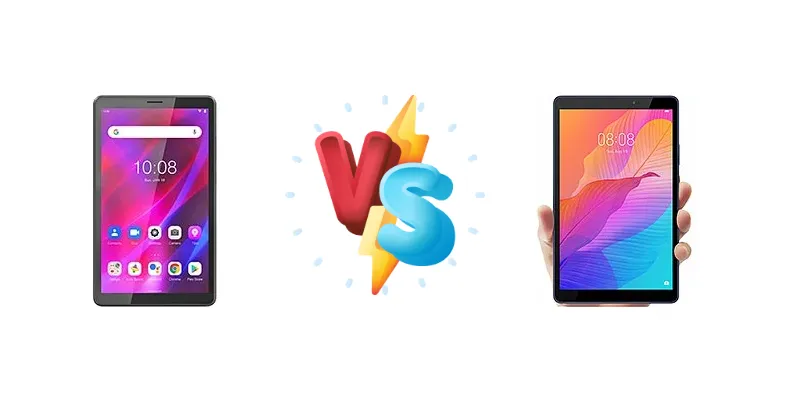
The Lenovo Tab M7 (3rd Gen) and Huawei MatePad T8 represent the entry-level of the Android tablet market. Both aim to provide basic functionality at an extremely affordable price point, but they differ significantly in their underlying hardware. This comparison dives deep into the chipset architectures and performance implications to help you determine which tablet best suits your needs.
🏆 Quick Verdict
For most users prioritizing basic tasks like web browsing, video streaming, and light reading, the Huawei MatePad T8 offers a slight edge due to its more modern Mediatek MT8768 chipset. While the Lenovo Tab M7 (3rd Gen) is still capable, the MT8768’s heterogeneous core design provides a smoother experience in multi-tasking scenarios.
| Network |
|---|
| 2G bands | GSM 850 / 900 / 1800 / 1900 | GSM 850 / 900 / 1800 / 1900 |
| 3G bands | HSDPA 850 / 900 / 1900 / 2100 | HSDPA 850 / 900 / 1700(AWS) / 1900 / 2100 - Kobe2-L03 |
| 4G bands | 1, 2, 3, 4, 5, 7, 8, 19, 20, 28, 38, 40, 41 | 1, 3, 5, 7, 8, 18, 19, 20, 26, 28, 38, 40, 41 - Kobe2-L09 |
| Speed | HSPA, LTE - cellular model only | HSPA, LTE - cellular model only |
| Technology | GSM / HSPA / LTE | GSM / HSPA / LTE |
| | - | 1, 2, 3, 4, 5, 7, 8, 12, 17, 28, 40, 66 - Kobe2-L03 |
| Launch |
|---|
| Announced | 2021, June 28 | 2020, May 07. Released 2020, May 19 |
| Status | Available. Released 2021, June 31 | Discontinued |
| Body |
|---|
| Build | Glass front, aluminum back, aluminum frame | - |
| Dimensions | 176.2 x 102.3 x 8.3 mm (6.94 x 4.03 x 0.33 in) | 199.7 x 121.1 x 8.6 mm (7.86 x 4.77 x 0.34 in) |
| SIM | Nano-SIM (cellular model only) | Nano-SIM (cellular model only) |
| Weight | 237 g (8.36 oz) | 310 g (10.93 oz) |
| Display |
|---|
| Resolution | 600 x 1024 pixels, 16:9 ratio (~170 ppi density) | 800 x 1280 pixels, 16:10 ratio (~189 ppi density) |
| Size | 7.0 inches, 137.9 cm2 (~76.5% screen-to-body ratio) | 8.0 inches, 185.6 cm2 (~76.7% screen-to-body ratio) |
| Type | TDDI IPS LCD, 350 nits (typ) | IPS LCD |
| Platform |
|---|
| CPU | Octa-core 2.0 GHz | Octa-core (4x2.0 GHz Cortex-A53 & 4x1.50 GHz Cortex A53) |
| Chipset | Mediatek MT8166 - Wi-Fi versionMediatek MT8766 - LTE version | Mediatek MT8768 |
| GPU | - | PowerVR GE8320 |
| OS | Android 11 (Go edition) | Android 10, EMUI 10, no Google Play Services |
| Memory |
|---|
| Card slot | microSDHC (dedicated slot) | microSDXC |
| Internal | 32GB 2GB RAM | 16GB 2GB RAM, 32GB 2GB RAM, 32GB 3GB RAM |
| | eMMC 5.1 | eMMC 5.1 |
| Main Camera |
|---|
| Single | 2 MP | 5 MP, f/2.2 |
| Video | 720p | 1080p@30fps |
| Selfie camera |
|---|
| Single | 2 MP | 2 MP, f/2.4 |
| Video | 720p | - |
| Sound |
|---|
| 3.5mm jack | Yes | Yes |
| 35mm jack | Yes | Yes |
| Loudspeaker | Yes | Yes |
| Comms |
|---|
| Bluetooth | 5.0, A2DP, LE | 5.0, A2DP, LE |
| NFC | No | No |
| Positioning | GPS - cellular model only | GPS, GLONASS, BDS - cellular model only |
| Radio | FM radio | No |
| USB | microUSB 2.0, OTG | microUSB 2.0, OTG |
| WLAN | Wi-Fi 802.11 a/b/g/n/ac, dual-band, Wi-Fi Direct | Wi-Fi 802.11 a/b/g/n/ac, dual-band, Wi-Fi Direct |
| Features |
|---|
| Sensors | Accelerometer | Accelerometer |
| Battery |
|---|
| Type | Li-Po 3750 mAh | Li-Po 5100 mAh |
| Misc |
|---|
| Colors | Iron Grey | Deepsea Blue |
| Models | ZA8C0027US, TB-7306X | Kobe2-L09, Kobe2-L03, KOB2-L09, KOB2-W09 |
| Price | About 120 EUR | About 100 EUR |
Lenovo Tab M7 (3rd Gen)
- Potentially lower price point (depending on retailer)
- Simple and straightforward user experience
- Reliable for basic tasks
- Older chipset (MT8166/MT8766)
- Less efficient CPU architecture
- May struggle with multitasking
Huawei MatePad T8
- More modern chipset (MT8768) with big.LITTLE architecture
- Improved multitasking performance
- Potentially better power efficiency
- May be slightly more expensive
- Still limited by budget components
- Camera quality is likely similar to the Lenovo Tab M7
Display Comparison
Neither tablet boasts a particularly impressive display. Specifics like panel type (IPS vs TFT) and resolution are not provided, but both are likely 1024x600. The focus here is on chipset performance, as display quality is often a secondary concern at this price point. Bezels are expected to be substantial on both devices, maximizing screen real estate within a compact form factor. Color accuracy is likely to be standard for budget tablets, prioritizing power efficiency over color fidelity.
Camera Comparison
Camera performance is unlikely to be a deciding factor for either tablet. Details regarding sensor size and image quality are not available, and both tablets likely feature basic cameras suitable for occasional snapshots. Focusing on camera specs is a misdirection at this price point; these tablets are not designed for photography.
Performance
The core difference lies in the chipsets. The Lenovo Tab M7 (3rd Gen) utilizes either the Mediatek MT8166 (Wi-Fi) or MT8766 (LTE), both featuring an octa-core CPU clocked at 2.0 GHz. However, the Huawei MatePad T8 employs the Mediatek MT8768, which utilizes a big.LITTLE architecture with four Cortex-A53 cores clocked at 2.0 GHz and four Cortex-A53 cores clocked at 1.5 GHz. This heterogeneous design allows the MT8768 to dynamically allocate tasks to the appropriate cores, improving power efficiency and responsiveness. While both are octa-core, the MT8768’s architecture provides a performance advantage in tasks that can benefit from parallel processing. The MT8766/MT8166 are older designs and will show more strain under sustained loads.
Battery Life
Battery capacity details are missing for both devices. However, given their similar screen sizes and chipsets, battery life is expected to be comparable – roughly 6-8 hours of moderate usage. Charging wattage is also unspecified, but both likely support standard 5W charging. The MT8768’s power efficiency, due to its big.LITTLE architecture, *may* translate to slightly longer battery life under certain workloads, but the difference is unlikely to be significant.
Buying Guide
Buy the Lenovo Tab M7 (3rd Gen) if you need a tablet primarily for static content consumption – reading ebooks, displaying photos, or simple web browsing – and are on the absolute tightest budget. Buy the Huawei MatePad T8 if you anticipate more varied usage, including light multitasking, occasional gaming, or require a slightly more responsive user interface. The MatePad T8’s chipset offers a more future-proof experience, even within the budget segment.
Frequently Asked Questions
❓ Will the Huawei MatePad T8 handle multiple apps open simultaneously without significant slowdown?
The MatePad T8’s Mediatek MT8768 chipset, with its big.LITTLE architecture, is better equipped to handle multitasking than the Lenovo Tab M7’s MT8166/MT8766. While it won’t offer flagship-level performance, you should experience a smoother experience when switching between apps.
❓ Is the difference in chipset performance noticeable for everyday tasks like browsing and streaming video?
For basic tasks like web browsing and streaming video, the difference may be subtle. However, the MT8768’s more efficient architecture will result in a slightly more responsive user interface and smoother transitions, especially over time as the tablet’s storage fills up.
❓ Does either tablet support expandable storage via microSD card?
While not explicitly stated in the provided data, both tablets in this price range *typically* include a microSD card slot for expandable storage. This is crucial given the limited internal storage often found on budget tablets.