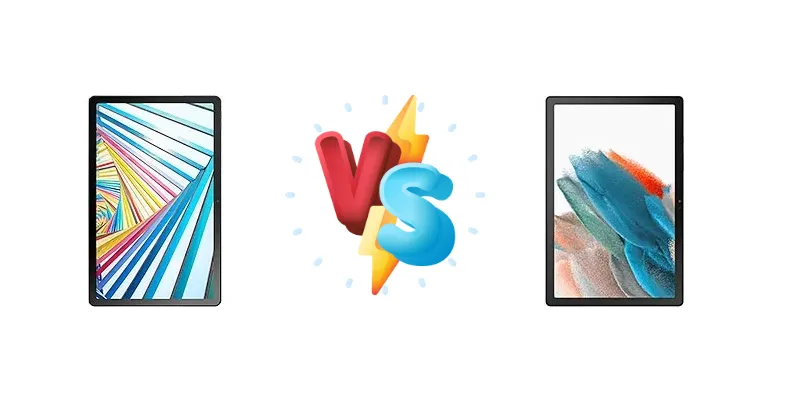
The mid-range tablet market is heating up, and two contenders are vying for your attention: the Lenovo Tab M10 Plus (3rd Gen) and the Samsung Galaxy Tab A8. Both offer compelling features at accessible prices, but which one truly delivers the best experience? Let's dive into a detailed comparison to help you decide.
🏆 Quick Verdict
The Lenovo Tab M10 Plus (3rd Gen) generally edges out the Galaxy Tab A8 thanks to its more powerful chipset (especially the LTE model) and faster charging. However, Samsung's brand recognition and One UI offer a polished software experience that some may prefer. It's a close call, depending on your priorities.
| Network |
|---|
| 2G bands | GSM 850 / 900 / 1800 / 1900 | GSM 850 / 900 / 1800 / 1900 |
| 3G bands | HSDPA 800 / 850 / 900 / 1900 / 2100 | HSDPA 850 / 900 / 1700(AWS) / 1900 / 2100 |
| 4G bands | 1, 2, 3, 4, 5, 7, 8, 19, 20, 26, 28, 28, 38, 40, 41 | 1, 2, 3, 4, 5, 7, 8, 12, 17, 20, 28, 38, 40, 41, 66 |
| Speed | HSPA 42.2/5.76 Mbps, LTE Cat13 390/75 Mbps - cellular model only | HSPA, LTE - cellular model only |
| Technology | GSM / HSPA / LTE | GSM / HSPA / LTE |
| Launch |
|---|
| Announced | 2022, May | 2021, December 15 |
| Status | Available. Released 2022, May | Available. Released 2022, January 17 |
| Body |
|---|
| Dimensions | 251.2 x 158.8 x 7.5 mm (9.89 x 6.25 x 0.30 in) | 246.8 x 161.9 x 6.9 mm (9.72 x 6.37 x 0.27 in) |
| SIM | Nano-SIM (cellular model only) | Nano-SIM (cellular model only) |
| Weight | 465 g (1.03 lb) | 508 g (1.12 lb) |
| | Stylus support | - |
| Display |
|---|
| Resolution | 1200 x 2000 pixels, 5:3 ratio (~220 ppi density) | 1200 x 1920 pixels, 16:10 ratio (~216 ppi density) |
| Size | 10.61 inches, 320.4 cm2 (~80.3% screen-to-body ratio) | 10.5 inches, 319.7 cm2 (~80.0% screen-to-body ratio) |
| Type | IPS LCD, 400 nits (typ) | TFT LCD |
| Platform |
|---|
| CPU | Octa-core (4x2.4 GHz Kryo 265 Gold & 4x1.9 GHz Kryo 265 Silver) - LTE model Octa-core (2x2.0 GHz Cortex-A75 & 6x1.8 GHz Cortex-A55) - Wi-Fi only model | Octa-core (2x2.0 GHz Cortex-A75 & 6x2.0 GHz Cortex-A55) |
| Chipset | Qualcomm SM6225 Snapdragon 680 4G (6 nm) - LTE model Mediatek MT6769V/CU Helio G80 (12 nm) - Wi-Fi only model | Unisoc Tiger T618 (12 nm) |
| GPU | Adreno 610 - LTE model Mali-G52 MC2 - Wi-Fi only model | Mali G52 MP2 |
| OS | Android 12 | Android 11, upgradable to Android 14, One UI 6 |
| Memory |
|---|
| Card slot | microSDXC (dedicated slot) | microSDXC (dedicated slot) |
| Internal | 32GB 3GB RAM, 64GB 4GB RAM, 128GB 4GB RAM, 128GB 6GB RAM | 32GB 2GB RAM, 32GB 3GB RAM, 64GB 2GB RAM, 64GB 3GB RAM, 64GB 4GB RAM, 128GB 3GB RAM, 128GB 4GB RAM |
| | eMCP/uMCP | - |
| Main Camera |
|---|
| Single | 8 MP, AF | 8 MP, AF |
| Video | 1080p | 1080p@30fps |
| Selfie camera |
|---|
| Single | 8 MP | 5 MP |
| Video | - | 1080p@30fps |
| Sound |
|---|
| 3.5mm jack | Yes | Yes |
| 35mm jack | Yes | Yes |
| Loudspeaker | Yes, with stereo speakers (4 speakers) | Yes, with stereo speakers (4 speakers) |
| Comms |
|---|
| Bluetooth | 5.0, A2DP, LE | 5.0, A2DP, LE |
| NFC | No | No |
| Positioning | GPS, GLONASS, BDS - cellular model only | GPS, GLONASS, BDS, GALILEO, QZSS - cellular model only |
| Radio | FM Radio | No |
| USB | USB Type-C 2.0 | USB Type-C 2.0 |
| WLAN | Wi-Fi 802.11 a/b/g/n/ac, dual-band, Wi-Fi Direct | Wi-Fi 802.11 a/b/g/n/ac, dual-band, Wi-Fi Direct |
| Features |
|---|
| Sensors | Accelerometer, proximity, gyro | Accelerometer, gyro, proximity, compass |
| Battery |
|---|
| Charging | 20W wired | 15W wired |
| Type | Li-Po 7700 mAh | Li-Po 7040 mAh |
| Misc |
|---|
| Colors | Storm Grey, Frost Blue | Gray, Silver, Pink Gold |
| Models | - | SM-X200, SM-X205 |
| Price | About 260 EUR | About 230 EUR |
| SAR EU | - | 0.92 W/kg (body) |
Lenovo Tab M10 Plus (3rd Gen)
- More powerful chipset (LTE model)
- Faster 20W charging
- LTE connectivity option
- Sleek design
- Camera quality could be better
- Wi-Fi only model performance is less impressive
- Software updates may be less frequent than Samsung
Samsung Galaxy Tab A8 10.5 (2021)
- Larger, slightly sharper display
- Reliable Samsung brand and One UI
- Clean software experience
- Good value for money
- Less powerful chipset
- Slower 15W charging
- Camera performance is average
Display Comparison
Both tablets feature a 10.5-inch display, but the Tab A8 boasts a slightly higher resolution (2000 x 1200 vs 1920 x 1200). While the difference is subtle, the Tab A8's display tends to be a bit sharper. Both offer decent viewing angles and color accuracy for the price range.
Camera Comparison
Neither tablet excels in the camera department. The Tab A8 generally produces slightly better images in well-lit conditions, but both struggle in low light. Don't expect to use these tablets for serious photography.
Performance
Here's where the Lenovo Tab M10 Plus (3rd Gen) pulls ahead, particularly the LTE model with the Snapdragon 680. The Snapdragon 680 offers significantly better CPU and GPU performance compared to the Unisoc Tiger T618 in the Tab A8. Expect smoother multitasking and better gaming performance on the Lenovo. The Wi-Fi only model of the Lenovo is less impressive.
Battery Life
The Tab A8 has a slightly larger battery capacity (5100 mAh vs 4600 mAh in the Lenovo). However, the Lenovo's 20W charging offers a faster charging experience compared to the Tab A8's 15W charging. Real-world battery life is comparable, offering around 8-10 hours of moderate use.
Buying Guide
The Lenovo Tab M10 Plus (3rd Gen) is ideal for users prioritizing performance and connectivity (LTE model). It's great for light gaming, streaming, and everyday tasks. The Samsung Galaxy Tab A8 is a solid choice for those who value a reliable brand, a clean software experience, and a slightly larger screen for media consumption, even if it means sacrificing some processing power.
Frequently Asked Questions
❓ Which tablet is better for gaming?
The Lenovo Tab M10 Plus (3rd Gen), especially the LTE model with the Snapdragon 680, offers significantly better gaming performance due to its more powerful chipset.
❓ Does the Samsung Galaxy Tab A8 get frequent software updates?
Samsung is generally known for providing more consistent and timely software updates compared to Lenovo, ensuring a smoother and more secure user experience.