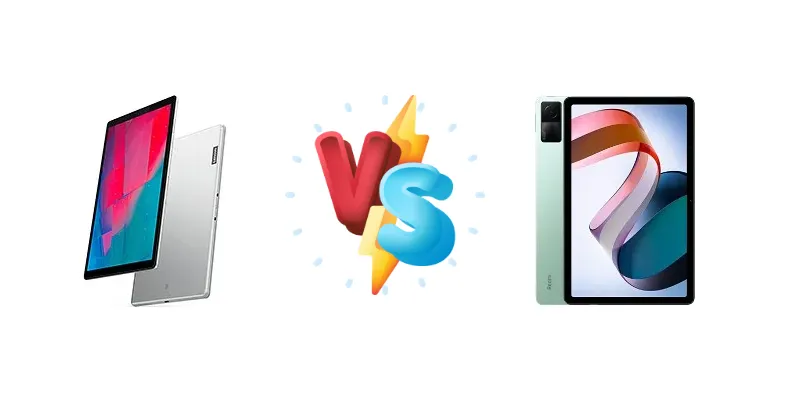
The budget tablet market is heating up, with the Xiaomi Redmi Pad and Lenovo Tab M10 HD Gen 2 offering compelling options for users seeking affordable entertainment and productivity. While both aim for accessibility, they diverge significantly in core components, particularly the chipset and display technology. This comparison dives deep into these differences to determine which tablet delivers the best value.
🏆 Quick Verdict
For most users, the Xiaomi Redmi Pad emerges as the superior choice. Its Helio G99 chipset provides a substantial performance uplift over the Lenovo Tab M10 HD Gen 2’s Helio P22T, making it better suited for multitasking and gaming. The Redmi Pad’s brighter display further enhances the user experience, justifying its slightly higher price.
| Network |
|---|
| 2G bands | GSM 850 / 900 / 1800 / 1900 | N/A |
| 3G bands | HSDPA 800 / 850 / 900 / 1900 / 2100 | N/A |
| 4G bands | 1, 2, 3, 4, 5, 7, 8, 19, 20, 28, 38, 40 | N/A |
| EDGE | - | N/A |
| GPRS | - | N/A |
| Speed | HSPA, LTE - cellular model only | - |
| Technology | GSM / HSPA / LTE | No cellular connectivity |
| Launch |
|---|
| Announced | 2020, August 31. Released 2020, November | 2022, October 04 |
| Status | Discontinued | Available. Released 2022, October 05 |
| Body |
|---|
| Build | - | Glass front, aluminum frame |
| Dimensions | 241.5 x 149.4 x 8.3 mm (9.51 x 5.88 x 0.33 in) | 250.5 x 158.1 x 7.1 mm (9.86 x 6.22 x 0.28 in) |
| SIM | Nano-SIM (cellular model only) | No |
| Weight | 420 g (14.82 oz) | 465 g (1.03 lb) |
| Display |
|---|
| Resolution | 800 x 1280 pixels, 16:10 ratio (~149 ppi density) | 1200 x 2000 pixels, 5:3 ratio (~220 ppi density) |
| Size | 10.1 inches, 295.8 cm2 (~82.0% screen-to-body ratio) | 10.61 inches, 320.4 cm2 (~80.9% screen-to-body ratio) |
| Type | IPS LCD, 400 nits (typ) | IPS LCD, 1B colors, 90Hz, 400 nits (typ) |
| Platform |
|---|
| CPU | Octa-core (4x2.3 GHz Cortex-A53 & 4x1.8 GHz Cortex-A53) | Octa-core (2x2.2 GHz Cortex-A76 & 6x2.0 GHz Cortex-A55) |
| Chipset | Mediatek MT6762 Helio P22T (12 nm) | Mediatek Helio G99 (6 nm) |
| GPU | PowerVR GE8320 | Mali-G57 MC2 |
| OS | Android 10 | Android 12, upgradable to Android 13, MIUI 14 |
| Memory |
|---|
| Card slot | microSDXC (dedicated slot) | microSDXC |
| Internal | 32GB 2GB RAM, 64GB 4GB RAM | 64GB 3GB RAM, 128GB 4GB RAM, 128GB 6GB RAM |
| | eMMC 5.1 | UFS 2.2 |
| Main Camera |
|---|
| Single | 8 MP, AF | 8 MP, f/2.0, (wide), AF |
| Video | 1080p@30fps | 1080p@30fps |
| Selfie camera |
|---|
| Single | 5 MP | 8 MP, f/2.3, 105° (ultrawide) |
| Video | - | 1080p@30fps |
| Sound |
|---|
| 3.5mm jack | Yes | No |
| 35mm jack | Yes | No |
| Loudspeaker | Yes, with stereo speakers | Yes, with stereo speakers (4 speakers) |
| | - | 24-bit/192kHz audio |
| Comms |
|---|
| Bluetooth | 5.0, LE | 5.2, A2DP, LE |
| NFC | No | No |
| Positioning | GPS, GLONASS - cellular model only | No |
| Radio | FM radio | No |
| USB | USB Type-C 2.0, OTG, magnetic connector | USB Type-C, OTG |
| WLAN | Wi-Fi 802.11 a/b/g/n/ac, dual-band, Wi-Fi Direct | Wi-Fi 802.11 a/b/g/n/ac, dual-band, Wi-Fi Direct |
| Features |
|---|
| Sensors | Accelerometer, proximity | Accelerometer |
| Battery |
|---|
| Charging | 10W wired | 18W wired |
| Type | Li-Po 5000 mAh | Li-Po 8000 mAh |
| Misc |
|---|
| Colors | Iron Gray, Platinum Gray | Graphite Gray, Moonlight Silver, Mint Green |
| Models | TB-X306X | 22081283G |
| Price | About 170 EUR | About 250 EUR |
| SAR EU | - | 0.36 W/kg (body) |
| Tests |
|---|
| Display | - |
Contrast ratio: 1529:1 (nominal) |
| Loudspeaker | - |
-23.9 LUFS (Very good)
|
| Performance | - |
AnTuTu: 319077 (v9)
GeekBench: 1852 (v5.1)
GFXBench: 13fps (ES 3.1 onscreen) |
Lenovo Tab M10 HD Gen 2
- Extremely affordable price point
- Functional for basic tasks
- Lightweight and portable
- Outdated Helio P22T chipset
- Lower display brightness
- Slow 10W charging
Xiaomi Redmi Pad
- Significantly faster Helio G99 chipset
- Brighter and more vibrant display
- Faster 18W charging
- Slightly higher price
- May not be ideal for extremely budget-conscious buyers
- Camera performance is likely basic
Display Comparison
The Xiaomi Redmi Pad boasts a significantly more appealing display. While both tablets share a similar nominal contrast ratio of 1529:1, the Redmi Pad’s measured peak brightness of 402 nits eclipses the Lenovo Tab M10 HD Gen 2’s unspecified brightness. This translates to better visibility in brightly lit environments. While neither tablet specifies panel technology (likely IPS LCD), the Redmi Pad’s superior brightness makes it the clear winner for media consumption. Bezels are comparable, and color accuracy data is unavailable for both, suggesting neither is geared towards color-critical work.
Camera Comparison
Camera performance is unlikely to be a deciding factor for most budget tablet buyers. Neither device is known for its photographic prowess. Given the lack of detailed camera specifications, it’s safe to assume both feature basic camera setups suitable for casual snapshots and video calls. Focusing on the chipset and display is far more important than scrutinizing camera sensors on these devices.
Performance
The performance gap between these tablets is substantial. The Xiaomi Redmi Pad’s Mediatek Helio G99, built on a 6nm process, represents a significant leap over the Lenovo Tab M10 HD Gen 2’s 12nm Mediatek MT6762 Helio P22T. The G99 features a more modern CPU architecture – 2x2.2 GHz Cortex-A76 cores alongside 6x2.0 GHz Cortex-A55 cores – compared to the P22T’s 4x2.3 GHz Cortex-A53 and 4x1.8 GHz Cortex-A53 configuration. This architectural advantage, combined with the smaller process node, results in noticeably faster application loading times, smoother multitasking, and improved gaming performance on the Redmi Pad. The Redmi Pad is likely to handle demanding apps and games with greater ease.
Battery Life
While battery capacity isn’t specified for either tablet, the Redmi Pad’s 18W wired charging offers a clear advantage over the Lenovo Tab M10 HD Gen 2’s 10W charging. Faster charging means less downtime and quicker top-ups, especially important for users who rely on their tablets throughout the day. The more efficient Helio G99 in the Redmi Pad may also contribute to slightly better battery life, even if the battery capacities are similar.
Buying Guide
Buy the Lenovo Tab M10 HD Gen 2 if you prioritize extreme affordability and only need a tablet for very basic tasks like web browsing and light video consumption. It’s a functional device for those on a tight budget. Buy the Xiaomi Redmi Pad if you value performance, a brighter and more enjoyable display, and faster charging. It’s ideal for students, streaming enthusiasts, and anyone who wants a more responsive tablet experience.
Frequently Asked Questions
❓ Will the Redmi Pad handle demanding games like Genshin Impact or Call of Duty Mobile?
The Helio G99 in the Redmi Pad is capable of running these games, but you’ll likely need to lower the graphics settings to achieve a smooth frame rate. The Lenovo Tab M10 HD Gen 2’s Helio P22T will struggle with these titles, even on the lowest settings.
❓ Is the 18W charging on the Redmi Pad a significant improvement over the 10W charging on the Lenovo Tab M10 HD Gen 2?
Yes, it is. 18W charging will noticeably reduce the time it takes to fully charge the Redmi Pad, getting you back to using your tablet much faster. The 10W charging on the Lenovo Tab M10 HD Gen 2 is comparatively slow.
❓ Which tablet is better for taking notes or using stylus input?
Neither tablet is specifically designed for stylus input, and official stylus support is limited or non-existent. However, both should work with generic capacitive styluses, but the experience won't be as refined as on tablets with dedicated stylus support.
❓ Does the Redmi Pad support video playback in high resolutions like 1440p or 4K?
The Redmi Pad is capable of playing 1080p and likely 1440p video content smoothly. 4K playback may be possible depending on the codec and file size, but performance could be affected. The Lenovo Tab M10 HD Gen 2 will likely struggle with 1080p content and is not recommended for higher resolutions.