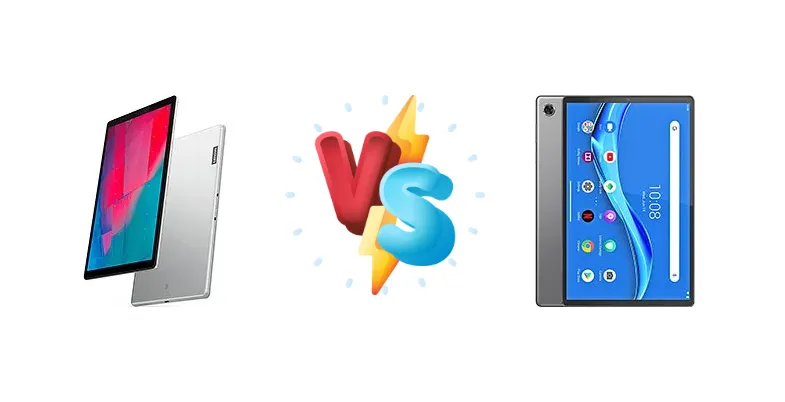
Lenovo's Tab M series offers affordable tablets for everyday use. The Tab M10 HD Gen 2 and M10 Plus represent two points within this budget segment. While both devices utilize the same MediaTek Helio P22T chipset, key differences in their implementation and potential features make choosing between them a nuanced decision. This comparison will dissect those differences to help you determine which tablet best suits your needs.
🏆 Quick Verdict
For the average user prioritizing a slightly more refined experience, the Lenovo Tab M10 Plus is the better choice. While both share the same core processing power, the M10 Plus typically offers a more premium build quality and potentially a better display, justifying a small price premium. However, the M10 HD Gen 2 remains a compelling option for those on a tighter budget.
| Network |
|---|
| 2G bands | GSM 850 / 900 / 1800 / 1900 | N/A |
| 3G bands | HSDPA 800 / 850 / 900 / 1900 / 2100 | N/A |
| 4G bands | 1, 2, 3, 4, 5, 7, 8, 19, 20, 28, 38, 40 | LTE |
| EDGE | - | No |
| GPRS | - | No |
| Speed | HSPA, LTE - cellular model only | HSPA 21.1/5.76 Mbps, LTE Cat4 150/50 Mbps - cellular model only |
| Technology | GSM / HSPA / LTE | LTE |
| Launch |
|---|
| Announced | 2020, August 31. Released 2020, November | 2020, March 27. Released 2020, March 27 |
| Status | Discontinued | Discontinued |
| Body |
|---|
| Dimensions | 241.5 x 149.4 x 8.3 mm (9.51 x 5.88 x 0.33 in) | 244.2 x 153.3 x 8.2 mm (9.61 x 6.04 x 0.32 in) |
| SIM | Nano-SIM (cellular model only) | Nano-SIM (cellular model only) |
| Weight | 420 g (14.82 oz) | 460 g (1.01 lb) |
| Display |
|---|
| Resolution | 800 x 1280 pixels, 16:10 ratio (~149 ppi density) | 1200 x 1920 pixels, 16:10 ratio (~220 ppi density) |
| Size | 10.1 inches, 295.8 cm2 (~82.0% screen-to-body ratio) | 10.3 inches, 307.6 cm2 (~82.2% screen-to-body ratio) |
| Type | IPS LCD, 400 nits (typ) | IPS LCD, 330 nits (typ) |
| Platform |
|---|
| CPU | Octa-core (4x2.3 GHz Cortex-A53 & 4x1.8 GHz Cortex-A53) | Octa-core (4x2.3 GHz Cortex-A53 & 4x1.8 GHz Cortex-A53) |
| Chipset | Mediatek MT6762 Helio P22T (12 nm) | Mediatek MT6762 Helio P22T (12 nm) |
| GPU | PowerVR GE8320 | PowerVR GE8320 |
| OS | Android 10 | Android 9.0 (Pie) |
| Memory |
|---|
| Card slot | microSDXC (dedicated slot) | microSDXC (dedicated slot) |
| Internal | 32GB 2GB RAM, 64GB 4GB RAM | 32GB 2GB RAM, 64GB 4GB RAM, 128GB 4GB RAM |
| | eMMC 5.1 | eMMC 5.1 |
| Main Camera |
|---|
| Single | 8 MP, AF | 8 MP, AF |
| Video | 1080p@30fps | 1080p@30fps |
| Selfie camera |
|---|
| Single | 5 MP | 5 MP |
| Sound |
|---|
| 3.5mm jack | Yes | Yes |
| 35mm jack | Yes | Yes |
| Loudspeaker | Yes, with stereo speakers | Yes, with stereo speakers |
| Comms |
|---|
| Bluetooth | 5.0, LE | 5.0, LE |
| NFC | No | No |
| Positioning | GPS, GLONASS - cellular model only | GPS - cellular model only |
| Radio | FM radio | No |
| USB | USB Type-C 2.0, OTG, magnetic connector | USB Type-C 2.0 |
| WLAN | Wi-Fi 802.11 a/b/g/n/ac, dual-band, Wi-Fi Direct | Wi-Fi 802.11 a/b/g/n/ac, dual-band, Wi-Fi Direct |
| Features |
|---|
| Sensors | Accelerometer, proximity | Accelerometer |
| Battery |
|---|
| Charging | 10W wired | 10W wired |
| Type | Li-Po 5000 mAh | Li-Po 5000 mAh |
| Misc |
|---|
| Colors | Iron Gray, Platinum Gray | Iron Grey |
| Models | TB-X306X | TB-X606, TB-X606F, TB-X606X, TB-X606V |
| Price | About 170 EUR | About 200 EUR |
Lenovo Tab M10 HD Gen 2
- Lowest possible price point within the Lenovo Tab M series.
- Identical processing power to the M10 Plus for basic tasks.
- Suitable for simple tasks like reading and web browsing.
- Potentially lower build quality compared to the M10 Plus.
- May have a less vibrant or brighter display.
- Limited gaming capabilities.
Lenovo M10 Plus
- Potentially more premium build quality and design.
- Likely features a slightly better display experience.
- Identical processing power to the M10 HD Gen 2.
- Higher price point than the M10 HD Gen 2.
- Shares the same limitations in gaming performance.
- Still utilizes a relatively slow 10W charging standard.
Display Comparison
Both the Lenovo Tab M10 HD Gen 2 and M10 Plus are equipped with displays designed for media consumption, but specific details beyond resolution are often variable based on regional configurations. Given the shared chipset, the display quality is a key differentiator. While both likely utilize IPS LCD panels, the M10 Plus often features a slightly larger screen size and potentially higher brightness levels. The absence of information regarding PWM dimming rates makes it difficult to assess eye strain potential, but users sensitive to flicker should research specific model configurations. Bezels are likely similar, reflecting the budget nature of both devices.
Camera Comparison
Camera performance on both tablets is expected to be basic. The context data doesn't specify camera sensors, but budget tablets typically feature low-resolution sensors primarily intended for video calls and occasional snapshots. Focusing on megapixel counts is misleading; sensor size and image processing algorithms are far more important. Given the shared chipset, image processing capabilities will be identical. Users should not expect high-quality photos or videos from either device.
Performance
The core performance of both tablets is identical, powered by the MediaTek MT6762 Helio P22T (12 nm) chipset with an Octa-core CPU configuration (4x2.3 GHz Cortex-A53 & 4x1.8 GHz Cortex-A53). This chipset is geared towards everyday tasks and light multitasking. The 12nm process node offers reasonable power efficiency, but don't expect flagship-level performance. Gaming will be limited to less demanding titles. The shared chipset means thermal management will be similar; sustained loads will likely result in some throttling, but this is expected in this price bracket. RAM configurations are a crucial factor not provided, but higher RAM (3GB or more) will significantly improve multitasking performance on both devices.
Battery Life
Both tablets feature 10W wired charging, indicating a similar charging experience. The actual battery capacity (mAh) is not provided, but it's likely similar between the two models. 10W charging is relatively slow, meaning a full charge will take several hours. Real-world battery life will depend heavily on usage patterns, but both tablets should provide sufficient power for a day of light use (web browsing, reading, video streaming). The shared charging wattage means battery capacity will be the primary determinant of overall endurance.
Buying Guide
Buy the Lenovo Tab M10 HD Gen 2 if you need a functional, no-frills tablet for basic tasks like web browsing, reading ebooks, and light video streaming, and are prioritizing the lowest possible price. Buy the Lenovo M10 Plus if you prefer a slightly more polished design, potentially a better display experience, and are willing to spend a bit more for a more premium feel, even if the core performance remains identical.
Frequently Asked Questions
❓ Will the Helio P22T chipset struggle with multitasking? How many apps can I realistically run simultaneously?
The Helio P22T is a budget chipset, so heavy multitasking is not its strength. While it can handle a few apps concurrently, performance will degrade with more than 2-3 apps open, especially if those apps are resource-intensive. The amount of RAM (which isn't specified in the provided data) will significantly impact multitasking capabilities; more RAM is always better.
❓ Is the 10W charging speed acceptable for daily use, or will I be waiting a long time for a full charge?
10W charging is relatively slow by modern standards. Expect a full charge to take several hours (likely 3-5 hours from 0% to 100%). This is acceptable for overnight charging, but if you frequently need to top up quickly, you'll find it limiting. Both tablets share this charging speed, so it's not a differentiator.
❓ Can either of these tablets handle popular mobile games like PUBG or Call of Duty?
While technically capable of running these games, the Helio P22T chipset will struggle to provide a smooth gaming experience in PUBG or Call of Duty. Expect low frame rates and significant lag, even on the lowest graphics settings. These tablets are better suited for less demanding games.