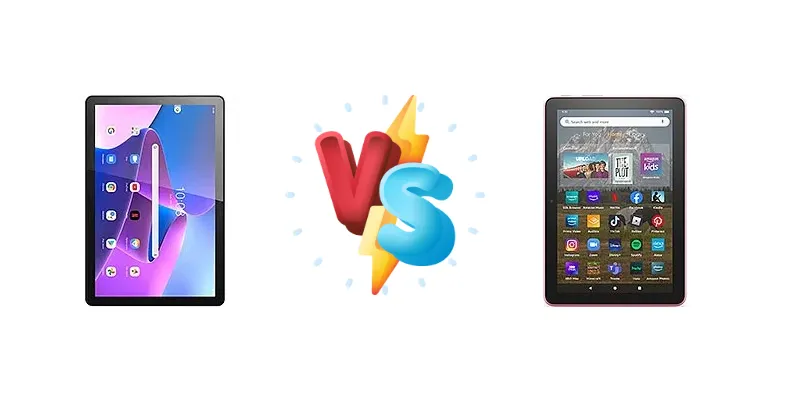
The sub-$200 tablet market is fiercely competitive, offering options for casual users, students, and families. The Lenovo Tab M10 Gen 3 and Amazon Fire HD 8 (2022) represent two popular choices, but cater to different priorities. The Lenovo aims for a more standard Android experience, while the Fire HD 8 prioritizes Amazon’s ecosystem and content delivery. This comparison dives deep into their specifications to determine which tablet delivers the best overall value.
🏆 Quick Verdict
For most users, the Lenovo Tab M10 Gen 3 is the better choice. Its Unisoc T610 chipset, featuring a combination of Cortex-A75 and A55 cores, provides a noticeable performance advantage over the Fire HD 8’s hexa-core Mediatek MT8169A, all Cortex-A55. While the Fire HD 8 offers faster charging, the Lenovo’s more versatile Android experience and superior processing power make it the winner.
| Network |
|---|
| 2G bands | GSM 850 / 900 / 1800 / 1900 | N/A |
| 3G bands | HSDPA 800 / 850 / 900 / 1900 / 2100 | - |
| 4G bands | 1, 2, 3, 4, 5, 7, 8, 19, 20, 28, 38, 40, 41 | - |
| EDGE | - | N/A |
| GPRS | - | N/A |
| Speed | HSPA, LTE - cellular model only | - |
| Technology | GSM / HSPA / LTE | No cellular connectivity |
| Launch |
|---|
| Announced | 2022, September | 2022, September 21 |
| Status | Available. Released 2022, September | Available. Released 2022, September 21 |
| Body |
|---|
| Dimensions | 239.8 x 158.6 x 8.5 mm (9.44 x 6.24 x 0.33 in) | 201.9 x 137.4 x 9.6 mm (7.95 x 5.41 x 0.38 in) |
| SIM | Nano-SIM (cellular model only) | No |
| Weight | 460 g (1.01 lb) | 337 g (11.89 oz) |
| Display |
|---|
| Resolution | 1200 x 1920 pixels, 16:10 ratio (~224 ppi density) | 800 x 1280 pixels, 16:10 ratio (~189 ppi density) |
| Size | 10.1 inches, 295.8 cm2 (~77.8% screen-to-body ratio) | 8.0 inches, 185.6 cm2 (~66.9% screen-to-body ratio) |
| Type | IPS LCD, 320 nits (typ) | IPS LCD |
| Platform |
|---|
| CPU | Octa-core (2x1.8 GHz Cortex-A75 & 6x1.8 GHz Cortex-A55) | Hexa-core (6x2.0 GHz Cortex-A55) |
| Chipset | Unisoc T610 (12 nm) | Mediatek MT8169A |
| GPU | Mali-G52 MP2 | Mali-G52 2EE MC2 |
| OS | Android 11, upgradable to Android 12 | Android 11, Fire OS 8 |
| Memory |
|---|
| Card slot | microSDXC (dedicated slot) | microSDXC (dedicated slot) |
| Internal | 32GB 3GB RAM, 64GB 4GB RAM | 32GB 2GB RAM, 64GB 2GB RAM |
| | eMCP or eMMC 5.1 | eMMC 5.1 |
| Main Camera |
|---|
| Single | 8 MP, AF | 5 MP |
| Video | 1080p@30fps | 1080p |
| Selfie camera |
|---|
| Single | 5 MP | 2 MP |
| Video | Yes | 720p |
| Sound |
|---|
| 3.5mm jack | Yes | Yes |
| 35mm jack | Yes | Yes |
| Loudspeaker | Yes, with stereo speakers (with Dolby Atmos) | Yes, with stereo speakers |
| Comms |
|---|
| Bluetooth | 5.0, LE | 5.2, A2DP, LE |
| NFC | No | No |
| Positioning | GPS - cellular model only | No |
| Radio | No | No |
| USB | USB Type-C 2.0, OTG, magnetic connector | USB Type-C 2.0 |
| WLAN | Wi-Fi 802.11 a/b/g/n/ac, dual-band, Wi-Fi Direct | Wi-Fi 802.11 a/b/g/n/ac, dual-band |
| Features |
|---|
| Sensors | Accelerometer, proximity | Accelerometer |
| | - | Alexa natural language commands
Text-to-Speech English-language content reader |
| Battery |
|---|
| Charging | 10W wired | 15W wired |
| Talk time | - | Up to 13 h |
| Type | Li-Po 5100 mAh | - |
| Misc |
|---|
| Colors | Storm Grey | Black, Denim, Rose |
| Models | - | KFRAWI |
| Price | About 200 EUR | About 110 EUR |
Lenovo Tab M10 Gen 3
- More powerful processor (Unisoc T610)
- Larger display for better media consumption
- Standard Android experience with Google Play Store access
- Slower charging speed (10W)
- Likely lower build quality compared to premium tablets
Amazon Fire HD 8 (2022)
- Faster charging speed (15W)
- Deep integration with Amazon’s ecosystem
- Compact and portable design
- Less powerful processor (Mediatek MT8169A)
- Limited app availability outside of Amazon Appstore
- Heavily customized Fire OS
Display Comparison
Neither device boasts a particularly impressive display. Both are likely to utilize IPS LCD panels, common in this price bracket. However, detailed specs like resolution and peak brightness are missing. The Fire HD 8’s smaller size (8 inches vs. the M10’s 10.1 inches) will result in a higher pixel density, potentially offering a slightly sharper image. Bezels are expected to be substantial on both, reflecting their budget nature. Color accuracy is unlikely to be a strong point on either device, but the larger screen of the Lenovo Tab M10 Gen 3 will be preferable for media consumption.
Camera Comparison
Camera performance is unlikely to be a deciding factor for either tablet. Both are expected to feature basic camera setups suitable for video calls and occasional snapshots. Detailed sensor information is unavailable, but given the price point, image quality will likely be mediocre in less-than-ideal lighting conditions. Focusing on camera specs is a misdirection; these tablets are not designed for photography.
Performance
The Lenovo Tab M10 Gen 3’s Unisoc T610 chipset is the clear winner in this category. Its octa-core configuration, incorporating two higher-performance Cortex-A75 cores alongside six Cortex-A55 cores, provides a significant advantage over the Fire HD 8’s hexa-core Mediatek MT8169A, which relies solely on Cortex-A55 cores. The A75 cores offer substantially higher single-core performance, crucial for responsive app launching and smoother multitasking. While the MT8169A’s 2.0 GHz clock speed appears higher, the architectural differences favor the Unisoc T610. The Lenovo will handle demanding apps and light gaming more effectively. RAM configurations are unknown, but will heavily influence real-world performance.
Battery Life
The Amazon Fire HD 8 (2022) has a slight edge in charging speed with its 15W wired charging capability, compared to the Lenovo Tab M10 Gen 3’s 10W charging. However, battery capacity is unknown for both devices. Faster charging is beneficial for quick top-ups, but the overall battery life will depend on usage patterns and the actual battery capacity. The more efficient Unisoc T610 in the Lenovo Tab M10 Gen 3 might offset the slower charging speed with longer runtimes during typical use.
Buying Guide
Buy the Lenovo Tab M10 Gen 3 if you need a tablet capable of handling multitasking, streaming, and light gaming with a more open Android experience. It’s ideal for students, users who prefer Google Play Store access, and those who want a tablet that isn’t locked into a single ecosystem. Buy the Amazon Fire HD 8 (2022) if you are deeply invested in Amazon’s services – Prime Video, Kindle, Music – and prioritize content consumption within that ecosystem. It’s a good option for casual users who primarily want a device for reading, watching videos, and basic web browsing.
Frequently Asked Questions
❓ Will the Unisoc T610 in the Lenovo Tab M10 Gen 3 handle demanding games like PUBG Mobile?
While the Unisoc T610 isn't a gaming powerhouse, it should be capable of running PUBG Mobile at lower to medium settings with acceptable frame rates. The Cortex-A75 cores provide a performance boost over the Fire HD 8’s processor, but don’t expect a flagship gaming experience. Expect some frame drops during intense action.
❓ How much does the Amazon Fire HD 8’s Fire OS restrict app choices compared to standard Android?
Fire OS is heavily customized and primarily relies on the Amazon Appstore. While many popular apps are available, you won’t have access to the full range of apps available on the Google Play Store. Sideloading apps is possible, but requires technical knowledge and isn’t officially supported.
❓ Is the 10W charging on the Lenovo Tab M10 Gen 3 significantly slower than the Fire HD 8’s 15W?
The difference in charging speed will be noticeable, but not drastic. The Fire HD 8 will likely charge faster from 0-100%, but the Lenovo’s battery life, if comparable, might mitigate the slower charging in daily use. The actual charging time will also depend on the charger used.