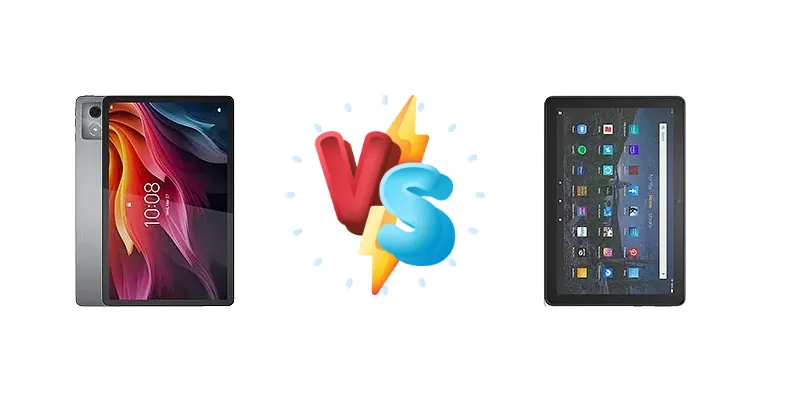
The budget tablet market is fiercely competitive, with options ranging from stripped-down media consumption devices to surprisingly capable all-rounders. We’re pitting the Lenovo Tab K11 Plus, powered by Qualcomm’s Snapdragon 680, against the Amazon Fire HD 10 Plus (2021) with its MediaTek Helio P60T chipset. This comparison focuses on how architectural differences and specific specs translate into real-world performance and usability.
🏆 Quick Verdict
For the average user prioritizing sustained performance and longer battery life, the Lenovo Tab K11 Plus emerges as the stronger choice. Its Snapdragon 680, built on a more efficient 6nm process, offers a noticeable advantage over the older 12nm Helio P60T in the Fire HD 10 Plus, despite the latter's wireless charging convenience.
| Network |
|---|
| 2G bands | GSM 850 / 900 / 1800 / 1900 | N/A |
| 3G bands | HSDPA 800 / 850 / 900 / 1900 / 2100 | - |
| 4G bands | 1, 2, 3, 4, 5, 7, 8, 19, 20, 26, 28, 38, 40, 41 | - |
| EDGE | - | No |
| GPRS | - | No |
| Speed | HSPA, LTE - cellular model only | - |
| Technology | GSM / HSPA / LTE | No cellular connectivity |
| Launch |
|---|
| Announced | 2024, July 01 | 2021, April 27. Released 2021, May 26 |
| Status | Available. Released 2024, July | Discontinued |
| Body |
|---|
| Build | Glass front, aluminum frame, aluminum back | - |
| Dimensions | 169 x 268.7 x 7.2 mm (6.65 x 10.58 x 0.28 in) | 247 x 166 x 9.2 mm (9.72 x 6.54 x 0.36 in) |
| SIM | Nano-SIM (cellular model only) | No |
| Weight | 520 g (1.15 lb) | 468 g (1.03 lb) |
| Display |
|---|
| Protection | Mohs level 6 | Aluminosilicate glass |
| Resolution | 1200 x 2000 pixels, 5:3 ratio (~204 ppi density) | 1920 x 1200 pixels, 16:10 ratio (~224 ppi density) |
| Size | 11.45 inches, 373.2 cm2 (~82.2% screen-to-body ratio) | 10.1 inches, 295.8 cm2 (~72.1% screen-to-body ratio) |
| Type | IPS LCD, 90Hz, 400 nits (typ) | IPS LCD |
| Platform |
|---|
| CPU | Octa-core (4x2.4 GHz Kryo 265 Gold & 4x1.9 GHz Kryo 265 Silver) | Octa-core (4x2.0 GHz Cortex-A73 & 4x2.0 GHz Cortex-A53) |
| Chipset | Qualcomm SM6225 Snapdragon 680 4G (6 nm) | Mediatek MT8183 Helio P60T (12 nm) |
| GPU | Adreno 610 | Mali-G72 MP3 |
| OS | Android 14 | Android 9.0 (Pie), Fire OS 7 |
| Memory |
|---|
| Card slot | microSDXC (dedicated slot) | microSDXC (dedicated slot) |
| Internal | 64GB 4GB RAM, 128GB 6GB RAM, 256GB 8GB RAM | 32GB 4GB RAM, 64GB 4GB RAM |
| | - | eMMC 5.1 |
| Main Camera |
|---|
| Features | LED flash | - |
| Single | 13 MP, f/2.2, (wide), AF | 5 MP |
| Video | 1080p@30fps | 720p |
| Selfie camera |
|---|
| Single | 8 MP, f/2.0, (wide) | 2 MP |
| Video | 1080p@30fps | 720p |
| Sound |
|---|
| 3.5mm jack | - | Yes |
| 35mm jack | Yes | Yes |
| Loudspeaker | Yes, with stereo speakers (4 speakers) | Yes, with stereo speakers |
| Comms |
|---|
| Bluetooth | 5.3, A2DP, LE | 5.0, A2DP, LE |
| NFC | Yes | No |
| Positioning | GPS, GLONASS, BDS - cellular model only | No |
| Radio | No | No |
| USB | USB Type-C 2.0, magnetic connector pins | USB Type-C 2.0, OTG |
| WLAN | Wi-Fi 802.11 a/b/g/n/ac/6, dual-band, Wi-Fi Direct | Wi-Fi 802.11 a/b/g/n/ac, dual-band |
| Features |
|---|
| Sensors | Accelerometer, gyro, proximity | Accelerometer |
| | - | Text-to-Speech English-language content reader |
| Battery |
|---|
| Charging | 20W wired | Wireless |
| Type | Li-Po 8600 mAh | Li-Ion |
| Misc |
|---|
| Colors | Luna grey | Slate |
| Models | TB352FU | T76N2P |
| Price | About 200 EUR | About 150 EUR |
| EU LABEL |
|---|
| Battery | 92:26h endurance, 1000 cycles | - |
| Energy | Class F | - |
| Free fall | Class E (3 falls) | - |
| Repairability | Class A | - |
Lenovo Tab K11 Plus
- Superior processor efficiency (Snapdragon 680, 6nm)
- Exceptional battery life (92:26h endurance)
- Faster wired charging (20W)
- Lacks wireless charging
- May have a less refined software experience compared to Fire OS
Amazon Fire HD 10 Plus (2021)
- Convenient wireless charging
- Deep integration with Amazon services
- Generally lower price point
- Less powerful processor (Helio P60T, 12nm)
- Shorter battery life
- Potentially slower performance under load
Display Comparison
Neither device boasts a particularly high-end display, but differences exist. While both likely feature IPS LCD panels (spec not provided), the core performance gap lies elsewhere. The Fire HD 10 Plus's inclusion of wireless charging is a notable convenience feature, but the Tab K11 Plus's chipset efficiency may offset this for users prioritizing longevity. Without specific display specs like resolution or brightness, it's difficult to declare a clear winner, but the Tab K11 Plus's more modern processor could potentially drive more efficient display management.
Camera Comparison
Camera performance is unlikely to be a deciding factor for either tablet, given their market segment. Without detailed camera specs, a direct comparison is limited. However, the focus should be on practical use cases like video calls rather than photography. Both tablets likely feature basic camera setups suitable for these tasks. The absence of detailed sensor information suggests neither device prioritizes photographic quality.
Performance
The Lenovo Tab K11 Plus’s Qualcomm Snapdragon 680 (6nm) represents a significant architectural leap over the Amazon Fire HD 10 Plus’s MediaTek Helio P60T (12nm). The 6nm process inherently delivers better power efficiency and thermal characteristics. The Snapdragon 680’s Kryo cores (4x2.4 GHz Gold & 4x1.9 GHz Silver) are also more modern than the Cortex-A73 & A53 cores in the Helio P60T (both clocked at 2.0 GHz). This translates to snappier app launches, smoother multitasking, and a more responsive user experience on the Lenovo tablet. The Helio P60T, while capable for basic tasks, will likely exhibit more noticeable slowdowns under sustained load.
Battery Life
The Lenovo Tab K11 Plus boasts a remarkable 92:26h endurance rating, a testament to the Snapdragon 680’s efficiency. While the Fire HD 10 Plus’s battery capacity isn’t specified, the less efficient Helio P60T will likely result in shorter runtimes. The Tab K11 Plus also supports 20W wired charging, offering a faster recharge compared to the Fire HD 10 Plus’s wireless charging, which is typically slower. The 1000 charge cycle rating for the Tab K11 Plus also suggests a longer lifespan for the battery itself.
Buying Guide
Buy the Lenovo Tab K11 Plus if you need a tablet for multitasking, light gaming, and extended use without frequent charging. Its more modern chipset and superior endurance make it ideal for students or anyone who relies on their tablet throughout the day. Buy the Amazon Fire HD 10 Plus (2021) if you primarily consume media, are deeply embedded in the Amazon ecosystem, and value the convenience of wireless charging, accepting a trade-off in processing power and overall responsiveness.
Frequently Asked Questions
❓ Will the Snapdragon 680 in the Lenovo Tab K11 Plus handle demanding games like Genshin Impact?
While the Snapdragon 680 isn't a gaming powerhouse, it can handle less graphically intensive games smoothly. Genshin Impact will likely require significantly reduced graphics settings and may still experience occasional frame drops. The Helio P60T in the Fire HD 10 Plus would struggle even more with such titles.
❓ How much does the Amazon Fire HD 10 Plus's integration with Amazon services lock you into their ecosystem?
The Fire HD 10 Plus is heavily integrated with Amazon services like Prime Video, Kindle, and Amazon Music. While you can sideload apps, the experience is optimized for Amazon's ecosystem. This means frequent prompts to use Amazon services and a less standard Android experience.
❓ Is the 20W charging on the Lenovo Tab K11 Plus significantly faster than the wireless charging on the Fire HD 10 Plus?
Yes, 20W wired charging will recharge the Lenovo Tab K11 Plus much faster than the wireless charging on the Fire HD 10 Plus. Wireless charging is convenient, but typically delivers lower wattage and takes considerably longer to reach a full charge.