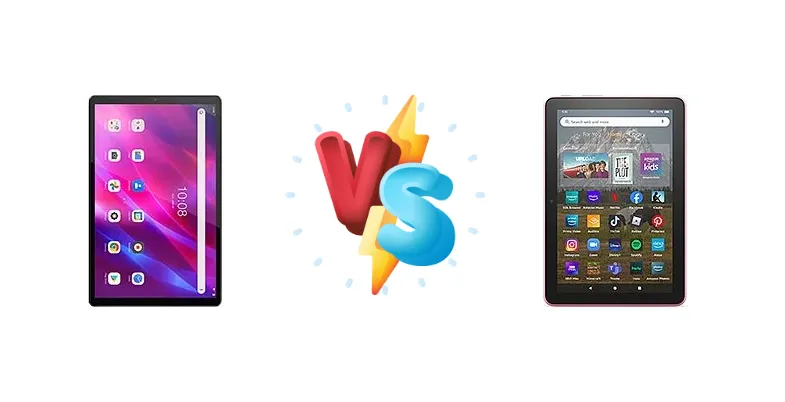
The sub-$200 tablet market is fiercely competitive, offering options for casual users, students, and families. The Lenovo Tab K10 and Amazon Fire HD 8 (2022) represent two distinct approaches to this segment: a more traditional Android experience versus Amazon’s heavily customized Fire OS. This comparison dives deep into their hardware and software to determine which tablet delivers the best value.
🏆 Quick Verdict
For most users, the Amazon Fire HD 8 (2022) is the better choice. While the Lenovo Tab K10 offers a standard Android experience, the Fire HD 8’s more efficient chipset and faster 15W charging provide a smoother, more convenient experience, especially for media consumption. The Tab K10's older chipset struggles to keep pace.
| Network |
|---|
| 2G bands | GSM 850 / 900 / 1800 / 1900 | N/A |
| 3G bands | HSDPA 800 / 850 / 900 / 1700(AWS) / 1900 / 2100 | - |
| 4G bands | 1, 2, 3, 4, 5, 7, 8, 19, 20, 26, 28, 34, 38, 39, 40, 41 | - |
| EDGE | - | N/A |
| GPRS | - | N/A |
| Speed | HSPA, LTE - cellular model only | - |
| Technology | GSM / CDMA / HSPA / EVDO / LTE | No cellular connectivity |
| | CDMA2000 1xEV-DO | - |
| Launch |
|---|
| Announced | 2021, May 19 | 2022, September 21 |
| Status | Available. Released 2021, June | Available. Released 2022, September 21 |
| Body |
|---|
| Dimensions | 244 x 153 x 8.2 mm (9.61 x 6.02 x 0.32 in) | 201.9 x 137.4 x 9.6 mm (7.95 x 5.41 x 0.38 in) |
| SIM | Nano-SIM (cellular model only) | No |
| Weight | 460 g (1.01 lb) | 337 g (11.89 oz) |
| Display |
|---|
| Resolution | 1200 x 1920 pixels, 16:10 ratio (~220 ppi density) | 800 x 1280 pixels, 16:10 ratio (~189 ppi density) |
| Size | 10.3 inches, 307.6 cm2 (~82.4% screen-to-body ratio) | 8.0 inches, 185.6 cm2 (~66.9% screen-to-body ratio) |
| Type | IPS LCD, 330 nits (typ) | IPS LCD |
| Platform |
|---|
| CPU | Octa-core (4x2.3 GHz Cortex-A53 & 4x1.8 GHz Cortex-A53) | Hexa-core (6x2.0 GHz Cortex-A55) |
| Chipset | Mediatek MT6762 Helio P22T (12 nm) | Mediatek MT8169A |
| GPU | PowerVR GE8320 | Mali-G52 2EE MC2 |
| OS | Android 11 | Android 11, Fire OS 8 |
| Memory |
|---|
| Card slot | microSDXC (dedicated slot) | microSDXC (dedicated slot) |
| Internal | 32GB 3GB RAM, 64GB 4GB RAM, 128GB 4GB RAM | 32GB 2GB RAM, 64GB 2GB RAM |
| | eMMC 5.1 | eMMC 5.1 |
| Main Camera |
|---|
| Features | LED flash | - |
| Single | 8 MP | 5 MP |
| Video | 1080p@30fps | 1080p |
| Selfie camera |
|---|
| Single | 5 MP | 2 MP |
| Video | Yes | 720p |
| Sound |
|---|
| 3.5mm jack | Yes | Yes |
| 35mm jack | Yes | Yes |
| Loudspeaker | Yes, with stereo speakers | Yes, with stereo speakers |
| Comms |
|---|
| Bluetooth | 5.0, LE | 5.2, A2DP, LE |
| NFC | No | No |
| Positioning | GPS, GLONASS - cellular model only | No |
| Radio | FM radio | No |
| USB | USB Type-C 2.0 | USB Type-C 2.0 |
| WLAN | Wi-Fi 802.11 a/b/g/n/ac, dual-band, Wi-Fi Direct | Wi-Fi 802.11 a/b/g/n/ac, dual-band |
| Features |
|---|
| Sensors | Accelerometer, gyro, proximity, compass | Accelerometer |
| | - | Alexa natural language commands
Text-to-Speech English-language content reader |
| Battery |
|---|
| Charging | 10W wired | 15W wired |
| Talk time | - | Up to 13 h |
| Type | Li-Po 7700 mAh | - |
| Misc |
|---|
| Colors | Abyss Blue | Black, Denim, Rose |
| Models | TB-X6C6F, TB-X6C6X | KFRAWI |
| Price | About 170 EUR | About 110 EUR |
Lenovo Tab K10
- Standard Android experience – no Amazon bloatware.
- Full access to the Google Play Store.
- Potentially more customization options.
- Older, less efficient processor.
- Slower 10W charging.
- Likely more noticeable performance lag.
Amazon Fire HD 8 (2022)
- More efficient processor for smoother performance.
- Faster 15W wired charging.
- Optimized for Amazon services (Prime Video, Kindle).
- Fire OS – limited app selection compared to Google Play.
- Amazon ecosystem lock-in.
- Heavier software customization.
Display Comparison
Neither tablet boasts a standout display. Both likely utilize IPS LCD panels, common in this price bracket. The key difference lies under the hood. While specific display specs are unavailable, the Lenovo Tab K10’s older chipset may struggle to efficiently drive a higher resolution or refresh rate display. The Fire HD 8’s MT8169A, being a more recent design, is likely optimized for its display, potentially offering slightly better power efficiency. Bezels are expected to be substantial on both devices, reflecting their budget positioning.
Camera Comparison
Camera quality is not a strength for either device, and detailed specs are lacking. Both tablets likely feature basic cameras suitable for video calls and occasional snapshots. Given the price point, expecting high-quality photography is unrealistic. Focusing on sensor size or aperture is irrelevant; the image processing capabilities of the chipsets will be the limiting factor. The Fire HD 8’s newer chipset *may* offer slightly improved image processing, but the difference will be minimal.
Performance
The performance gap is the most significant differentiator. The Lenovo Tab K10’s Mediatek MT6762 Helio P22T, while an octa-core processor, utilizes older Cortex-A53 cores clocked at 2.3 GHz and 1.8 GHz. This contrasts with the Amazon Fire HD 8’s Mediatek MT8169A, a hexa-core processor with newer Cortex-A55 cores clocked at 2.0 GHz. The Cortex-A55 architecture is demonstrably more efficient and offers better performance per clock cycle than the A53. This translates to snappier app launches and smoother multitasking on the Fire HD 8, despite having fewer cores. The Tab K10 will likely exhibit more noticeable lag during demanding tasks.
Battery Life
Battery life will depend heavily on usage patterns. While mAh ratings are unavailable, the Fire HD 8’s 15W wired charging is a clear advantage over the Tab K10’s 10W charging. This faster charging speed significantly reduces downtime, making the Fire HD 8 more convenient for on-the-go users. The more efficient MT8169A chipset in the Fire HD 8 will also contribute to longer battery life during typical use, offsetting any potential capacity difference.
Buying Guide
Buy the Lenovo Tab K10 if you prioritize a clean, unmodified Android experience and need access to the full Google Play Store without Amazon’s ecosystem. This is ideal for users who rely on specific Android apps not available on Fire OS. Buy the Amazon Fire HD 8 (2022) if you’re heavily invested in Amazon’s services (Prime Video, Kindle) and want a tablet optimized for media consumption with faster charging and a generally more responsive user interface, even with the limitations of Fire OS.
Frequently Asked Questions
❓ Will the Lenovo Tab K10 struggle with multitasking or running multiple apps simultaneously?
Yes, the Tab K10’s older Mediatek MT6762 Helio P22T processor and its Cortex-A53 cores are less efficient at handling multitasking compared to the Fire HD 8’s MT8169A. Expect noticeable lag when switching between apps or running demanding applications.
❓ Can I sideload apps onto the Amazon Fire HD 8 (2022) if they aren't available in the Amazon Appstore?
Yes, you can sideload apps onto the Fire HD 8, but it requires enabling developer mode and using third-party app stores or APK files. This process is not officially supported by Amazon and may void your warranty. Compatibility isn't guaranteed, and some apps may not function correctly.
❓ Is the Amazon Fire HD 8 (2022) heavily loaded with ads?
The Fire HD 8 does display sponsored content on the lock screen, but these ads can be removed for a small fee. Amazon also promotes its services within the Fire OS interface, but this is generally less intrusive than the lock screen ads.