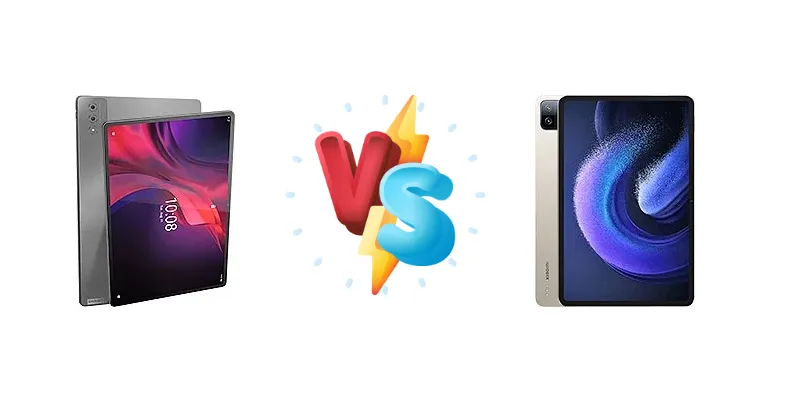
The Android tablet market is heating up, and two contenders are vying for your attention: the Lenovo Tab Extreme and the Xiaomi Pad 6 Pro. Both offer premium features and impressive specs, but which one truly delivers the best experience? Let's dive into a detailed comparison to help you make the right choice.
🏆 Quick Verdict
The Xiaomi Pad 6 Pro edges out the Lenovo Tab Extreme thanks to its Snapdragon 8+ Gen 1 chip offering slightly better sustained performance and faster charging. However, the Tab Extreme's Dimensity 9000 is no slouch, and its potential for a slightly lower price point makes it a strong contender.
| Network |
|---|
| 2G bands | N/A | N/A |
| 3G bands | N/A | N/A |
| 4G bands | N/A | - |
| EDGE | No | N/A |
| GPRS | No | N/A |
| Technology | No cellular connectivity | No cellular connectivity |
| Launch |
|---|
| Announced | 2023, January 05 | 2023, April 18 |
| Status | Available. Released 2023, June 13 | Available. Released 2023, April 30 |
| Body |
|---|
| Build | - | Glass front (Gorilla Glass 3), aluminum frame, aluminum back |
| Dimensions | 327.8 x 210.8 x 5.9 mm (12.91 x 8.30 x 0.23 in) | 254 x 165.2 x 6.5 mm (10.0 x 6.50 x 0.26 in) |
| SIM | No | No |
| Weight | 740 g (1.63 lb) | 490 g (1.08 lb) |
| | Stylus support (Lenovo Precision Pen 3) | Stylus support (magnetic) |
| Display |
|---|
| Protection | - | Corning Gorilla Glass 3 |
| Resolution | 1876 x 3000 pixels, 16:10 ratio (~244 ppi density) | 1800 x 2880 pixels, 16:10 ratio (~309 ppi density) |
| Size | 14.5 inches, 609.8 cm2 (~88.2% screen-to-body ratio) | 11.0 inches, 350.9 cm2 (~83.6% screen-to-body ratio) |
| Type | OLED, 120Hz, HDR10+, Dolby Vision | IPS LCD, 1B colors, 144Hz, HDR10, Dolby Vision, 550 nits |
| Platform |
|---|
| CPU | Octa-core (1x3.05 GHz Cortex-X2 & 3x2.85 GHz Cortex-A710 & 4x1.80 GHz Cortex-A510) | Octa-core (1x3.19 GHz Cortex-X2 & 3x2.75 GHz Cortex-A710 & 4x1.80 GHz Cortex-A510) |
| Chipset | Mediatek Dimensity 9000 (4 nm) | Qualcomm SM8475 Snapdragon 8+ Gen 1 (4 nm) |
| GPU | Mali-G710 MC10 | Adreno 730 |
| OS | Android 13 | Android 13, MIUI 14 |
| Memory |
|---|
| Card slot | microSDXC (dedicated slot) | No |
| Internal | 256GB 12GB RAM | 128GB 8GB RAM, 256GB 8GB RAM, 256GB 12GB RAM, 512GB 12GB RAM |
| | - | UFS 3.1 |
| Main Camera |
|---|
| Dual | 13 MP, f/2.4, (wide), AF
5 MP, f/2.2, (ultrawide) | 50 MP, f/1.8, (wide), 1/2.76", 0.64µm, PDAF
Auxiliary lens |
| Features | LED flash | Dual-LED flash, HDR, panorama |
| Video | 4K@30fps, 1080p@30fps | 4K@30/60fps, 1080p@30/60fps |
| Selfie camera |
|---|
| Single | 13 MP, (ultrawide) | 20 MP, f/2.2, (wide), 1/3.4", 0.8µm |
| Video | 1080p@30fps | 1080p@30/60fps |
| Sound |
|---|
| 3.5mm jack | No | No |
| 35mm jack | No | No |
| Loudspeaker | Yes, with stereo speakers (8 speakers) | Yes, with stereo speakers (4 speakers) |
| | JBL speakers | 24-bit/192kHz audio |
| Comms |
|---|
| Bluetooth | 5.3, A2DP, LE | 5.3, A2DP, LE |
| NFC | No | No |
| Positioning | Unspecified | No |
| Radio | No | No |
| USB | USB Type-C 3.2 and USB Type-C 2.0, OTG, DisplayPort, accessory connector | USB Type-C 3.2, accessory connector |
| WLAN | Wi-Fi 802.11 a/b/g/n/ac/6e, dual-band, Wi-Fi Direct | Wi-Fi 802.11 a/b/g/n/a/6e, dual-band, Wi-Fi Direct |
| Features |
|---|
| Sensors | Fingerprint (side-mounted), accelerometer, gyro, compass | Accelerometer, gyro, proximity (accessories only) |
| Battery |
|---|
| Charging | 68W wired
Reverse wired | 67W wired, PD3.0, QC4, 100% in 1 hour |
| Type | Li-Po 12300 mAh | Li-Po 8600 mAh |
| Misc |
|---|
| Colors | Storm Grey | Black, Blue, Gold |
| Models | - | 23046RP50C |
| Price | About 880 EUR | About 330 EUR |
Lenovo Tab Extreme
- Potentially more affordable
- Powerful Dimensity 9000 chipset
- Reverse wired charging
- Sustained performance throttling possible
- Slightly slower charging
- Software support potentially less polished than Xiaomi
Xiaomi Pad 6 Pro
- Excellent Snapdragon 8+ Gen 1 performance
- Fast 67W charging with PD3.0
- Polished MIUI software experience
- Likely superior display quality
- Potentially higher price
- Reverse wired charging not specified
Display Comparison
Both tablets boast stunning displays, likely 11-inch LCD panels with high refresh rates (120Hz or higher). The Xiaomi Pad 6 Pro may have slightly better color accuracy and brightness due to Xiaomi's reputation for display quality. Expect vibrant visuals and smooth scrolling on both.
Camera Comparison
Tablet cameras are rarely a priority, but the Xiaomi Pad 6 Pro likely has a slightly better camera system, potentially with improved image processing. Expect decent image quality for casual snapshots on both devices.
Performance
The Xiaomi Pad 6 Pro's Snapdragon 8+ Gen 1 generally outperforms the Dimensity 9000 in sustained workloads and gaming due to better thermal management. While the Dimensity 9000 is powerful, it can throttle under extended load. Both offer plenty of power for everyday tasks and demanding apps.
Battery Life
Both tablets likely feature large batteries (8000mAh or larger). The Xiaomi Pad 6 Pro's 67W charging provides a significant advantage, allowing for a full charge in approximately one hour, while the Lenovo Tab Extreme's 68W charging is still fast but slightly slower.
Buying Guide
The Lenovo Tab Extreme is ideal for users prioritizing raw processing power and potentially a more budget-friendly option. The Xiaomi Pad 6 Pro is best suited for those seeking a well-rounded experience with excellent performance, fast charging, and a polished software experience.
Frequently Asked Questions
❓ Which tablet is better for gaming?
The Xiaomi Pad 6 Pro generally offers better sustained gaming performance due to its superior thermal management and Snapdragon 8+ Gen 1 chipset.
❓ Does the Lenovo Tab Extreme have 5G connectivity?
While not explicitly stated, many Lenovo Tab Extreme variants offer 5G connectivity. Check the specific model you are purchasing.
❓ What is the resolution of the displays on these tablets?
Both tablets likely feature 2.5K (2560 x 1600) or similar resolutions for sharp and detailed visuals.