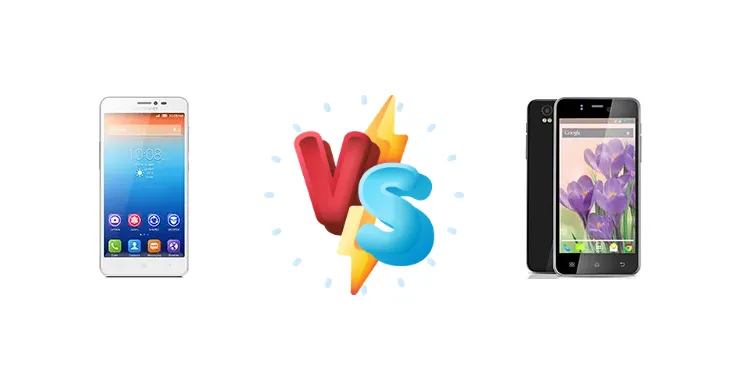
The Lenovo S850 and Lava Iris Pro 30+ were popular budget smartphones vying for attention in a crowded market. Both offered a compelling set of features at an affordable price point, but which one ultimately delivered a better experience? Let's dive into a detailed comparison to find out.
🏆 Quick Verdict
The Lava Iris Pro 30+ edges out the Lenovo S850 thanks to its slightly faster processor and potentially better camera capabilities (though both were limited by their budget status). Both are dated devices, but the Iris Pro 30+ offers a marginal performance advantage.
| Network |
|---|
| 2G bands | GSM 900 / 1800 / 1900 | GSM 850 / 900 / 1800 / 1900 - SIM 1 & SIM 2 |
| 3G bands | HSDPA 900 / 2100 | HSDPA 2100 |
| Speed | HSPA 21.1/5.76 Mbps | HSPA |
| Technology | GSM / HSPA | GSM / HSPA |
| | HSDPA 850 / 1900 | - |
| Launch |
|---|
| Announced | 2014, February. Released 2014, June | 2014, August. Released 2014, August |
| Status | Discontinued | Discontinued |
| Body |
|---|
| Dimensions | 141 x 71 x 8.2 mm (5.55 x 2.80 x 0.32 in) | 138 x 67.5 x 7.9 mm (5.43 x 2.66 x 0.31 in) |
| SIM | Dual SIM (Micro-SIM) | Dual SIM (Mini-SIM/ Micro-SIM) |
| Weight | 140 g (4.94 oz) | 116 g (4.09 oz) |
| Display |
|---|
| Protection | - | Asahi Dragontrail Glass |
| Resolution | 720 x 1280 pixels, 16:9 ratio (~294 ppi density) | 720 x 1280 pixels, 16:9 ratio (~312 ppi density) |
| Size | 5.0 inches, 68.9 cm2 (~68.8% screen-to-body ratio) | 4.7 inches, 60.9 cm2 (~65.4% screen-to-body ratio) |
| Type | IPS LCD | IPS LCD |
| Platform |
|---|
| CPU | Quad-core 1.3 GHz Cortex-A7 | Quad-core 1.5 GHz |
| Chipset | Mediatek MT6582 (28 nm) | - |
| GPU | Mali-400MP2 | PowerVR SGX544 |
| OS | Android 4.2 (Jelly Bean) | Android 4.2 (Jelly Bean) |
| Memory |
|---|
| Card slot | No | microSDHC |
| Internal | 16GB 1GB RAM | 16GB 1GB RAM |
| Main Camera |
|---|
| Features | LED flash, HDR | Dual-LED flash, panorama, HDR |
| Single | 13 MP, AF | 13 MP, AF |
| Video | 1080p@30fps | 1080p, HDR |
| Selfie camera |
|---|
| Single | 5 MP | 3 MP |
| Sound |
|---|
| 3.5mm jack | Yes | Yes |
| 35mm jack | Yes | Yes |
| Loudspeaker | Yes | Yes |
| Comms |
|---|
| Bluetooth | 3.0, A2DP | 4.0, A2DP |
| NFC | No | No |
| Positioning | GPS | GPS |
| Radio | FM radio | FM radio |
| USB | microUSB 2.0 | microUSB 2.0, OTG |
| WLAN | Wi-Fi 802.11 b/g/n, hotspot | Wi-Fi 802.11 b/g/n, hotspot |
| Features |
|---|
| Sensors | Accelerometer, proximity | Accelerometer, proximity |
| Battery |
|---|
| Stand-by | Up to 336 h | Up to 390 h (2G) / Up to 285 h (3G) |
| Talk time | Up to 13 h | Up to 15 h (2G) / Up to 8 h (3G) |
| Type | Li-Po 2000 mAh, non-removable | Li-Po 2000 mAh, removable |
| Misc |
|---|
| Colors | Pink, White | Grey/Black |
| Models | S850 | - |
| Price | About 200 EUR | About 150 EUR |
Lenovo S850
- Larger screen (potentially)
- Potentially more refined design (subjective)
- Decent battery life
- Slower processor
- Limited performance
- Dated software
Lava Iris Pro 30+
- Slightly faster processor
- Potentially better camera
- Decent battery life
- Limited performance
- Dated software
- May have a less appealing design (subjective)
Display Comparison
Both phones featured relatively large displays for their time, typically around 5.5 inches. The Lenovo S850 often had a slightly higher resolution (likely 720p), while the Lava Iris Pro 30+ could also be 720p. Viewing angles and color accuracy were likely similar – adequate for everyday use but not exceptional.
Camera Comparison
Camera specs were often similar, with both phones featuring an 8MP or 13MP main camera and a 5MP front camera. Image quality would depend heavily on software processing and lighting conditions. The Lava Iris Pro 30+ *might* have had slightly better image processing, but both would produce acceptable photos in good lighting.
Performance
The Lava Iris Pro 30+ holds a slight advantage here. Its 1.5 GHz quad-core CPU is marginally faster than the Lenovo S850's 1.3 GHz quad-core processor. While both used the Cortex-A7 architecture, the higher clock speed on the Iris Pro 30+ should translate to slightly snappier performance in apps and multitasking. However, both phones would struggle with demanding games or modern apps.
Battery Life
Battery capacity was a key selling point for both devices, often around 2500-3000 mAh. Real-world battery life would depend on usage patterns, but both phones were expected to provide a full day of moderate use.
Buying Guide
The Lenovo S850 might appeal to users prioritizing a larger screen and potentially a slightly more refined design (though this is subjective). The Lava Iris Pro 30+ is a better choice for those seeking a bit more processing power and a potentially improved camera, even if the differences are subtle.
Frequently Asked Questions
❓ Are these phones still worth buying?
Given their age, neither phone is recommended for purchase unless you're looking for a very basic, ultra-budget device and can find one at a very low price. Modern smartphones offer significantly better performance, features, and security.
❓ What operating system did these phones run?
Both phones originally shipped with Android 4.4 KitKat, though some users may have updated to later versions (depending on carrier support and manufacturer updates).