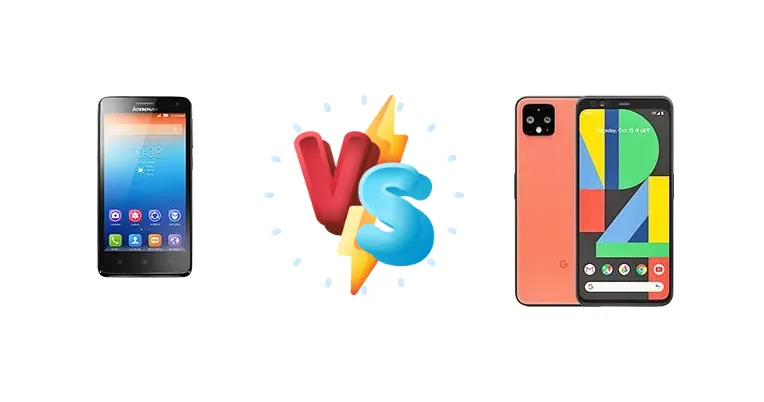
The Lenovo S660 represents a bygone era of affordable smartphones, while the Google Pixel 4 XL embodies modern flagship technology. This comparison explores the vast differences between these two devices, examining their strengths and weaknesses to help you decide which one is right for you.
🏆 Quick Verdict
The Google Pixel 4 XL utterly dominates the Lenovo S660 in almost every aspect. While the S660 offers budget-friendly appeal, the Pixel 4 XL's superior performance, camera, and features make it the clear winner for anyone seeking a premium smartphone experience.
| Network |
|---|
| 2G bands | GSM 900 / 1800 / 1900 - SIM 1 & SIM 2 | GSM 850 / 900 / 1800 / 1900 |
| 3G bands | HSDPA 900 / 2100 | HSDPA 850 / 900 / 1700(AWS) / 1900 / 2100 |
| 4G bands | - | 1, 2, 3, 4, 5, 7, 8, 12, 13, 17, 20, 25, 26, 28, 32, 38, 39, 40, 41, 66, 71 - Global |
| Speed | HSPA 21.1/5.76 Mbps | HSPA 42.2/5.76 Mbps, LTE (5CA) Cat18 1200/150 Mbps |
| Technology | GSM / HSPA | GSM / CDMA / HSPA / EVDO / LTE |
| | HSDPA 850 / 1900 | 1, 2, 3, 4, 5, 7, 8, 12, 13, 14, 17, 18, 19, 20, 25, 26, 28, 29, 30, 38, 39, 40, 41, 46, 48, 66, 71 - USA |
| Launch |
|---|
| Announced | 2014, February. Released 2014, June | 2019, October 15 |
| Status | Discontinued | Available. Released 2019, October 22 |
| Body |
|---|
| Build | - | Glass front (Gorilla Glass 5), glass back (Gorilla Glass 5), aluminum frame |
| Dimensions | 137 x 68.8 x 10 mm (5.39 x 2.71 x 0.39 in) | 160.4 x 75.1 x 8.2 mm (6.31 x 2.96 x 0.32 in) |
| SIM | Dual SIM | Nano-SIM + eSIM |
| Weight | 151 g (5.33 oz) | 193 g (6.81 oz) |
| | - | IP68 dust/water resistant (up to 1.5m for 30 min) |
| Display |
|---|
| Protection | - | Corning Gorilla Glass 5 |
| Resolution | 540 x 960 pixels, 16:9 ratio (~234 ppi density) | 1440 x 3040 pixels, 19:9 ratio (~537 ppi density) |
| Size | 4.7 inches, 60.9 cm2 (~64.6% screen-to-body ratio) | 6.3 inches, 98.0 cm2 (~81.3% screen-to-body ratio) |
| Type | IPS LCD | P-OLED, 90Hz, HDR |
| | - | Always-on display |
| Platform |
|---|
| CPU | Quad-core 1.3 GHz Cortex-A7 | Octa-core (1x2.84 GHz Kryo 485 & 3x2.42 GHz Kryo 485 & 4x1.78 GHz Kryo 485) |
| Chipset | Mediatek MT6582M (28 nm) | Qualcomm SM8150 Snapdragon 855 (7 nm) |
| GPU | Mali-400MP2 | Adreno 640 |
| OS | Android 4.2 (Jelly Bean) | Android 10, upgradable to Android 13 |
| Memory |
|---|
| Card slot | microSDHC (dedicated slot) | No |
| Internal | 8GB 1GB RAM | 64GB 6GB RAM, 128GB 6GB RAM |
| | - | UFS 2.1 |
| Main Camera |
|---|
| Dual | - | 12.2 MP, f/1.7, 27mm (wide), 1/2.55", 1.4µm, dual pixel PDAF, OIS
16 MP, f/2.4, 50mm (telephoto), 1/3.6", 1.0µm, PDAF, OIS, 2x optical zoom |
| Features | LED flash, HDR | Dual-LED flash, Pixel Shift, Auto-HDR, panorama |
| Single | 8 MP, AF | - |
| Video | 1080p@30fps | 4K@30fps, 1080p@30/60/120fps, 1080p@30fps (gyro-EIS) |
| Selfie camera |
|---|
| Features | - | HDR |
| Single | VGA | 8 MP, f/2.0, 22mm (wide), 1.22µm, no AF
TOF 3D, (depth/biometrics sensor) |
| Video | - | 1080p@30fps |
| Sound |
|---|
| 3.5mm jack | Yes | No |
| 35mm jack | Yes | No |
| Loudspeaker | Yes | Yes, with stereo speakers |
| Comms |
|---|
| Bluetooth | 4.0, A2DP | 5.0, A2DP, LE, aptX HD |
| NFC | No | Yes |
| Positioning | GPS | GPS, GLONASS, BDS, GALILEO |
| Radio | FM radio | No |
| USB | microUSB 2.0 | USB Type-C 3.1 |
| WLAN | Wi-Fi 802.11 b/g/n, hotspot | Wi-Fi 802.11 a/b/g/n/ac, dual-band, Wi-Fi Direct, DLNA |
| Features |
|---|
| Sensors | Accelerometer, proximity | Face ID, accelerometer, gyro, proximity, compass, barometer |
| Battery |
|---|
| Charging | - | 18W wired, PD2.0
Wireless |
| Stand-by | Up to 840 h (2G) / Up to 840 h (3G) | - |
| Talk time | Up to 36 h (2G) / Up to 20 h (3G) | - |
| Type | Li-Po 3000 mAh, removable | Li-Po 3700 mAh, non-removable |
| Misc |
|---|
| Colors | Titanium | Clearly White, Just Black, Oh So Orange |
| Models | S660 | G020P, G020, GA01181-US, GA01182-US, GA01180-US |
| Price | About 170 EUR | About 180 EUR |
| Pricing |
|---|
| 128GB 6GB RAM | - | $ 364.52 |
| 64GB 6GB RAM | - | $ 274.99 |
| RENEWED | - | $ 149.00 |
| Tests |
|---|
| Audio quality | - |
Noise -93.9 / Crosstalk -94.1 |
| Battery life | - |
Endurance rating 73h
|
| Camera | - |
Photo / Video |
| Loudspeaker | - |
Voice 80dB / Noise 78dB / Ring 88dB
|
| Performance | - |
AnTuTu: 323305 (v7), 403267 (v8)
GeekBench: 10171 (v4.4), 2267 (v5.1)
GFXBench: 21fps (ES 3.1 onscreen) |
Lenovo S660
- Affordable
- Compact size
- Decent battery life
- Outdated chipset
- Low-resolution display
- Poor camera quality
- Limited storage
Google Pixel 4 XL
- Exceptional camera
- Flagship performance
- Premium design
- Clean Android experience
- Fast charging
- Expensive
- Outdated design (compared to newer Pixels)
- Battery life could be better (though still good)
Display Comparison
The Pixel 4 XL boasts a vibrant 6.3-inch OLED display with a 90Hz refresh rate, offering stunning visuals and smooth scrolling. The S660 features a smaller, lower-resolution IPS LCD screen, which is adequate for basic tasks but lacks the Pixel's color accuracy and sharpness.
Camera Comparison
The Pixel 4 XL's camera is renowned for its exceptional image quality, computational photography prowess, and user-friendly interface. The S660's camera is basic and produces mediocre results, especially in low-light conditions.
Performance
The Snapdragon 855 in the Pixel 4 XL delivers blazing-fast performance, effortlessly handling demanding games and applications. The S660's Mediatek MT6582M struggles with even moderate multitasking and exhibits noticeable lag.
Battery Life
Both phones offer impressive battery life with endurance ratings of 73h. However, the Pixel 4 XL benefits from faster charging speeds (18W wired, PD2.0, wireless) compared to the S660.
Buying Guide
The Lenovo S660 is for users on an extremely tight budget who prioritize basic functionality over performance and features. The Google Pixel 4 XL is ideal for photography enthusiasts, Android purists, and those who demand a smooth, powerful, and feature-rich smartphone experience.
Frequently Asked Questions
❓ Is the Lenovo S660 still worth buying in 2024?
Unless you're on an incredibly tight budget and only need basic smartphone functionality, the Lenovo S660 is outdated and not recommended. Newer budget phones offer significantly better performance and features.
❓ What are the key differences between the Pixel 4 XL and other Android phones?
The Pixel 4 XL stands out with its clean Android experience, exceptional camera, and timely software updates. Google's computational photography is a major selling point.