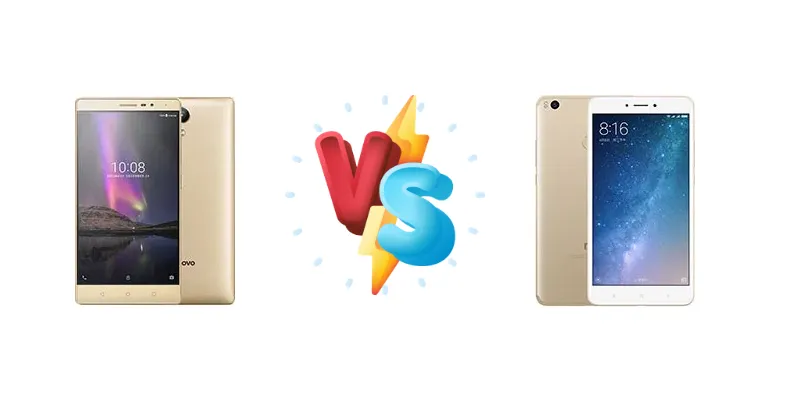
The Lenovo Phab2 and Xiaomi Mi Max 2 represent a bygone era of truly massive smartphones, often referred to as 'phablets'. Both aimed to deliver a large-screen experience without the flagship price tag. However, significant differences in their internal hardware dictate vastly different user experiences, making a direct comparison crucial for anyone considering these devices today, particularly on the used market.
🏆 Quick Verdict
For the average user, the Xiaomi Mi Max 2 is the clear winner. Its Qualcomm Snapdragon 625 chipset provides a significantly smoother and more responsive experience than the Lenovo Phab2’s Mediatek MT8735, and the inclusion of Quick Charge 3.0 adds a modern convenience the Phab2 lacks. While both offer similar battery endurance, the Mi Max 2’s overall refinement makes it the better choice.
| Network |
|---|
| 2G bands | GSM 850 / 900 / 1800 / 1900 - SIM 1 & SIM 2 | GSM 850 / 900 / 1800 / 1900 - SIM 1 & SIM 2 |
| 3G bands | HSDPA 850 / 900 / 1900 / 2100 - EMEA | HSDPA 850 / 900 / 1900 / 2100 |
| 4G bands | 1, 2, 3, 5, 7, 8, 20, 38, 40, 41 - EMEA | 1, 3, 5, 7, 8, 38, 39, 40, 41 |
| Speed | HSPA, LTE | HSPA 42.2/5.76 Mbps, LTE (2CA) Cat6 300/50 Mbps |
| Technology | GSM / HSPA / LTE | GSM / CDMA / HSPA / EVDO / LTE |
| | 2, 4, 5, 7, 12, 13, 17 - USA | CDMA2000 1xEV-DO |
| Launch |
|---|
| Announced | 2016, June. Released 2016, June | 2017, May. Released 2017, June |
| Status | Discontinued | Discontinued |
| Body |
|---|
| Build | - | Glass front (Gorilla Glass 3), aluminum back, aluminum frame |
| Dimensions | 175 x 89.5 x 9.6 mm (6.89 x 3.52 x 0.38 in) | 174.1 x 88.7 x 7.6 mm (6.85 x 3.49 x 0.30 in) |
| SIM | Hybrid Dual SIM (Micro-SIM, dual stand-by) | Nano-SIM + Micro-SIM |
| Weight | 225 g (7.94 oz) | 211 g (7.44 oz) |
| Display |
|---|
| Protection | - | Corning Gorilla Glass 3 |
| Resolution | 720 x 1280 pixels, 16:9 ratio (~229 ppi density) | 1080 x 1920 pixels, 16:9 ratio (~342 ppi density) |
| Size | 6.4 inches, 112.9 cm2 (~72.1% screen-to-body ratio) | 6.44 inches, 114.3 cm2 (~74.0% screen-to-body ratio) |
| Type | IPS LCD | IPS LCD |
| Platform |
|---|
| CPU | Quad-core 1.3 GHz Cortex-A53 | Octa-core 2.0 GHz Cortex-A53 |
| Chipset | Mediatek MT8735 | Qualcomm MSM8953 Snapdragon 625 (14 nm) |
| GPU | Mali-T720MP2 | Adreno 506 |
| OS | Android 6.0 (Marshmallow) | Android 7.1.1 (Nougat), MIUI 11 |
| Memory |
|---|
| Card slot | microSDXC (uses shared SIM slot) | microSDXC (uses shared SIM slot) |
| Internal | 32GB 3GB RAM | 32GB 4GB RAM, 64GB 4GB RAM, 128GB 4GB RAM |
| | - | eMMC 5.1 |
| Main Camera |
|---|
| Features | LED flash, HDR, panorama | Dual-LED dual-tone flash, HDR, panorama |
| Single | 13 MP, f/2.0, PDAF | 12 MP, f/2.2, 1/2.9", 1.25µm, PDAF |
| Video | 720p@30fps | 4K@30fps, 720p@120fps |
| Selfie camera |
|---|
| Single | 5 MP | 5 MP, f/2.0 |
| Video | - | 1080p@30fps |
| Sound |
|---|
| 3.5mm jack | Yes | Yes |
| 35mm jack | Yes | Yes |
| Loudspeaker | Yes | Yes, with stereo speakers |
| Comms |
|---|
| Bluetooth | 4.0, A2DP | 4.2, A2DP, LE |
| Infrared port | - | Yes |
| NFC | No | No |
| Positioning | GPS | GPS, GLONASS, BDS |
| Radio | FM radio | FM radio |
| USB | microUSB 2.0 | USB Type-C |
| WLAN | Wi-Fi 802.11 a/b/g/n | Wi-Fi 802.11 a/b/g/n/ac, dual-band, Wi-Fi Direct, DLNA |
| Features |
|---|
| Sensors | Accelerometer, gyro, proximity, compass | Fingerprint (rear-mounted), accelerometer, gyro, proximity, compass |
| Battery |
|---|
| Charging | - | 18W wired, QC3 |
| Type | Li-Ion 4050 mAh, non-removable | Li-Ion 5300 mAh, non-removable |
| Misc |
|---|
| Colors | Gunmetal Grey, Champagne Gold | Gold, Matte Black |
| Models | PB2-650M, PB2-650Y | MDE40, MDI40 |
| Price | About 230 EUR | About 200 EUR |
| SAR | - | 1.22 W/kg (head) 0.71 W/kg (body) |
| Tests |
|---|
| Audio quality | - |
Noise -93.4dB / Crosstalk -98.8dB |
| Battery life | - |
Endurance rating 126h
|
| Camera | - |
Photo / Video |
| Display | - |
Contrast ratio: 1294:1 (nominal), 2.561 (sunlight) |
| Loudspeaker | - |
Voice 78dB / Noise 71dB / Ring 79dB
|
| Performance | - |
GeekBench: 2445 (v4.4)
GFXBench: 3.5fps (ES 3.1 onscreen) |
Lenovo Phab2
- Very large display for immersive media consumption
- Extremely affordable (likely on the used market)
- Decent battery life
- Weak processor performance
- Lacks fast charging
- Potentially outdated software support
Xiaomi Mi Max 2
- Significantly faster and more efficient processor
- Quick Charge 3.0 support for rapid charging
- Better overall user experience
- May be slightly more expensive than the Phab2
- Large size can be unwieldy for some users
- Camera performance likely average
Display Comparison
Both devices share a similar display contrast ratio of 1294:1 (nominal) and 2.561 (sunlight), suggesting comparable outdoor visibility. However, the context data lacks specific resolution or panel technology details for the Phab2. The Mi Max 2, being a slightly later model, likely benefits from improved color calibration and viewing angles. The larger screen size of both devices necessitates a strong contrast ratio to maintain readability in bright conditions, and both appear to deliver on that front.
Camera Comparison
Both phones are listed with 'Photo / Video' capabilities, but lack specific details regarding sensor size, aperture, or image processing. Given the market positioning of both devices, it’s unlikely either boasts a particularly impressive camera system. The Mi Max 2 likely benefits from Qualcomm’s image signal processor (ISP) within the Snapdragon 625, potentially offering slightly better image quality and faster processing times. However, without more detailed specifications, a definitive comparison is impossible.
Performance
The performance gap between these two devices is substantial. The Xiaomi Mi Max 2’s Qualcomm Snapdragon 625, built on a 14nm process, features an octa-core Cortex-A53 CPU clocked at 2.0 GHz. This is a significant upgrade over the Lenovo Phab2’s Mediatek MT8735, a quad-core 1.3 GHz Cortex-A53 processor. The Snapdragon 625’s more efficient architecture translates to better thermal management and sustained performance, crucial for multitasking and gaming. The Mi Max 2 will exhibit noticeably less lag and stuttering in everyday use.
Battery Life
Both the Lenovo Phab2 and Xiaomi Mi Max 2 achieve an impressive endurance rating of 126 hours, indicating excellent battery life. However, the Mi Max 2 gains a significant advantage with its 18W wired charging and Quick Charge 3.0 support. This allows for much faster charging times compared to the Phab2, which likely lacks fast charging capabilities. While both will last a full day on a single charge, the Mi Max 2’s ability to quickly top up is a major convenience.
Buying Guide
Buy the Lenovo Phab2 if your primary need is a very large screen on an extremely tight budget and you primarily engage in light tasks like media consumption and basic communication. Buy the Xiaomi Mi Max 2 if you prioritize a smoother, more responsive user experience, faster charging, and a chipset capable of handling more demanding applications, even if it means spending slightly more.
Frequently Asked Questions
❓ Is the Mediatek MT8735 in the Lenovo Phab2 capable of running modern apps smoothly?
The Mediatek MT8735 is a relatively old and low-powered chipset. While it can handle basic tasks like calling, texting, and web browsing, it will struggle with more demanding applications and multitasking. Expect noticeable lag and slowdowns when running modern apps.
❓ How long does it realistically take to fully charge the Xiaomi Mi Max 2 with Quick Charge 3.0?
With a compatible Quick Charge 3.0 charger, the Xiaomi Mi Max 2 can charge from 0% to 100% in approximately 1 hour and 45 minutes to 2 hours, depending on the charger's output. This is significantly faster than the Lenovo Phab2, which likely takes 3+ hours to fully charge.
❓ Are software updates still available for either the Lenovo Phab2 or the Xiaomi Mi Max 2?
Software update support for both devices is likely limited or non-existent at this point. Both phones are several years old, and manufacturers typically cease providing updates after a certain period. Users should not expect to receive the latest Android security patches or feature updates.
❓ Which phone is better for playing mobile games?
The Xiaomi Mi Max 2 is the far better choice for mobile gaming. The Snapdragon 625’s GPU is significantly more powerful than the MT8735’s, allowing for smoother frame rates and a more enjoyable gaming experience. The Phab2 will struggle with even moderately demanding games.