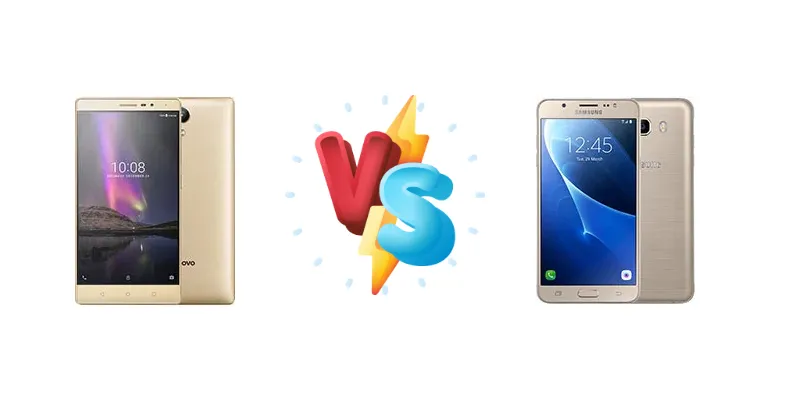
Released in 2016, both the Lenovo Phab2 and Samsung Galaxy J7 (2016) targeted the affordable smartphone market. However, they took different approaches. The Phab2 prioritized a large screen size, while the J7 focused on a more balanced experience with a potentially more efficient chipset. This comparison dissects their key differences to help you determine which device offers the best value today.
🏆 Quick Verdict
For the average user, the Samsung Galaxy J7 (2016) is the better choice. While both phones offer similar battery endurance, the J7’s Snapdragon 617 chipset (or Exynos 7870 variant) provides a more responsive user experience and better long-term performance than the Phab2’s Mediatek MT8735.
| Network |
|---|
| 2G bands | GSM 850 / 900 / 1800 / 1900 - SIM 1 & SIM 2 | GSM 850 / 900 / 1800 / 1900 - SIM 1 & SIM 2 (dual-SIM model only) |
| 3G bands | HSDPA 850 / 900 / 1900 / 2100 - EMEA | HSDPA 850 / 900 / 1900 / 2100 |
| 4G bands | 1, 2, 3, 5, 7, 8, 20, 38, 40, 41 - EMEA | 1, 3, 5, 7, 8, 20, 40 |
| Speed | HSPA, LTE | HSPA, LTE Cat4 150/50 Mbps |
| Technology | GSM / HSPA / LTE | GSM / HSPA / LTE |
| | 2, 4, 5, 7, 12, 13, 17 - USA | - |
| Launch |
|---|
| Announced | 2016, June. Released 2016, June | 2016, March 29. Released 2016, April |
| Status | Discontinued | Discontinued |
| Body |
|---|
| Build | - | Glass front, plastic back, aluminum frame |
| Dimensions | 175 x 89.5 x 9.6 mm (6.89 x 3.52 x 0.38 in) | 151.7 x 76 x 7.8 mm (5.97 x 2.99 x 0.31 in) |
| SIM | Hybrid Dual SIM (Micro-SIM, dual stand-by) | Single SIM (Micro-SIM) or Dual SIM (Micro-SIM, dual stand-by) |
| Weight | 225 g (7.94 oz) | 170 g (6.00 oz) |
| Display |
|---|
| Resolution | 720 x 1280 pixels, 16:9 ratio (~229 ppi density) | 720 x 1280 pixels, 16:9 ratio (~267 ppi density) |
| Size | 6.4 inches, 112.9 cm2 (~72.1% screen-to-body ratio) | 5.5 inches, 83.4 cm2 (~72.3% screen-to-body ratio) |
| Type | IPS LCD | Super AMOLED |
| Platform |
|---|
| CPU | Quad-core 1.3 GHz Cortex-A53 | Octa-core (4x1.6 GHz Cortex-A53 & 4x1.0 GHz Cortex-A53)Octa-core 1.6 GHz Cortex-A53 |
| Chipset | Mediatek MT8735 | Qualcomm MSM8952 Snapdragon 617 (28 nm)Exynos 7870 Octa (14 nm) |
| GPU | Mali-T720MP2 | Adreno 405Mali-T830 MP1 |
| OS | Android 6.0 (Marshmallow) | Android 6.0.1 (Marshmallow), upgradable to Android 8.1 (Oreo) |
| Memory |
|---|
| Card slot | microSDXC (uses shared SIM slot) | microSDXC (dedicated slot) |
| Internal | 32GB 3GB RAM | 16GB 2GB RAM |
| | - | eMMC 5.1 |
| Main Camera |
|---|
| Features | LED flash, HDR, panorama | LED flash, panorama, HDR |
| Single | 13 MP, f/2.0, PDAF | 13 MP, f/1.9, 28mm (wide), AF |
| Video | 720p@30fps | 1080p@30fps |
| Selfie camera |
|---|
| Features | - | LED flash |
| Single | 5 MP | 5 MP, f/1.9 |
| Sound |
|---|
| 3.5mm jack | Yes | Yes |
| 35mm jack | Yes | Yes |
| Loudspeaker | Yes | Yes |
| Comms |
|---|
| Bluetooth | 4.0, A2DP | 4.1, A2DP |
| NFC | No | Yes (market dependent for dual-SIM model) |
| Positioning | GPS | GPS, GLONASS, BDS |
| Radio | FM radio | FM radio, RDS, recording |
| USB | microUSB 2.0 | microUSB 2.0, OTG |
| WLAN | Wi-Fi 802.11 a/b/g/n | Wi-Fi 802.11 b/g/n, Wi-Fi Direct |
| Features |
|---|
| Sensors | Accelerometer, gyro, proximity, compass | Accelerometer, proximity |
| | - | ANT+ |
| Battery |
|---|
| Music play | - | Up to 96 h |
| Talk time | - | Up to 23 h (3G) |
| Type | Li-Ion 4050 mAh, non-removable | Li-Ion 3300 mAh, removable |
| Misc |
|---|
| Colors | Gunmetal Grey, Champagne Gold | White, Black, Gold, Rose Gold |
| Models | PB2-650M, PB2-650Y | SM-J710FN, SM-J710F, SM-J710H, SM-J710M, SM-J710GN, SM-J710MN, SM-J710K, SM-J7108, SM-J710FQ |
| Price | About 230 EUR | About 230 EUR |
| SAR | - | 1.10 W/kg (head) 1.01 W/kg (body) |
| SAR EU | - | 0.35 W/kg (head) 1.39 W/kg (body) |
| Tests |
|---|
| Audio quality | - |
Noise -92.4dB / Crosstalk -92.3dB |
| Battery life | - |
Endurance rating 101h
|
| Camera | - |
Photo / Video |
| Display | - |
Contrast ratio: Infinite (nominal), 3.902 (sunlight) |
| Loudspeaker | - |
Voice 64dB / Noise 71dB / Ring 68dB
|
| Performance | - |
Basemark OS II 2.0: 1007Basemark X: 11199 |
Lenovo Phab2
- Larger screen size ideal for media consumption
- Comparable battery life to the J7
- Potentially lower price point (depending on current market)
- Less powerful processor leading to slower performance
- Likely lower display pixel density due to larger screen size
- Mediatek chipset may receive fewer software updates
Samsung Galaxy J7 (2016)
- More powerful Snapdragon 617 or Exynos 7870 chipset
- Potentially better camera image processing
- More established brand reputation and software support
- Smaller screen size compared to the Phab2
- Similar battery life, but potentially less efficient chipset (Snapdragon variant)
- May be slightly more expensive than the Phab2
Display Comparison
Both devices share an 'infinite' contrast ratio (a marketing term indicating deep blacks), and a sunlight contrast ratio of 3.902, suggesting similar outdoor visibility. However, the Phab2’s larger screen size is its defining feature. While the J7’s display resolution isn’t specified, it’s likely 720p, similar to the Phab2, meaning pixel density will be lower on the larger Phab2 screen. This could result in a slightly less sharp image. Neither device is expected to offer advanced display features like high refresh rates or HDR support, common in more premium phones.
Camera Comparison
Both phones feature photo and video capabilities, but detailed camera specifications are limited. Without sensor size or aperture information, a direct comparison is difficult. However, Samsung generally employs more sophisticated image processing algorithms. The J7’s potential for better image quality stems from the more powerful ISP (Image Signal Processor) within the Snapdragon 617 or Exynos 7870, allowing for faster processing and potentially better noise reduction. The presence of a 2MP macro camera on either device is unlikely to significantly impact overall camera performance; these sensors often lack the detail and dynamic range needed for truly compelling macro shots.
Performance
The Samsung Galaxy J7 (2016) has a significant advantage in processing power. It comes equipped with either the Qualcomm MSM8952 Snapdragon 617 (28nm) or the Exynos 7870 Octa (14nm) – both octa-core processors. The Snapdragon 617 utilizes a quad-core Cortex-A53 setup clocked at 1.6 GHz paired with another quad-core Cortex-A53 at 1.0 GHz, while the Exynos 7870 features eight Cortex-A53 cores at 1.6 GHz. This contrasts with the Lenovo Phab2’s Mediatek MT8735, a quad-core 1.3 GHz Cortex-A53 processor. The 14nm process node of the Exynos 7870 offers superior power efficiency compared to the Snapdragon 617’s 28nm node, potentially leading to less thermal throttling during sustained tasks. The additional cores and higher clock speeds in the J7’s chipsets translate to noticeably faster app loading times and smoother multitasking.
Battery Life
Both the Lenovo Phab2 and Samsung Galaxy J7 (2016) achieve an endurance rating of 101 hours, indicating comparable battery life under similar usage conditions. This suggests that despite the Phab2’s larger screen, the more efficient chipset in the J7 compensates for the power draw. Charging speeds are not specified, but given the age of these devices, fast charging is unlikely to be a prominent feature. The similar endurance ratings mean that real-world battery life will depend heavily on individual usage patterns.
Buying Guide
Buy the Lenovo Phab2 if your primary need is a large screen for media consumption and you prioritize size over raw performance. Buy the Samsung Galaxy J7 (2016) if you value a smoother, more reliable user experience, potentially better camera performance, and a more established brand reputation within the budget segment.
Frequently Asked Questions
❓ Does the Exynos 7870 chip in some J7 (2016) models overheat during prolonged gaming?
While the Exynos 7870 is more efficient than the Snapdragon 617, and both are significantly less powerful than modern chips, sustained gaming can still generate heat. The 14nm process helps mitigate throttling, but expect some performance reduction after extended play sessions. The Phab2's MT8735 will likely throttle even more quickly.
❓ Is the camera on the Samsung Galaxy J7 (2016) significantly better than the Phab2 in low-light conditions?
The J7 likely performs better in low light due to the more capable ISP within the Snapdragon 617 or Exynos 7870. This allows for more effective noise reduction and potentially brighter, more detailed images. However, neither phone is expected to deliver flagship-level low-light performance.
❓ Can either of these phones handle modern mobile games like PUBG or Call of Duty Mobile?
While both phones can *run* these games, expect to play at the lowest graphics settings and potentially experience frame rate drops. The Snapdragon 617 or Exynos 7870 in the J7 will provide a slightly smoother experience, but neither phone is optimized for demanding modern titles.
❓ What kind of software updates can I expect for these phones in 2024?
Software support for both devices is extremely limited at this point. Neither Lenovo nor Samsung are likely to release further updates. Security patches are also unlikely, making these phones potentially vulnerable to security threats.