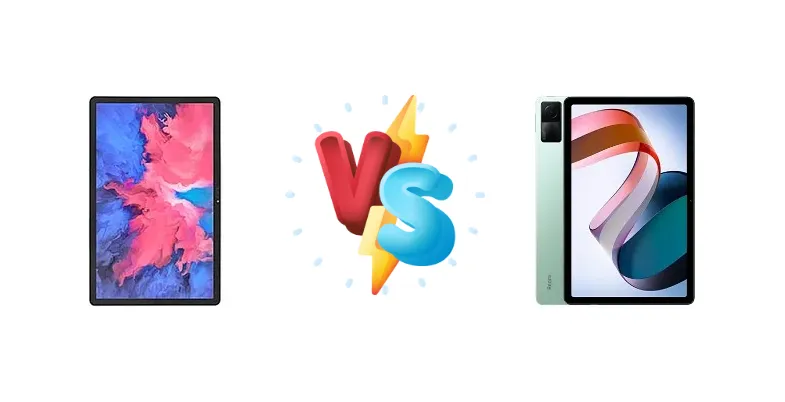
The Lenovo Pad and Xiaomi Redmi Pad represent compelling options in the increasingly crowded budget tablet space. While both aim to deliver a versatile experience without breaking the bank, they take different approaches to achieving this goal. The Lenovo Pad relies on Qualcomm’s Snapdragon 662, while the Redmi Pad opts for MediaTek’s newer Helio G99. This comparison will dissect their strengths and weaknesses to determine which tablet best suits your needs.
🏆 Quick Verdict
For most users, the Xiaomi Redmi Pad emerges as the better choice. Its more modern Mediatek Helio G99 chipset delivers noticeably improved performance, and the 402 nits of brightness provides a more enjoyable viewing experience, despite the similar contrast ratios. While the Lenovo Pad offers Quick Charge support, the performance gains of the Redmi Pad outweigh this advantage.
| Network |
|---|
| 2G bands | N/A | N/A |
| 3G bands | N/A | N/A |
| 4G bands | N/A | N/A |
| EDGE | No | N/A |
| GPRS | No | N/A |
| Technology | No cellular connectivity | No cellular connectivity |
| Launch |
|---|
| Announced | 2021, May 24 | 2022, October 04 |
| Status | Available. Released 2021, June 01 | Available. Released 2022, October 05 |
| Body |
|---|
| Build | Glass front, plastic frame, plastic back | Glass front, aluminum frame |
| Dimensions | 258.4 x 163 x 7.5 mm (10.17 x 6.42 x 0.30 in) | 250.5 x 158.1 x 7.1 mm (9.86 x 6.22 x 0.28 in) |
| SIM | No | No |
| Weight | 490 g (1.08 lb) | 465 g (1.03 lb) |
| | Stylus support | - |
| Display |
|---|
| Resolution | 1200 x 2000 pixels, 5:3 ratio (~212 ppi density) | 1200 x 2000 pixels, 5:3 ratio (~220 ppi density) |
| Size | 11.0 inches, 344.4 cm2 (~81.8% screen-to-body ratio) | 10.61 inches, 320.4 cm2 (~80.9% screen-to-body ratio) |
| Type | TDDI IPS LCD, 400 nits (typ) | IPS LCD, 1B colors, 90Hz, 400 nits (typ) |
| Platform |
|---|
| CPU | Octa-core (4x2.0 GHz Kryo 260 Gold & 4x1.8 GHz Kryo 260 Silver) | Octa-core (2x2.2 GHz Cortex-A76 & 6x2.0 GHz Cortex-A55) |
| Chipset | Qualcomm SM6115 Snapdragon 662 (11 nm) | Mediatek Helio G99 (6 nm) |
| GPU | Adreno 610 | Mali-G57 MC2 |
| OS | Android 11, ZUI 12.5 | Android 12, upgradable to Android 13, MIUI 14 |
| Memory |
|---|
| Card slot | microSDXC (dedicated slot) | microSDXC |
| Internal | 64GB 4GB RAM, 128GB 6GB RAM | 64GB 3GB RAM, 128GB 4GB RAM, 128GB 6GB RAM |
| | UFS 2.1 | UFS 2.2 |
| Main Camera |
|---|
| Features | LED flash | - |
| Single | 13 MP, AF | 8 MP, f/2.0, (wide), AF |
| Video | 1080p@30fps | 1080p@30fps |
| Selfie camera |
|---|
| Single | 8 MP
TOF 3D, (depth/biometrics sensor) | 8 MP, f/2.3, 105° (ultrawide) |
| Video | 1080p@30fps | 1080p@30fps |
| Sound |
|---|
| 3.5mm jack | No | No |
| 35mm jack | No | No |
| Loudspeaker | Yes, with stereo speakers (4 speakers) | Yes, with stereo speakers (4 speakers) |
| | - | 24-bit/192kHz audio |
| Comms |
|---|
| Bluetooth | 5.0, A2DP, LE | 5.2, A2DP, LE |
| NFC | No | No |
| Positioning | GPS, BDS | No |
| Radio | No | No |
| USB | USB Type-C 2.0, OTG, magnetic connector | USB Type-C, OTG |
| WLAN | Wi-Fi 802.11 a/b/g/n/ac, dual-band, Wi-Fi Direct | Wi-Fi 802.11 a/b/g/n/ac, dual-band, Wi-Fi Direct |
| Features |
|---|
| Sensors | Face recognition, accelerometer, gyro, proximity | Accelerometer |
| Battery |
|---|
| Charging | 20W wired, QC3 | 18W wired |
| Type | Li-Po 7700 mAh | Li-Po 8000 mAh |
| Misc |
|---|
| Colors | Gray | Graphite Gray, Moonlight Silver, Mint Green |
| Models | ZA7R0232CN | 22081283G |
| Price | About 140 EUR | About 250 EUR |
| SAR EU | - | 0.36 W/kg (body) |
| Tests |
|---|
| Display | - |
Contrast ratio: 1529:1 (nominal) |
| Loudspeaker | - |
-23.9 LUFS (Very good)
|
| Performance | - |
AnTuTu: 319077 (v9)
GeekBench: 1852 (v5.1)
GFXBench: 13fps (ES 3.1 onscreen) |
Lenovo Pad
- Quick Charge 3.0 support for potentially faster charging.
- Qualcomm chipset may offer better software optimization for some apps.
- Established Qualcomm ecosystem.
- Older Snapdragon 662 chipset offers lower performance.
- 11nm process is less efficient than the Redmi Pad’s 6nm process.
- Display brightness is unspecified and likely lower than the Redmi Pad.
Xiaomi Redmi Pad
- More powerful and efficient MediaTek Helio G99 chipset.
- Brighter display (402 nits) for better visibility.
- 6nm process for improved battery life and thermal management.
- Slower 18W charging compared to the Lenovo Pad’s 20W.
- MediaTek chipset may have compatibility issues with some niche apps.
- Less established software ecosystem compared to Qualcomm.
Display Comparison
The Xiaomi Redmi Pad boasts a brighter display, reaching a measured 402 nits compared to the Lenovo Pad’s unspecified brightness. While both share a 1529:1 contrast ratio, the higher peak brightness of the Redmi Pad significantly improves visibility in brightly lit environments. The lack of detailed display specifications for the Lenovo Pad, such as panel type (IPS, TFT) and color gamut coverage, makes a comprehensive comparison difficult, but the Redmi Pad’s measured brightness is a clear advantage for outdoor use and HDR content viewing. Bezels appear comparable based on available imagery, suggesting neither device excels in maximizing screen real estate.
Camera Comparison
Neither tablet is positioned as a photography powerhouse, and detailed camera specifications are limited. Without information on sensor size or image processing capabilities for the Lenovo Pad, it’s difficult to make a direct comparison. However, given the Redmi Pad’s focus on overall value, it’s reasonable to assume its camera system is optimized for its price point. Users should temper expectations for image quality on both devices, as they are primarily designed for video calls and casual snapshots. The absence of OIS or advanced features on either tablet further reinforces this point.
Performance
The core difference lies in the chipsets. The Xiaomi Redmi Pad’s MediaTek Helio G99, fabricated on a 6nm process, offers a significant architectural advantage over the Lenovo Pad’s Qualcomm Snapdragon 662 (11nm). The Helio G99’s Cortex-A76 cores, clocked at 2.2 GHz, provide a substantial performance uplift compared to the Snapdragon 662’s Kryo 260 Gold cores at 2.0 GHz. This translates to smoother multitasking, faster app loading times, and improved gaming performance on the Redmi Pad. While both utilize an octa-core configuration, the newer architecture and smaller process node of the Helio G99 result in better efficiency and sustained performance. The Lenovo Pad’s Snapdragon 662 is adequate for basic tasks, but will struggle with demanding applications.
Battery Life
The Lenovo Pad supports 20W wired charging with Quick Charge 3.0 compatibility, while the Xiaomi Redmi Pad is limited to 18W wired charging. While the Lenovo Pad has a charging speed advantage, the more efficient MediaTek Helio G99 in the Redmi Pad may offset this difference in real-world usage. The actual battery capacity of both devices is not specified, making it difficult to predict overall battery life. However, the Helio G99’s 6nm process should contribute to longer runtimes on the Redmi Pad, especially during demanding tasks. The 2W difference in charging wattage is unlikely to be a significant factor for most users.
Buying Guide
Buy the Lenovo Pad if you prioritize Qualcomm’s established software ecosystem and potentially faster charging speeds, and are primarily focused on basic tasks like web browsing and light media consumption. Buy the Xiaomi Redmi Pad if you value performance for gaming and multitasking, a brighter display for outdoor use, and a more future-proof chipset, even if it means slightly slower charging.
Frequently Asked Questions
❓ Will the MediaTek Helio G99 in the Redmi Pad struggle with graphically intensive games like Genshin Impact?
While the Helio G99 isn't a flagship gaming chip, it's capable of running Genshin Impact at lower settings (medium or low) with acceptable frame rates. Expect some frame drops during intense combat scenarios. The Snapdragon 662 in the Lenovo Pad will likely struggle even at the lowest settings.
❓ Does the Xiaomi Redmi Pad support video playback of high-resolution codecs like AV1?
The Xiaomi Redmi Pad's MediaTek Helio G99 chipset does support AV1 decoding, allowing for efficient playback of content from streaming services like YouTube and Netflix. The Lenovo Pad's Snapdragon 662 support for AV1 is limited, potentially resulting in higher data consumption and reduced battery life when streaming AV1 content.
❓ Is the 18W charging on the Redmi Pad noticeably slower than the 20W charging on the Lenovo Pad?
The difference in charging speed is unlikely to be dramatic. While 20W is technically faster, the Redmi Pad’s more efficient chipset and potentially optimized charging algorithms may minimize the real-world difference. Expect both tablets to take around 2-3 hours to fully charge from 0%.