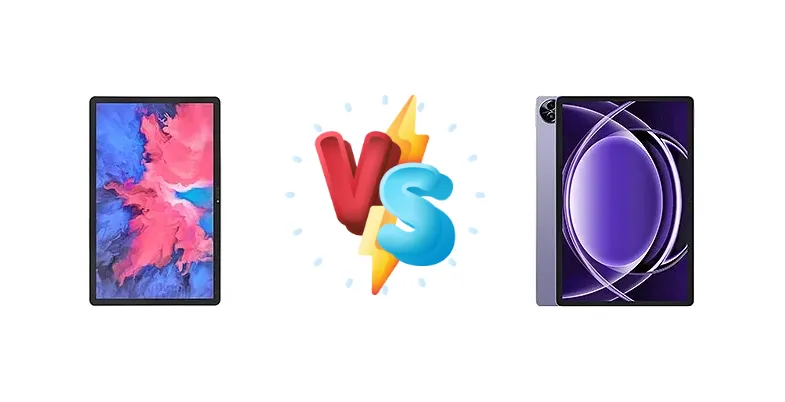
The budget tablet market is fiercely competitive, and the Lenovo Pad and Realme Pad 2 Lite represent compelling options for users seeking affordable entertainment and productivity. While both aim for accessibility, they take different approaches to achieving it, primarily through their chipset choices. This comparison dissects those choices and their implications for everyday use.
🏆 Quick Verdict
For most users, the Realme Pad 2 Lite emerges as the better choice. Its Mediatek Helio G99, built on a 6nm process, delivers a noticeable performance uplift over the Lenovo Pad’s Snapdragon 662, despite the Lenovo Pad’s slightly faster charging. The efficiency gains of the 6nm node also translate to potentially better battery life under load.
| Network |
|---|
| 2G bands | N/A | GSM 850 / 900 / 1800 / 1900 |
| 3G bands | N/A | HSDPA 850 / 900 / 2100 |
| 4G bands | N/A | 1, 3, 5, 7, 8, 20, 28, 38, 40, 41 |
| EDGE | No | - |
| GPRS | No | - |
| Speed | - | HSPA, LTE |
| Technology | No cellular connectivity | GSM / HSPA / LTE |
| Launch |
|---|
| Announced | 2021, May 24 | 2024, September 13 |
| Status | Available. Released 2021, June 01 | Available. Released 2024, September 26 |
| Body |
|---|
| Build | Glass front, plastic frame, plastic back | - |
| Dimensions | 258.4 x 163 x 7.5 mm (10.17 x 6.42 x 0.30 in) | 258 x 169.5 x 8.3 mm (10.16 x 6.67 x 0.33 in) |
| SIM | No | No |
| Weight | 490 g (1.08 lb) | 525 g (1.16 lb) |
| | Stylus support | - |
| Display |
|---|
| Resolution | 1200 x 2000 pixels, 5:3 ratio (~212 ppi density) | 1200 x 1920 pixels, 16:10 ratio (~207 ppi density) |
| Size | 11.0 inches, 344.4 cm2 (~81.8% screen-to-body ratio) | 10.95 inches, 347.7 cm2 (~79.5% screen-to-body ratio) |
| Type | TDDI IPS LCD, 400 nits (typ) | IPS LCD, 1B colors, 90Hz, 450 nits (peak) |
| Platform |
|---|
| CPU | Octa-core (4x2.0 GHz Kryo 260 Gold & 4x1.8 GHz Kryo 260 Silver) | Octa-core (2x2.2 GHz Cortex-A76 & 6x2.0 GHz Cortex-A55) |
| Chipset | Qualcomm SM6115 Snapdragon 662 (11 nm) | Mediatek Helio G99 (6 nm) |
| GPU | Adreno 610 | Mali-G57 MC2 |
| OS | Android 11, ZUI 12.5 | Android 14, Realme UI 5.0 for Pad |
| Memory |
|---|
| Card slot | microSDXC (dedicated slot) | Unspecified |
| Internal | 64GB 4GB RAM, 128GB 6GB RAM | 128GB 4GB RAM, 128GB 8GB RAM |
| | UFS 2.1 | - |
| Main Camera |
|---|
| Features | LED flash | Panorama |
| Single | 13 MP, AF | 8 MP, f/2.0 |
| Video | 1080p@30fps | 1080p@30fps |
| Selfie camera |
|---|
| Features | - | Panorama |
| Single | 8 MP
TOF 3D, (depth/biometrics sensor) | 5 MP, f/2.2 |
| Video | 1080p@30fps | 1080p@30fps |
| Sound |
|---|
| 3.5mm jack | No | - |
| 35mm jack | No | No |
| Loudspeaker | Yes, with stereo speakers (4 speakers) | Yes, with stereo speakers (4 speakers) |
| Comms |
|---|
| Bluetooth | 5.0, A2DP, LE | 5.2, A2DP, LE |
| NFC | No | No |
| Positioning | GPS, BDS | GPS, GALILEO, GLONASS, BDS |
| Radio | No | No |
| USB | USB Type-C 2.0, OTG, magnetic connector | USB Type-C |
| WLAN | Wi-Fi 802.11 a/b/g/n/ac, dual-band, Wi-Fi Direct | Wi-Fi 802.11 a/b/g/n/ac, dual-band |
| Features |
|---|
| Sensors | Face recognition, accelerometer, gyro, proximity | Accelerometer |
| Battery |
|---|
| Charging | 20W wired, QC3 | 15W wired |
| Type | Li-Po 7700 mAh | 8300 mAh |
| Misc |
|---|
| Colors | Gray | Nebula Purple, Space Grey |
| Models | ZA7R0232CN | RMP2402 |
| Price | About 140 EUR | About 160 EUR |
Lenovo Pad
- Faster 20W charging with QC3 support.
- Established Qualcomm chipset ecosystem.
- Potentially wider accessory availability.
- Older 11nm process node leads to lower efficiency.
- Snapdragon 662 offers less raw performance than Helio G99.
- Likely to throttle more under sustained load.
Realme Pad 2 Lite
- More powerful and efficient Mediatek Helio G99 (6nm).
- Modern CPU architecture with Cortex-A76 cores.
- Better sustained performance due to improved thermal management.
- Slower 15W charging.
- Realme UI may not appeal to all users.
- Potentially less established software support compared to Qualcomm.
Display Comparison
Neither device’s display specifications are provided, so a direct comparison is limited. However, given their price points, both likely utilize IPS LCD panels. The Realme Pad 2 Lite’s newer chipset *could* suggest a slightly more advanced display controller, potentially leading to better color accuracy or refresh rate support, but this is speculative. Bezels are likely comparable, aiming for maximizing screen real estate within the budget constraints. Without specific nit ratings, it’s difficult to assess brightness performance.
Camera Comparison
Without detailed camera specifications, a meaningful comparison is challenging. Both tablets likely feature basic camera setups geared towards video calls and casual snapshots. The absence of information regarding sensor size, aperture, or image stabilization suggests neither device prioritizes photography. Any differences in image quality will likely stem from software processing rather than hardware capabilities.
Performance
The core difference lies in the chipsets. The Realme Pad 2 Lite’s Mediatek Helio G99 (6nm) boasts a more modern architecture than the Lenovo Pad’s Qualcomm Snapdragon 662 (11nm). While the Snapdragon 662 features an octa-core configuration with Kryo 260 cores clocked up to 2.0 GHz, the Helio G99 utilizes a combination of Cortex-A76 (2.2 GHz) and Cortex-A55 cores. The Cortex-A76 cores in the G99 offer significantly higher single-core performance, crucial for responsive UI and app loading. The 6nm process node of the G99 also provides superior power efficiency, reducing heat generation and potentially extending sustained performance. This means the Realme Pad 2 Lite is likely to exhibit less throttling during prolonged gaming or video editing.
Battery Life
The Lenovo Pad supports 20W wired charging with Quick Charge 3.0, while the Realme Pad 2 Lite is limited to 15W. This suggests the Lenovo Pad could achieve a faster 0-100% charge time. However, the Helio G99’s 6nm efficiency could offset the slower charging speed by reducing overall power consumption. Real-world battery life will depend heavily on usage patterns, but the G99’s efficiency gives the Realme Pad 2 Lite an advantage in scenarios involving demanding applications or extended screen-on time.
Buying Guide
Buy the Lenovo Pad if you prioritize Qualcomm’s established software ecosystem and potentially wider accessory availability, and if fast charging is a key concern. Buy the Realme Pad 2 Lite if you value raw performance for the price, a more modern chipset architecture, and are comfortable with the Realme UI software experience. The G99 offers a more future-proof experience for gaming and demanding apps.
Frequently Asked Questions
❓ Will the Realme Pad 2 Lite struggle with graphically intensive games like PUBG Mobile?
The Mediatek Helio G99 is a capable chipset for gaming, and should handle PUBG Mobile at medium settings with reasonable frame rates. While it won't deliver a flagship gaming experience, it's a significant step up from the Snapdragon 662 in the Lenovo Pad, offering better sustained performance and less throttling during extended gaming sessions.
❓ Is the 15W charging on the Realme Pad 2 Lite noticeably slower than the 20W charging on the Lenovo Pad?
While 20W is faster on paper, the difference in real-world charging times may not be dramatic. The Helio G99’s efficiency means the battery depletes slower, and the 15W charger can still provide a reasonable charge time. The efficiency gains may even result in a similar overall time to fully charge from a very low percentage.
❓ Does the Snapdragon 662 in the Lenovo Pad support software updates for longer than the Helio G99 in the Realme Pad 2 Lite?
Historically, Qualcomm chipsets have sometimes received longer software support from manufacturers. However, Realme has been improving its software update commitment. It's difficult to predict definitively, but it's a valid consideration if long-term software support is a priority.