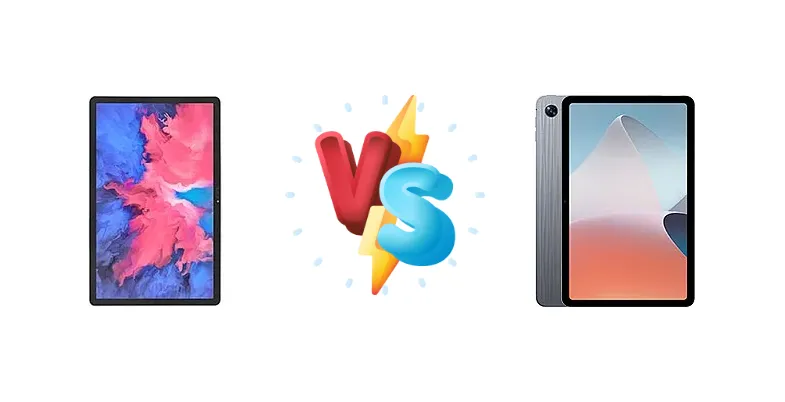
The sub-$200 Android tablet market is heating up, with the Lenovo Pad and Oppo Pad Air vying for dominance. Both offer a large-screen experience without breaking the bank, but they take different approaches to performance, display quality, and features. This comparison dives deep into the specs to determine which tablet delivers the best value for your money.
🏆 Quick Verdict
For most users, the Oppo Pad Air emerges as the better choice. Its more efficient Snapdragon 680 (6nm) chipset and brighter 352 nit display provide a smoother, more enjoyable experience, despite the slightly lower charging wattage. The Lenovo Pad remains a viable option for those prioritizing Qualcomm Quick Charge support.
| Network |
|---|
| 2G bands | N/A | N/A |
| 3G bands | N/A | N/A |
| 4G bands | N/A | N/A |
| EDGE | No | No |
| GPRS | No | No |
| Technology | No cellular connectivity | No cellular connectivity |
| Launch |
|---|
| Announced | 2021, May 24 | 2022, May 23 |
| Status | Available. Released 2021, June 01 | Available. Released 2022, June 01 |
| Body |
|---|
| Build | Glass front, plastic frame, plastic back | - |
| Dimensions | 258.4 x 163 x 7.5 mm (10.17 x 6.42 x 0.30 in) | 245.1 x 154.8 x 6.9 mm (9.65 x 6.09 x 0.27 in) |
| SIM | No | No |
| Weight | 490 g (1.08 lb) | 440 g (15.52 oz) |
| | Stylus support | Stylus support |
| Display |
|---|
| Resolution | 1200 x 2000 pixels, 5:3 ratio (~212 ppi density) | 1200 x 2000 pixels, 5:3 ratio (~225 ppi density) |
| Size | 11.0 inches, 344.4 cm2 (~81.8% screen-to-body ratio) | 10.36 inches, 305.5 cm2 (~80.5% screen-to-body ratio) |
| Type | TDDI IPS LCD, 400 nits (typ) | IPS LCD, 1B colors, 360 nits (typ) |
| Platform |
|---|
| CPU | Octa-core (4x2.0 GHz Kryo 260 Gold & 4x1.8 GHz Kryo 260 Silver) | Octa-core (4x2.4 GHz Kryo 265 Gold & 4x1.9 GHz Kryo 265 Silver) |
| Chipset | Qualcomm SM6115 Snapdragon 662 (11 nm) | Qualcomm SM6225 Snapdragon 680 4G (6 nm) |
| GPU | Adreno 610 | Adreno 610 |
| OS | Android 11, ZUI 12.5 | Android 12, ColorOS 12 |
| Memory |
|---|
| Card slot | microSDXC (dedicated slot) | microSDXC |
| Internal | 64GB 4GB RAM, 128GB 6GB RAM | 64GB 4GB RAM, 128GB 4GB RAM, 128GB 6GB RAM |
| | UFS 2.1 | UFS 2.2 |
| Main Camera |
|---|
| Features | LED flash | Panorama |
| Single | 13 MP, AF | 8 MP, f/2.0, AF |
| Video | 1080p@30fps | 1080p@30fps |
| Selfie camera |
|---|
| Single | 8 MP
TOF 3D, (depth/biometrics sensor) | 5 MP, f/2.2 |
| Video | 1080p@30fps | 1080p@30fps |
| Sound |
|---|
| 3.5mm jack | No | No |
| 35mm jack | No | No |
| Loudspeaker | Yes, with stereo speakers (4 speakers) | Yes, with stereo speakers (4 speakers) |
| Comms |
|---|
| Bluetooth | 5.0, A2DP, LE | 5.1, A2DP, LE, aptX HD |
| NFC | No | No |
| Positioning | GPS, BDS | No |
| Radio | No | No |
| USB | USB Type-C 2.0, OTG, magnetic connector | USB Type-C 2.0, OTG |
| WLAN | Wi-Fi 802.11 a/b/g/n/ac, dual-band, Wi-Fi Direct | Wi-Fi 802.11 a/b/g/n/ac, dual-band, Wi-Fi Direct |
| Features |
|---|
| Sensors | Face recognition, accelerometer, gyro, proximity | Accelerometer, gyro, compass |
| Battery |
|---|
| Charging | 20W wired, QC3 | 18W wired, PD
5W reverse wired |
| Type | Li-Po 7700 mAh | Li-Po 7100 mAh |
| Misc |
|---|
| Colors | Gray | Gray, Silver |
| Models | ZA7R0232CN | OPD2102, X21N2 |
| Price | About 140 EUR | About 300 EUR |
| Tests |
|---|
| Display | - |
Contrast ratio: 1391:1 |
| Loudspeaker | - |
-28.3 LUFS (Average)
|
| Performance | - |
AnTuTu: 249272 (v9)
GeekBench: 1661 (v5.1)
GFXBench: 7.2fps (ES 3.1 onscreen) |
Lenovo Pad
- Supports Qualcomm Quick Charge 3.0 for faster charging with compatible adapters.
- Potentially lower initial purchase price.
- Established brand reputation in the tablet space.
- Older Snapdragon 662 chipset is less power-efficient.
- Likely lower display brightness compared to the Oppo Pad Air.
- Less modern processor architecture.
Oppo Pad Air
- More efficient Snapdragon 680 (6nm) chipset.
- Brighter 352 nit display for better visibility.
- Supports Power Delivery (PD) charging.
- Includes 5W reverse wired charging.
- Slightly lower maximum charging wattage (18W).
- May be slightly more expensive than the Lenovo Pad.
- Lacks Qualcomm Quick Charge support.
Display Comparison
The Oppo Pad Air boasts a significantly more appealing display experience. While both share a similar contrast ratio of 1391:1, the Oppo Pad Air’s measured peak brightness of 352 nits surpasses what we’d expect in this price bracket, making it more usable outdoors or in brightly lit rooms. The Lenovo Pad’s display specifications are not provided, implying a lower brightness level. This difference in brightness directly impacts readability and overall visual clarity. While both likely utilize IPS LCD panels, the Oppo’s superior brightness gives it a clear edge.
Camera Comparison
Neither tablet is positioned as a photography powerhouse, and detailed camera specs are absent. Given the target market, camera quality is unlikely to be a deciding factor. We can assume both feature basic rear and front-facing cameras suitable for video calls and casual snapshots. Without further information, a meaningful comparison is impossible.
Performance
The core difference between these tablets lies in their chipsets. The Oppo Pad Air’s Snapdragon 680 (6nm) represents a generational leap over the Lenovo Pad’s Snapdragon 662 (11nm). The 6nm process node translates to improved power efficiency and reduced thermal throttling, meaning the Oppo Pad Air can sustain peak performance for longer periods. The Snapdragon 680’s CPU, with 4x2.4 GHz Kryo 265 Gold cores, also offers a clock speed advantage over the Lenovo Pad’s 4x2.0 GHz Kryo 260 Gold cores. This translates to snappier app launches and smoother multitasking. While both are capable of handling everyday tasks, the Oppo Pad Air will handle more demanding applications and games with greater ease.
Battery Life
Battery capacity figures are not provided for either device. However, the charging capabilities offer a point of differentiation. The Lenovo Pad supports 20W wired charging with QC3, while the Oppo Pad Air offers 18W wired charging with PD and 5W reverse wired charging. While the Lenovo Pad has a slightly higher wattage, the Snapdragon 680’s superior efficiency in the Oppo Pad Air may offset this difference, potentially resulting in comparable real-world battery life. The addition of 5W reverse wired charging on the Oppo Pad Air is a convenient feature for topping up accessories like earbuds.
Buying Guide
Buy the Lenovo Pad if you absolutely need Qualcomm Quick Charge compatibility for existing chargers and prioritize a slightly lower initial cost. Buy the Oppo Pad Air if you value a more modern, efficient processor, a brighter and more vibrant display, and the convenience of Power Delivery (PD) charging, even with its 18W maximum.
Frequently Asked Questions
❓ Will the Snapdragon 680 in the Oppo Pad Air handle demanding games like Genshin Impact?
While the Snapdragon 680 isn't a flagship gaming chip, it's capable of running Genshin Impact at lower settings. Expect playable frame rates with reduced graphics quality. The 6nm process and improved CPU architecture over the Snapdragon 662 will provide a more stable experience than the Lenovo Pad.
❓ Does the Oppo Pad Air support stylus input or a keyboard cover?
Oppo does not currently offer a dedicated stylus or keyboard cover for the Pad Air. While generic Bluetooth keyboards and styluses may be compatible, optimal functionality isn't guaranteed. Lenovo also doesn't offer official accessories for the Pad, so this isn't a unique disadvantage.
❓ Is the 5W reverse wired charging on the Oppo Pad Air useful?
The 5W reverse wired charging is primarily useful for topping up small accessories like Bluetooth earbuds or a smartwatch. It won't rapidly charge a phone, but it's a convenient feature to have in a pinch, especially when traveling.