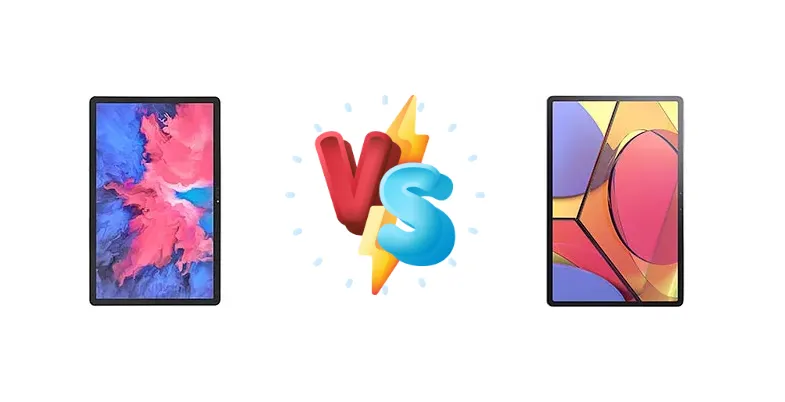
Lenovo offers a compelling range of Android tablets, but navigating the options can be tricky. The Lenovo Pad and Tab P11 Pro represent distinct tiers within their lineup. The Pad focuses on affordability, while the P11 Pro aims for a more premium experience. This comparison dissects the core differences – specifically the chipsets – to determine which tablet best suits your needs and budget.
🏆 Quick Verdict
For most users, the Lenovo Tab P11 Pro is the superior choice. Its Snapdragon 730G chipset, built on a more efficient 8nm process, delivers noticeably better performance for multitasking, gaming, and demanding applications. While both tablets share 20W charging, the P11 Pro’s processing power justifies the price difference.
| Network |
|---|
| 2G bands | N/A | GSM 850 / 900 / 1800 / 1900 |
| 3G bands | N/A | HSDPA 850 / 900 / 1900 / 2100 |
| 4G bands | N/A | 1, 2, 3, 4, 5, 7, 8, 18, 19, 20, 26, 28, 38, 39, 40, 41 |
| EDGE | No | - |
| GPRS | No | - |
| Speed | - | HSPA, LTE - cellular model only |
| Technology | No cellular connectivity | GSM / HSPA / LTE |
| Launch |
|---|
| Announced | 2021, May 24 | 2020, August 31. Released 2020, December 14 |
| Status | Available. Released 2021, June 01 | Discontinued |
| Body |
|---|
| Build | Glass front, plastic frame, plastic back | Glass front, aluminum frame, aluminum back |
| Dimensions | 258.4 x 163 x 7.5 mm (10.17 x 6.42 x 0.30 in) | 264.3 x 171.4 x 6.9 mm (10.41 x 6.75 x 0.27 in) |
| SIM | No | Nano-SIM (cellular model only) |
| Weight | 490 g (1.08 lb) | 485 g (1.07 lb) |
| | Stylus support | Stylus support |
| Display |
|---|
| Resolution | 1200 x 2000 pixels, 5:3 ratio (~212 ppi density) | 1600 x 2560 pixels, 16:10 ratio (~263 ppi density) |
| Size | 11.0 inches, 344.4 cm2 (~81.8% screen-to-body ratio) | 11.5 inches, 383.5 cm2 (~84.6% screen-to-body ratio) |
| Type | TDDI IPS LCD, 400 nits (typ) | OLED, HDR10, Dolby Vision, 500 nits (typ) |
| Platform |
|---|
| CPU | Octa-core (4x2.0 GHz Kryo 260 Gold & 4x1.8 GHz Kryo 260 Silver) | Octa-core (2x2.2 GHz Kryo 470 Gold & 6x1.8 GHz Kryo 470 Silver) |
| Chipset | Qualcomm SM6115 Snapdragon 662 (11 nm) | Qualcomm SDM730 Snapdragon 730G (8 nm) |
| GPU | Adreno 610 | Adreno 618 |
| OS | Android 11, ZUI 12.5 | Android 10 |
| Memory |
|---|
| Card slot | microSDXC (dedicated slot) | microSDXC |
| Internal | 64GB 4GB RAM, 128GB 6GB RAM | 128GB 4GB RAM, 128GB 6GB RAM |
| | UFS 2.1 | - |
| Main Camera |
|---|
| Dual | - | 13 MP, (wide), AF
5 MP, (ultrawide) |
| Features | LED flash | - |
| Single | 13 MP, AF | - |
| Video | 1080p@30fps | 1080p@30fps |
| Selfie camera |
|---|
| Single | 8 MP
TOF 3D, (depth/biometrics sensor) | 8 MP, (wide)
8 MP, IR TOF 3D, (biometrics sensor only) |
| Video | 1080p@30fps | - |
| Sound |
|---|
| 3.5mm jack | No | No |
| 35mm jack | No | No |
| Loudspeaker | Yes, with stereo speakers (4 speakers) | Yes, with stereo speakers (4 speakers) |
| Comms |
|---|
| Bluetooth | 5.0, A2DP, LE | 5.0, A2DP, LE |
| NFC | No | No |
| Positioning | GPS, BDS | GPS, GLONASS, BDS - cellular model only |
| Radio | No | Unspecified |
| USB | USB Type-C 2.0, OTG, magnetic connector | USB Type-C 3.2 |
| WLAN | Wi-Fi 802.11 a/b/g/n/ac, dual-band, Wi-Fi Direct | Wi-Fi 802.11 a/b/g/n/ac, dual-band, Wi-Fi Direct |
| Features |
|---|
| Sensors | Face recognition, accelerometer, gyro, proximity | Fingerprint (side-mounted), accelerometer, gyro, proximity |
| Battery |
|---|
| Charging | 20W wired, QC3 | 20W wired |
| Type | Li-Po 7700 mAh | Li-Po 8600 mAh |
| Misc |
|---|
| Colors | Gray | Slate Grey, Platinum Grey |
| Models | ZA7R0232CN | TB-J706F |
| Price | About 140 EUR | About 550 EUR |
Lenovo Pad
- More affordable price point
- Sufficient for basic tasks
- Decent performance for casual use
- Less powerful processor
- Potentially lower-quality display
- Limited multitasking capabilities
Lenovo Tab P11 Pro
- More powerful Snapdragon 730G chipset
- Improved multitasking and gaming performance
- Likely higher-quality display
- Higher price tag
- May not be necessary for basic users
- Similar charging speed to the Pad
Display Comparison
Both tablets lack detailed display specifications in the provided data. However, given the P11 Pro’s positioning, it likely features a higher-resolution panel and potentially a higher refresh rate than the standard Lenovo Pad. The P11 Pro’s premium status suggests a more color-accurate display, potentially with HDR support, making it better suited for media consumption. Bezels are likely slimmer on the P11 Pro, contributing to a more immersive viewing experience.
Camera Comparison
The provided data doesn’t offer camera specifics. Given the market positioning, the P11 Pro likely features a more sophisticated camera system with a larger sensor and potentially optical image stabilization (OIS). The Pad likely utilizes a more basic camera setup focused on casual snapshots. Without detailed specs, it’s difficult to make a definitive comparison, but the P11 Pro is expected to deliver superior image quality, especially in low-light conditions.
Performance
The core difference lies in the chipsets. The Lenovo Pad’s Qualcomm Snapdragon 662 (11nm) is a capable processor for everyday tasks, but the Tab P11 Pro’s Snapdragon 730G (8nm) represents a significant step up. The 8nm process node of the 730G is more efficient, leading to better thermal management and sustained performance under load. The 730G’s CPU configuration – 2x2.2 GHz Kryo 470 Gold and 6x1.8 GHz Kryo 470 Silver – offers a higher peak clock speed on its performance cores compared to the Pad’s 4x2.0 GHz Kryo 260 Gold. This translates to faster app launches, smoother multitasking, and improved gaming performance. While both use similar Kryo architecture, the 730G’s newer generation and higher clock speeds provide a tangible advantage.
Battery Life
Both tablets support 20W wired charging, meaning charging times will be comparable. However, the Snapdragon 730G’s greater efficiency in the P11 Pro could lead to slightly better battery life during demanding tasks. The actual battery capacity (mAh) isn’t specified, but the P11 Pro’s more efficient chipset will likely offset any potential capacity differences, resulting in similar or slightly longer real-world usage.
Buying Guide
Buy the Lenovo Pad if you need a basic, affordable tablet for light tasks like web browsing, video streaming, and casual gaming. It’s ideal for families or users who prioritize cost over performance. Buy the Lenovo Tab P11 Pro if you prioritize smoother multitasking, more responsive gaming, and a generally more refined experience. This is the better choice for students, professionals, or anyone who frequently uses their tablet for productivity or entertainment.
Frequently Asked Questions
❓ Will the Snapdragon 662 in the Lenovo Pad struggle with graphically intensive games like PUBG or Call of Duty?
The Snapdragon 662 can run these games, but you’ll likely need to lower the graphics settings to achieve a smooth frame rate. Expect some stuttering and potential overheating during extended gaming sessions. The P11 Pro’s Snapdragon 730G offers a significantly better gaming experience with higher frame rates and more stable performance.
❓ Is the difference in performance between the Snapdragon 662 and 730G noticeable for everyday tasks like browsing and streaming?
For basic tasks, the difference might not be immediately apparent. However, when multitasking – switching between apps, running multiple apps simultaneously – the P11 Pro’s Snapdragon 730G will feel noticeably smoother and more responsive. The 730G’s extra processing power prevents lag and ensures a more fluid user experience.
❓ Does the Lenovo Tab P11 Pro support stylus input or a keyboard attachment for increased productivity?
While not explicitly stated in the provided data, Lenovo frequently offers optional accessories like styluses and keyboards for their Pro-level tablets. It's highly probable the P11 Pro supports these accessories, enhancing its productivity capabilities. The Pad is less likely to have dedicated accessory support.