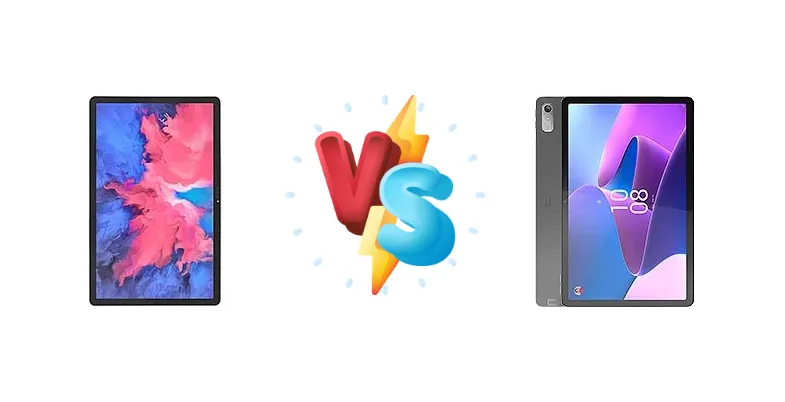
Lenovo offers a compelling range of budget tablets, and the Pad and Tab P11 Gen 2 represent two popular choices. While both aim to deliver an affordable tablet experience, they differ significantly under the hood. This comparison dives deep into the core specifications – specifically the chipsets – to determine which tablet offers the best performance, efficiency, and overall value for your money.
🏆 Quick Verdict
For most users, the Lenovo Tab P11 Gen 2 is the better choice. Its Mediatek Helio G99, built on a 6nm process, provides a noticeable performance uplift and improved power efficiency compared to the Lenovo Pad’s Snapdragon 662. While the Pad remains a viable option, the P11 Gen 2 offers a more future-proof experience.
| Network |
|---|
| 2G bands | N/A | GSM 850 / 900 / 1800 / 1900 |
| 3G bands | N/A | HSDPA 800 / 850 / 900 / 1700(AWS) / 1900 / 2100 |
| 4G bands | N/A | 1, 2, 3, 4, 5, 7, 8, 12, 13, 18, 19, 20, 25, 26, 28, 38, 40, 41, 66 |
| EDGE | No | - |
| GPRS | No | - |
| Speed | - | HSPA, LTE - cellular model only |
| Technology | No cellular connectivity | GSM / HSPA / LTE |
| Launch |
|---|
| Announced | 2021, May 24 | 2022, September 01 |
| Status | Available. Released 2021, June 01 | Available. Released 2023, January |
| Body |
|---|
| Build | Glass front, plastic frame, plastic back | - |
| Dimensions | 258.4 x 163 x 7.5 mm (10.17 x 6.42 x 0.30 in) | 269.1 x 169.4 x 7.4 mm (10.59 x 6.67 x 0.29 in) |
| SIM | No | Nano-SIM (cellular model only) |
| Weight | 490 g (1.08 lb) | 520 g (1.15 lb) |
| | Stylus support | Stylus support |
| Display |
|---|
| Resolution | 1200 x 2000 pixels, 5:3 ratio (~212 ppi density) | 1200 x 2000 pixels, 5:3 ratio (~203 ppi density) |
| Size | 11.0 inches, 344.4 cm2 (~81.8% screen-to-body ratio) | 11.5 inches, 376.4 cm2 (~82.6% screen-to-body ratio) |
| Type | TDDI IPS LCD, 400 nits (typ) | IPS LCD, 120Hz, 400 nits (typ) |
| Platform |
|---|
| CPU | Octa-core (4x2.0 GHz Kryo 260 Gold & 4x1.8 GHz Kryo 260 Silver) | Octa-core (2x2.2 GHz Cortex-A76 & 6x2.0 GHz Cortex-A55) |
| Chipset | Qualcomm SM6115 Snapdragon 662 (11 nm) | Mediatek Helio G99 (6 nm) |
| GPU | Adreno 610 | Mali-G57 MC2 |
| OS | Android 11, ZUI 12.5 | Android 12L |
| Memory |
|---|
| Card slot | microSDXC (dedicated slot) | microSDXC (dedicated slot) |
| Internal | 64GB 4GB RAM, 128GB 6GB RAM | 64GB 4GB RAM, 128GB 4GB RAM, 128GB 6GB RAM |
| | UFS 2.1 | - |
| Main Camera |
|---|
| Features | LED flash | LED flash |
| Single | 13 MP, AF | 13 MP, f/2.4, (wide), AF |
| Video | 1080p@30fps | 1080p@30fps |
| Selfie camera |
|---|
| Single | 8 MP
TOF 3D, (depth/biometrics sensor) | 8 MP, f/2.0 |
| Video | 1080p@30fps | 1080p@30fps |
| Sound |
|---|
| 3.5mm jack | No | Yes |
| 35mm jack | No | Yes |
| Loudspeaker | Yes, with stereo speakers (4 speakers) | Yes, with stereo speakers (4 speakers) |
| Comms |
|---|
| Bluetooth | 5.0, A2DP, LE | 5.2, A2DP, LE |
| NFC | No | No |
| Positioning | GPS, BDS | GPS, GLONASS, BDS - cellular model only |
| Radio | No | No |
| USB | USB Type-C 2.0, OTG, magnetic connector | USB Type-C 2.0, OTG, magnetic connector |
| WLAN | Wi-Fi 802.11 a/b/g/n/ac, dual-band, Wi-Fi Direct | Wi-Fi 802.11 a/b/g/n/ac/6e, dual-band, Wi-Fi Direct |
| Features |
|---|
| Sensors | Face recognition, accelerometer, gyro, proximity | Accelerometer, gyro, proximity |
| Battery |
|---|
| Charging | 20W wired, QC3 | - |
| Type | Li-Po 7700 mAh | Li-Po 7700 mAh |
| Misc |
|---|
| Colors | Gray | Storm Grey, Sage |
| Models | ZA7R0232CN | TB350FU |
| Price | About 140 EUR | About 350 EUR |
Lenovo Pad
- Potentially lower price point.
- Qualcomm chipset offers established software support.
- QC3 fast charging support.
- Less efficient 11nm Snapdragon 662.
- Older CPU architecture.
- Likely lower performance in demanding tasks.
Lenovo Tab P11 Gen 2
- More efficient 6nm Mediatek Helio G99.
- Modern CPU architecture for improved responsiveness.
- Better GPU performance for casual gaming.
- May be slightly more expensive.
- Mediatek chipset software support can vary.
- Potential for more aggressive background app management.
Display Comparison
Both tablets likely feature LCD panels, a common trait in this price segment. However, detailed display specs (resolution, brightness, color gamut) are missing. The P11 Gen 2’s newer chipset *could* indicate a more advanced display controller, potentially leading to slightly better color accuracy or refresh rate handling, but this is speculative. Bezels are likely similar on both, focusing on cost reduction rather than premium aesthetics.
Camera Comparison
Given the budget nature of these tablets, camera performance isn’t a primary focus. Detailed camera specs are unavailable, but it’s safe to assume both feature modest camera setups. Any differences in image quality will likely be minimal and more dependent on software processing than hardware capabilities. Expect acceptable results in well-lit conditions, but don’t anticipate flagship-level photography.
Performance
The core difference lies in the chipsets. The Lenovo Pad’s Qualcomm Snapdragon 662 (11nm) is a capable SoC, but the Tab P11 Gen 2’s Mediatek Helio G99 (6nm) represents a significant step forward. The 6nm process inherently offers better power efficiency, translating to longer battery life and less thermal throttling. While both are octa-core CPUs, the Helio G99 utilizes a more modern CPU architecture – 2x2.2 GHz Cortex-A76 cores versus the Pad’s 4x2.0 GHz Kryo 260 Gold cores – providing a performance advantage in single-threaded tasks and overall responsiveness. The G99’s GPU is also expected to outperform the Snapdragon 662’s Adreno 610, making it a better choice for casual gaming.
Battery Life
Battery capacity is not specified for either device. However, the Helio G99’s 6nm process gives the Tab P11 Gen 2 a clear advantage in battery efficiency. Even with a similar battery capacity, the P11 Gen 2 should deliver longer runtimes on a single charge. Both support 20W wired charging with QC3, meaning similar charging speeds – expect around 2-3 hours for a full charge, depending on the battery size.
Buying Guide
Buy the Lenovo Pad if you prioritize a lower upfront cost and primarily need a tablet for basic tasks like web browsing, video conferencing, and light media consumption. Buy the Lenovo Tab P11 Gen 2 if you value smoother multitasking, occasional gaming, and a more responsive user experience, even if it means spending a bit more. The P11 Gen 2 is the better choice for students or anyone who needs a tablet that can handle a heavier workload.
Frequently Asked Questions
❓ Will the Mediatek Helio G99 in the Tab P11 Gen 2 struggle with demanding games like Genshin Impact?
While the Helio G99 is a capable chip, Genshin Impact is a very demanding game. You'll likely need to lower the graphics settings to medium or low to achieve playable frame rates on the Tab P11 Gen 2. The Snapdragon 662 in the Pad would struggle even more, making the P11 Gen 2 the better, albeit still limited, option for gaming.
❓ Does the Tab P11 Gen 2's 6nm process significantly impact real-world battery life compared to the Pad?
Yes, the 6nm process is a key advantage. It allows the Helio G99 to operate more efficiently, consuming less power for the same level of performance. This translates to noticeably longer battery life, especially during sustained use like video streaming or web browsing. Expect several extra hours of usage on the P11 Gen 2.
❓ Is the difference in CPU architecture between the Snapdragon 662 and Helio G99 noticeable in everyday tasks?
Absolutely. The Helio G99’s Cortex-A76 cores are more powerful and efficient than the Snapdragon 662’s Kryo 260 Gold cores. This results in snappier app launches, smoother multitasking, and a more responsive overall user experience on the Tab P11 Gen 2.