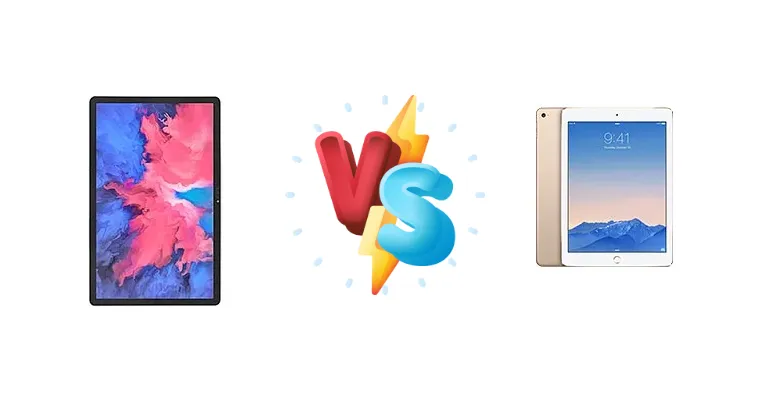
The tablet market offers a wide range of choices, but the Lenovo Pad and Apple iPad Air 2 represent distinct approaches. The iPad Air 2, while older, benefits from Apple’s optimized hardware and software ecosystem. The Lenovo Pad, a more recent offering, leverages Qualcomm’s Snapdragon platform to deliver a competitive experience at a potentially lower price point. This comparison dissects their key differences to help you determine which tablet best suits your needs.
🏆 Quick Verdict
For the average user prioritizing a refined software experience and long-term support, the Apple iPad Air 2 remains a compelling choice despite its age. However, the Lenovo Pad offers a viable alternative for budget-conscious buyers who prioritize newer hardware and Android’s flexibility.
| Network |
|---|
| 2G bands | N/A | GSM 850 / 900 / 1800 / 1900 |
| 3G bands | N/A | HSDPA 850 / 900 / 1700 / 1900 / 2100 |
| 4G bands | N/A | 1, 2, 3, 4, 5, 7, 8, 13, 17, 18, 19, 20, 25, 26, 28, 29, 38, 39, 40, 41 - A1567 |
| EDGE | No | - |
| GPRS | No | - |
| Speed | - | HSPA 42.2/5.76 Mbps, LTE Cat4 150/50 Mbps, EV-DO Rev.A 3.1 Mbps - cellular model only |
| Technology | No cellular connectivity | GSM / CDMA / HSPA / EVDO / LTE |
| Launch |
|---|
| Announced | 2021, May 24 | 2014, October 16. Released 2014, October 24 |
| Status | Available. Released 2021, June 01 | Discontinued |
| Body |
|---|
| Build | Glass front, plastic frame, plastic back | Glass front, aluminum back, aluminum frame |
| Dimensions | 258.4 x 163 x 7.5 mm (10.17 x 6.42 x 0.30 in) | 240 x 169.5 x 6.1 mm (9.45 x 6.67 x 0.24 in) |
| SIM | No | Nano-SIM + eSIM (cellular model only) |
| Weight | 490 g (1.08 lb) | 437 g (Wi-Fi) / 444 g (3G/LTE) (15.41 oz) |
| | Stylus support | - |
| Display |
|---|
| Protection | - | Scratch-resistant glass, oleophobic coating |
| Resolution | 1200 x 2000 pixels, 5:3 ratio (~212 ppi density) | 1536 x 2048 pixels, 4:3 ratio (~264 ppi density) |
| Size | 11.0 inches, 344.4 cm2 (~81.8% screen-to-body ratio) | 9.7 inches, 291.4 cm2 (~71.6% screen-to-body ratio) |
| Type | TDDI IPS LCD, 400 nits (typ) | IPS LCD |
| Platform |
|---|
| CPU | Octa-core (4x2.0 GHz Kryo 260 Gold & 4x1.8 GHz Kryo 260 Silver) | Triple-core 1.5 GHz Typhoon |
| Chipset | Qualcomm SM6115 Snapdragon 662 (11 nm) | Apple A8X (20 nm) |
| GPU | Adreno 610 | PowerVR GXA6850 (octa-core graphics) |
| OS | Android 11, ZUI 12.5 | iOS 8.1, upgradable to iPadOS 15.8.5 |
| Memory |
|---|
| Card slot | microSDXC (dedicated slot) | No |
| Internal | 64GB 4GB RAM, 128GB 6GB RAM | 16GB 2GB RAM, 32GB 2GB RAM, 64GB 2GB RAM, 128GB 2GB RAM |
| | UFS 2.1 | - |
| Main Camera |
|---|
| Features | LED flash | HDR |
| Single | 13 MP, AF | 8 MP, f/2.4, 31mm (standard), 1.12µm, AF |
| Video | 1080p@30fps | 1080p@30fps, 720p@120fps, HDR, stereo sound rec. |
| Selfie camera |
|---|
| Features | - | face detection, HDR, FaceTime over Wi-Fi or Cellular |
| Single | 8 MP
TOF 3D, (depth/biometrics sensor) | 1.2 MP, f/2.2, 31mm (standard) |
| Video | 1080p@30fps | 720p@30fps |
| Sound |
|---|
| 3.5mm jack | No | Yes |
| 35mm jack | No | Yes |
| Loudspeaker | Yes, with stereo speakers (4 speakers) | Yes, with stereo speakers |
| Comms |
|---|
| Bluetooth | 5.0, A2DP, LE | 4.0, A2DP, EDR |
| NFC | No | No |
| Positioning | GPS, BDS | GPS, GLONASS - cellular model only |
| Radio | No | No |
| USB | USB Type-C 2.0, OTG, magnetic connector | Lightning, USB 2.0 |
| WLAN | Wi-Fi 802.11 a/b/g/n/ac, dual-band, Wi-Fi Direct | Wi-Fi 802.11 a/b/g/n/ac, dual-band, hotspot |
| Features |
|---|
| Sensors | Face recognition, accelerometer, gyro, proximity | Fingerprint (front-mounted), accelerometer, gyro, compass, barometer |
| Battery |
|---|
| Charging | 20W wired, QC3 | - |
| Talk time | - | Up to 10 h (multimedia) |
| Type | Li-Po 7700 mAh | Li-Po 7340 mAh, non-removable (27.62 Wh) |
| Misc |
|---|
| Colors | Gray | Space Gray, Silver, Gold |
| Models | ZA7R0232CN | A1566, A1567, iPad5,3, iPad5,4 |
| Price | About 140 EUR | About 440 EUR |
| Tests |
|---|
| Audio quality | - |
Noise -93.9dB / Crosstalk -83.9dB |
| Camera | - |
Photo / Video |
| Display | - |
Contrast ratio: 1048 (nominal) |
| Loudspeaker | - |
Voice 75dB / Noise 70dB / Ring 78dB |
| Performance | - |
Basemark X: 29753 |
Lenovo Pad
- Faster charging with QC3 support
- More modern chipset (Snapdragon 662)
- Likely more affordable price point
- Display specifications are unknown
- Android ecosystem fragmentation
Apple iPad Air 2
- Optimized iOS ecosystem
- Established contrast ratio of 1048:1
- Long-term software support
- Older chipset (A8X)
- Slower charging (likely)
- Higher price (potentially)
Display Comparison
The iPad Air 2 boasts a contrast ratio of 1048:1, a respectable figure for its time, but lacks specifics regarding peak brightness or panel technology. The Lenovo Pad’s display specifications are absent, making a direct comparison difficult. However, given its market positioning, it likely utilizes an IPS LCD panel. The Air 2’s established contrast ratio suggests deeper blacks and more vibrant colors, potentially offering a superior viewing experience for multimedia content. The absence of information on the Lenovo Pad’s display resolution and brightness makes it difficult to assess its overall quality.
Camera Comparison
Both devices feature cameras capable of photo and video capture, but detailed specifications are lacking. Without information on sensor size, aperture, or image processing capabilities, a meaningful comparison is impossible. Given Apple’s emphasis on camera quality, the iPad Air 2 likely offers a more refined camera experience, even if the resolution isn’t significantly higher. The Lenovo Pad’s camera is likely geared towards basic functionality for video calls and casual snapshots.
Performance
The Lenovo Pad’s Qualcomm Snapdragon 662, built on an 11nm process, features an octa-core CPU configuration with Kryo 260 Gold and Silver cores. This architecture aims to balance performance and efficiency. In contrast, the iPad Air 2 utilizes Apple’s A8X chip, fabricated on a 20nm process, with a triple-core 1.5 GHz Typhoon CPU. While the A8X has fewer cores, Apple’s chip design and software optimization historically deliver impressive single-core performance, crucial for responsive app launching and smooth multitasking. The Snapdragon 662’s multi-core advantage may shine in heavily threaded tasks, but the A8X’s architecture is likely more efficient, potentially leading to better sustained performance under load. The newer manufacturing process of the Snapdragon 662 should also contribute to improved thermal efficiency.
Battery Life
Battery capacity data is unavailable for both devices. However, the Lenovo Pad supports 20W wired charging with Quick Charge 3.0 (QC3), indicating faster charging speeds. The iPad Air 2’s charging specifications are unknown, but it likely utilizes a slower charging standard. While the iPad Air 2 may have optimized power management, the Lenovo Pad’s faster charging capability provides a tangible benefit for users who need to quickly replenish their battery.
Buying Guide
Buy the Lenovo Pad if you need a tablet for media consumption, light gaming, and general productivity tasks, and value a modern Android experience with Quick Charge support. Buy the Apple iPad Air 2 if you prefer a polished, secure operating system, seamless integration with other Apple devices, and a tablet that will continue to receive software updates for the foreseeable future, even if the hardware is aging.
Frequently Asked Questions
❓ Is the Snapdragon 662 in the Lenovo Pad powerful enough for gaming?
The Snapdragon 662 is a capable mid-range chipset. It can handle most mobile games at medium settings, but demanding titles may require lower graphics settings to maintain a smooth frame rate. It's suitable for casual gaming but may not deliver the best experience for hardcore gamers.
❓ How long will the Apple iPad Air 2 continue to receive software updates?
While Apple no longer actively updates the iPad Air 2 with major iOS versions, it still receives security updates. However, app compatibility may become an issue over time as developers optimize for newer iOS versions. The longevity of app support is a key consideration for potential buyers.
❓ Does the Lenovo Pad support expandable storage via microSD card?
This information is not provided in the context data. However, many Lenovo tablets in this price range *do* include a microSD card slot, offering a convenient way to expand storage capacity. Checking the official product specifications is recommended.