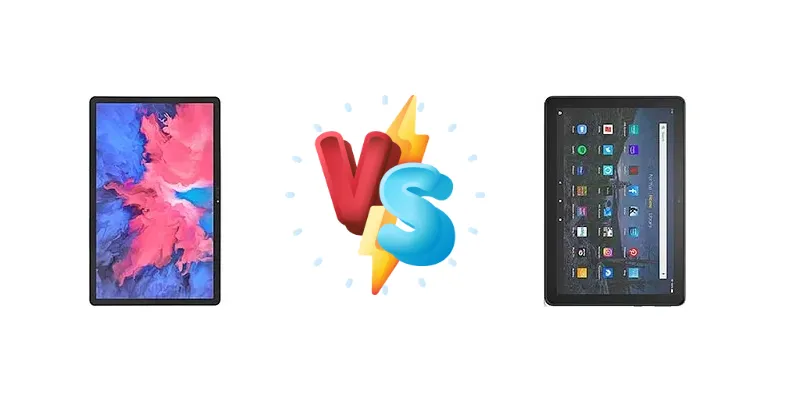
The sub-$200 tablet market is fiercely competitive, and the Lenovo Pad and Amazon Fire HD 10 Plus (2021) represent two compelling options. While both aim to deliver an affordable tablet experience, they take distinctly different approaches to hardware and software. This comparison dives deep into their specifications to determine which tablet best suits your needs.
🏆 Quick Verdict
For users prioritizing raw performance and a more standard Android experience, the Lenovo Pad emerges as the winner. Its Qualcomm Snapdragon 662 chipset offers a noticeable advantage over the MediaTek Helio P60T in the Fire HD 10 Plus, making it better suited for multitasking and demanding applications. However, the Fire HD 10 Plus's wireless charging is a unique convenience.
| Network |
|---|
| 2G bands | N/A | N/A |
| 3G bands | N/A | - |
| 4G bands | N/A | - |
| EDGE | No | No |
| GPRS | No | No |
| Technology | No cellular connectivity | No cellular connectivity |
| Launch |
|---|
| Announced | 2021, May 24 | 2021, April 27. Released 2021, May 26 |
| Status | Available. Released 2021, June 01 | Discontinued |
| Body |
|---|
| Build | Glass front, plastic frame, plastic back | - |
| Dimensions | 258.4 x 163 x 7.5 mm (10.17 x 6.42 x 0.30 in) | 247 x 166 x 9.2 mm (9.72 x 6.54 x 0.36 in) |
| SIM | No | No |
| Weight | 490 g (1.08 lb) | 468 g (1.03 lb) |
| | Stylus support | - |
| Display |
|---|
| Protection | - | Aluminosilicate glass |
| Resolution | 1200 x 2000 pixels, 5:3 ratio (~212 ppi density) | 1920 x 1200 pixels, 16:10 ratio (~224 ppi density) |
| Size | 11.0 inches, 344.4 cm2 (~81.8% screen-to-body ratio) | 10.1 inches, 295.8 cm2 (~72.1% screen-to-body ratio) |
| Type | TDDI IPS LCD, 400 nits (typ) | IPS LCD |
| Platform |
|---|
| CPU | Octa-core (4x2.0 GHz Kryo 260 Gold & 4x1.8 GHz Kryo 260 Silver) | Octa-core (4x2.0 GHz Cortex-A73 & 4x2.0 GHz Cortex-A53) |
| Chipset | Qualcomm SM6115 Snapdragon 662 (11 nm) | Mediatek MT8183 Helio P60T (12 nm) |
| GPU | Adreno 610 | Mali-G72 MP3 |
| OS | Android 11, ZUI 12.5 | Android 9.0 (Pie), Fire OS 7 |
| Memory |
|---|
| Card slot | microSDXC (dedicated slot) | microSDXC (dedicated slot) |
| Internal | 64GB 4GB RAM, 128GB 6GB RAM | 32GB 4GB RAM, 64GB 4GB RAM |
| | UFS 2.1 | eMMC 5.1 |
| Main Camera |
|---|
| Features | LED flash | - |
| Single | 13 MP, AF | 5 MP |
| Video | 1080p@30fps | 720p |
| Selfie camera |
|---|
| Single | 8 MP
TOF 3D, (depth/biometrics sensor) | 2 MP |
| Video | 1080p@30fps | 720p |
| Sound |
|---|
| 3.5mm jack | No | Yes |
| 35mm jack | No | Yes |
| Loudspeaker | Yes, with stereo speakers (4 speakers) | Yes, with stereo speakers |
| Comms |
|---|
| Bluetooth | 5.0, A2DP, LE | 5.0, A2DP, LE |
| NFC | No | No |
| Positioning | GPS, BDS | No |
| Radio | No | No |
| USB | USB Type-C 2.0, OTG, magnetic connector | USB Type-C 2.0, OTG |
| WLAN | Wi-Fi 802.11 a/b/g/n/ac, dual-band, Wi-Fi Direct | Wi-Fi 802.11 a/b/g/n/ac, dual-band |
| Features |
|---|
| Sensors | Face recognition, accelerometer, gyro, proximity | Accelerometer |
| | - | Text-to-Speech English-language content reader |
| Battery |
|---|
| Charging | 20W wired, QC3 | Wireless |
| Type | Li-Po 7700 mAh | Li-Ion |
| Misc |
|---|
| Colors | Gray | Slate |
| Models | ZA7R0232CN | T76N2P |
| Price | About 140 EUR | About 150 EUR |
Lenovo Pad
- More powerful Snapdragon 662 chipset
- Standard Android experience
- Faster wired charging (20W with QC3)
- No wireless charging
- Display specs are unknown
Amazon Fire HD 10 Plus (2021)
- Wireless charging convenience
- Lower price point (typically)
- Amazon ecosystem integration
- Less powerful MediaTek Helio P60T chipset
- Amazon Fire OS (limited app access)
- Slower charging speeds (wireless)
Display Comparison
Neither device boasts a particularly high-end display. Both likely utilize IPS LCD panels, but detailed specs like resolution and peak brightness are missing. However, the core difference lies in the chipsets impacting display responsiveness. The Snapdragon 662’s slightly more powerful GPU in the Lenovo Pad *could* translate to smoother scrolling and animations, though this is highly dependent on software optimization. The Fire HD 10 Plus’s lack of detailed display specs suggests a focus on cost reduction in this area.
Camera Comparison
Camera performance is unlikely to be a deciding factor for either tablet. Both are positioned as budget devices, and detailed camera specifications are absent. It’s safe to assume both feature basic camera setups suitable for casual snapshots and video calls. Without sensor size or aperture information, a direct comparison is impossible. Focusing on the chipset’s image signal processor (ISP) capabilities, the Snapdragon 662 likely offers slightly better image processing, but the difference will be minimal in real-world usage.
Performance
The Lenovo Pad’s Qualcomm Snapdragon 662 (11nm) holds a clear architectural advantage over the Amazon Fire HD 10 Plus’s MediaTek Helio P60T (12nm). The Snapdragon 662’s Kryo 260 cores, split into performance (Gold) and efficiency (Silver) clusters, offer a more refined approach to power management and sustained performance. While both CPUs feature octa-core configurations with 2.0 GHz peak speeds, the Cortex-A73 cores in the Helio P60T are older generation and less efficient than the Kryo 260 Gold cores. This translates to better multitasking and app loading times on the Lenovo Pad, especially with demanding applications. The 11nm process node of the Snapdragon 662 also contributes to improved thermal efficiency, potentially reducing throttling during extended use.
Battery Life
Battery life will largely depend on usage patterns. While specific mAh capacities are not provided, the Lenovo Pad’s more efficient Snapdragon 662 chipset should contribute to longer runtimes during typical tasks like web browsing and video playback. The Amazon Fire HD 10 Plus compensates with wireless charging, a feature absent on the Lenovo Pad. This convenience allows for cable-free top-ups, but wireless charging is inherently less efficient than wired charging. The Lenovo Pad supports 20W wired charging with Quick Charge 3.0, offering faster charging speeds than the Fire HD 10 Plus’s unspecified wireless charging rate.
Buying Guide
Buy the Lenovo Pad if you need a tablet for general productivity, light gaming, and a more open Android ecosystem. It’s ideal for students or anyone who wants a versatile device without the Amazon-centric software. Buy the Amazon Fire HD 10 Plus (2021) if you primarily consume media – streaming video, reading ebooks – and are heavily invested in the Amazon ecosystem. The wireless charging and lower price point are compelling for casual users.
Frequently Asked Questions
❓ Will the MediaTek Helio P60T in the Fire HD 10 Plus struggle with multitasking?
Yes, the Helio P60T is a less powerful chipset than the Snapdragon 662. While it can handle basic tasks like web browsing and video playback, you may experience slowdowns when running multiple apps simultaneously or using demanding applications. The Lenovo Pad offers a smoother multitasking experience.
❓ How much does the Amazon Fire OS limit app availability compared to standard Android on the Lenovo Pad?
Amazon Fire OS is a heavily customized version of Android that primarily directs users to the Amazon Appstore. While many popular apps are available, you may find some apps are missing or require sideloading (installing from outside the Amazon Appstore), which isn't straightforward. The Lenovo Pad runs a closer-to-stock Android experience, providing access to the full Google Play Store and a wider range of apps.
❓ Is the wireless charging on the Fire HD 10 Plus significantly slower than the Lenovo Pad's wired charging?
Yes, wireless charging is inherently slower than wired charging. While the Fire HD 10 Plus offers the convenience of wireless charging, the Lenovo Pad's 20W Quick Charge 3.0 support will deliver a significantly faster 0-100% charge time.