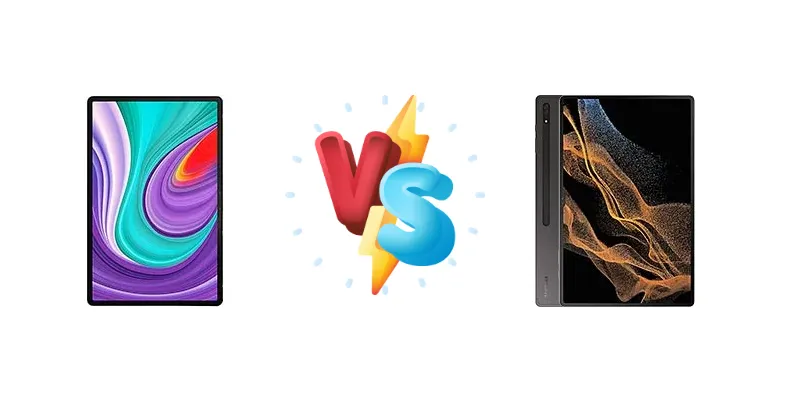
The Android tablet market is heating up, with Lenovo challenging Samsung's dominance. We pit the Lenovo Pad Pro, a strong contender focused on value, against the Samsung Galaxy Tab S8 Ultra, a premium device boasting the latest Snapdragon silicon. This comparison dissects their strengths and weaknesses to determine which tablet best suits your needs.
🏆 Quick Verdict
For most users, the Samsung Galaxy Tab S8 Ultra justifies its higher price with significantly faster performance thanks to the Snapdragon 8 Gen 1. However, the Lenovo Pad Pro offers excellent value, providing a smooth experience for everyday tasks and light gaming at a considerably lower cost.
| Network |
|---|
| 2G bands | N/A | GSM 850 / 900 / 1800 / 1900 |
| 3G bands | N/A | HSDPA 850 / 900 / 1700(AWS) / 1900 / 2100 |
| 4G bands | N/A | LTE |
| 5G bands | - | SA/NSA |
| EDGE | No | - |
| GPRS | No | - |
| Speed | - | HSPA, LTE, 5G - cellular model only |
| Technology | No cellular connectivity | GSM / HSPA / LTE / 5G |
| Launch |
|---|
| Announced | 2021, May 24 | 2022, February 09 |
| Status | Available. Released 2021, May 31 | Available. Released 2022, April 30 |
| Body |
|---|
| Build | Glass front, aluminum frame, aluminum back | - |
| Dimensions | 264.3 x 171.4 x 5.8 mm (10.41 x 6.75 x 0.23 in) | 326.4 x 208.6 x 5.5 mm (12.85 x 8.21 x 0.22 in) |
| SIM | No | Nano-SIM (cellular model only) |
| Weight | 485 g (1.07 lb) | 726 g (Wi-Fi), 728 g (5G) (1.60 lb) |
| | Stylus support | Stylus, 2.8ms latency (Bluetooth integration, accelerometer, gyro) |
| Display |
|---|
| Protection | - | Corning Gorilla Glass 5 |
| Resolution | 1600 x 2560 pixels, 16:10 ratio (~263 ppi density) | 1848 x 2960 pixels, 16:10 ratio (~240 ppi density) |
| Size | 11.5 inches, 383.5 cm2 (~84.6% screen-to-body ratio) | 14.6 inches, 612.6 cm2 (~90.0% screen-to-body ratio) |
| Type | OLED, HDR10, Dolby Vision, 90Hz, 420 nits (typ), 600 nits (peak) | Super AMOLED, 120Hz, HDR10+ |
| Platform |
|---|
| CPU | Octa-core (1x3.2 GHz Kryo 585 & 3x2.42 GHz Kryo 585 & 4x1.80 GHz Kryo 585) | Octa-core (1x3.00 GHz Cortex-X2 & 3x2.50 GHz Cortex-A710 & 4x1.80 GHz Cortex-A510) |
| Chipset | Qualcomm SM8250-AC Snapdragon 870 5G (7 nm) | Qualcomm SM8450 Snapdragon 8 Gen 1 (4 nm) |
| GPU | Adreno 650 | Adreno 730 |
| OS | Android 11, ZUI 12.5 | Android 12, up to 4 major Android upgrades, One UI 6.1.1 |
| Memory |
|---|
| Card slot | microSDXC (dedicated slot) | microSDXC (dedicated slot) |
| Internal | 128GB 6GB RAM | 128GB 8GB RAM, 256GB 8GB RAM, 256GB 12GB RAM, 256GB 16GB RAM, 512GB 12GB RAM, 512GB 16GB RAM |
| | UFS 3.1 | UFS |
| Main Camera |
|---|
| Dual | 13 MP, (wide), AF
5 MP, 120˚ (ultrawide) | 13 MP, f/2.0, 26mm (wide), 1/3.4", 1.0µm, AF
6 MP, f/2.2, (ultrawide) |
| Features | LED flash | LED flash, HDR, panorama |
| Video | 1080p@30fps | 4K@30/60fps, 1080p@30fps |
| Selfie camera |
|---|
| Dual | - | 12 MP, f/2.2, 26mm (wide)
12 MP, f/2.4, 120˚ (ultrawide) |
| Features | - | HDR |
| Single | 8 MP
8 MP, IR TOF 3D, (depth/biometrics sensor) | - |
| Video | 1080p@30fps | 4K@30/60fps, 1080p@30fps |
| Sound |
|---|
| 3.5mm jack | No | No |
| 35mm jack | No | No |
| Loudspeaker | Yes, with stereo speakers (4 speakers) | Yes, with stereo speakers (4 speakers) |
| | Tuned by JBL | Tuned by AKG |
| Comms |
|---|
| Bluetooth | 5.1, A2DP, LE | 5.2, A2DP, LE |
| NFC | No | No |
| Positioning | No | GPS, GLONASS, BDS, GALILEO - cellular model only |
| Radio | No | No |
| USB | USB Type-C 3.1, OTG, magnetic connector | USB Type-C 3.2, magnetic connector |
| WLAN | Wi-Fi 802.11 a/b/g/n/ac/6, dual-band, Wi-Fi Direct | Wi-Fi 802.11 a/b/g/n/ac/6e, dual-band, Wi-Fi Direct |
| Features |
|---|
| Sensors | Infrared Face ID, fingerprint (side-mounted), accelerometer, gyro, proximity | Fingerprint (under display, optical), accelerometer, gyro, proximity, compass |
| | - | Wireless Samsung DeX |
| Battery |
|---|
| Charging | 20W wired, QC3 | 45W wired, 100% in 82 min |
| Type | Li-Po 8600 mAh | Li-Po 11200 mAh |
| Misc |
|---|
| Colors | Silver | Graphite |
| Models | ZA910001CN, TB-J716F | SM-X900, SM-X906, SM-X906B, SM-X906U, SM-X906N |
| Price | About 320 EUR | About 1150 EUR |
| SAR EU | - | 0.69 W/kg (body) |
Lenovo Pad Pro
- Significantly more affordable
- Good performance for everyday tasks
- Decent battery life for its price range
- Slower processor compared to the Tab S8 Ultra
- Slower charging speed
Samsung Galaxy Tab S8 Ultra
- Exceptional performance with Snapdragon 8 Gen 1
- Faster 45W charging
- Likely superior display quality and features
- Much higher price tag
- Potential for thermal throttling under heavy load (though mitigated by 4nm process)
Display Comparison
While both tablets likely feature high-quality LCD panels (specific panel tech is not provided), the comparison hinges on resolution and refresh rate. The Tab S8 Ultra, being a flagship, likely boasts a higher resolution and potentially an adaptive refresh rate (LTPO) for smoother scrolling and animations. The Lenovo Pad Pro, while still offering a good visual experience, will likely have a standard refresh rate. Bezels are also a key differentiator, with Samsung typically prioritizing minimal bezels on its Ultra series. Color accuracy is expected to be excellent on both, but the Tab S8 Ultra may offer wider color gamut coverage.
Camera Comparison
Given the context data, a detailed camera comparison is limited. Both tablets likely feature multi-camera setups, but the focus should be on the main sensor. The Tab S8 Ultra, as a premium device, likely features a larger, higher-resolution main sensor with Optical Image Stabilization (OIS) for sharper images and videos. The Lenovo Pad Pro’s camera system will likely be adequate for casual snapshots but won’t compete with the Tab S8 Ultra in terms of image quality, especially in low-light conditions. The presence of potentially useless 2MP macro or depth sensors on either device should be disregarded.
Performance
The core difference lies in the chipsets. The Samsung Galaxy Tab S8 Ultra’s Snapdragon 8 Gen 1 (4nm) represents a significant leap over the Lenovo Pad Pro’s Snapdragon 870 (7nm). The 4nm process node translates to improved power efficiency and reduced thermal throttling under sustained load. The Snapdragon 8 Gen 1’s Cortex-X2 prime core clocked at 3.00 GHz provides a substantial performance advantage over the Kryo 585 in the 870. While both utilize octa-core configurations, the architectural improvements in the 8 Gen 1’s Cortex-A710 and A510 cores further enhance multi-tasking and overall responsiveness. The Tab S8 Ultra will excel in demanding applications and gaming, while the Pad Pro will handle everyday tasks smoothly but may struggle with graphically intensive games at maximum settings.
Battery Life
The Samsung Galaxy Tab S8 Ultra’s 45W charging is a clear advantage, promising a full charge in approximately 82 minutes. The Lenovo Pad Pro’s 20W charging will take considerably longer. While battery capacity isn’t specified, the Tab S8 Ultra’s more efficient Snapdragon 8 Gen 1 chipset, combined with potentially larger battery capacity, should result in comparable or even better real-world battery life despite the higher power draw of its display and processor. The faster charging speed of the Tab S8 Ultra is a significant convenience factor.
Buying Guide
Buy the Lenovo Pad Pro if you prioritize affordability and a balanced experience for media consumption, web browsing, and light productivity. It’s ideal for students or casual users. Buy the Samsung Galaxy Tab S8 Ultra if you demand the absolute best performance for demanding tasks like video editing, graphic design, or intensive gaming, and are willing to pay a premium for it.
Frequently Asked Questions
❓ Will the Snapdragon 870 in the Lenovo Pad Pro struggle with demanding games like Genshin Impact?
While the Snapdragon 870 is capable, Genshin Impact and similar graphically intensive games will likely require reduced graphics settings on the Lenovo Pad Pro to maintain a smooth frame rate. The Tab S8 Ultra’s Snapdragon 8 Gen 1 will handle these games at maximum settings with ease.
❓ How much of a real-world difference will the 45W charging make on the Samsung Galaxy Tab S8 Ultra?
The 45W charging on the Tab S8 Ultra translates to a significantly faster recharge time compared to the Lenovo Pad Pro’s 20W charging. This is particularly beneficial for users who rely heavily on their tablet throughout the day and need to quickly top up the battery.
❓ Is the Lenovo Pad Pro a good choice for taking handwritten notes with a stylus?
The Lenovo Pad Pro is a viable option for note-taking, but the responsiveness and pressure sensitivity of the stylus experience will likely be superior on the Samsung Galaxy Tab S8 Ultra, which is designed with S Pen integration in mind. The Tab S8 Ultra's display technology may also contribute to a more natural writing feel.