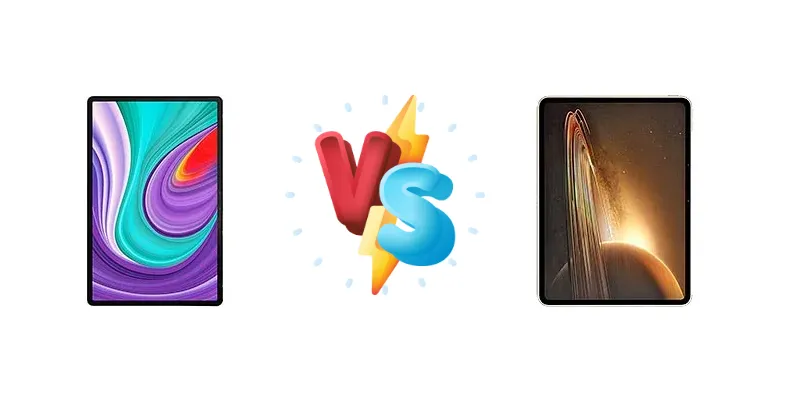
The Android tablet market is heating up, with Lenovo and Oppo offering compelling options. The Lenovo Pad Pro, leveraging the proven Snapdragon 870 5G, faces off against the newer Oppo Pad 2, powered by the Mediatek Dimensity 9000. This comparison dissects the core differences to help you choose the right tablet for your workflow and entertainment.
🏆 Quick Verdict
For most users, the Oppo Pad 2 emerges as the superior choice. Its Dimensity 9000 chipset delivers a noticeable performance uplift over the Snapdragon 870 in the Lenovo Pad Pro, and the significantly faster 67W charging is a game-changer. While the Lenovo Pad Pro offers good value, the Oppo Pad 2 justifies its price with a more future-proof experience.
| Network |
|---|
| 2G bands | N/A | N/A |
| 3G bands | N/A | N/A |
| 4G bands | N/A | N/A |
| EDGE | No | No |
| GPRS | No | No |
| Technology | No cellular connectivity | No cellular connectivity |
| Launch |
|---|
| Announced | 2021, May 24 | 2023, March 21 |
| Status | Available. Released 2021, May 31 | Available. Released 2023, March 24 |
| Body |
|---|
| Build | Glass front, aluminum frame, aluminum back | Glass front, aluminum frame |
| Dimensions | 264.3 x 171.4 x 5.8 mm (10.41 x 6.75 x 0.23 in) | 258 x 189.4 x 6.5 mm (10.16 x 7.46 x 0.26 in) |
| SIM | No | No |
| Weight | 485 g (1.07 lb) | 552 g (1.22 lb) |
| | Stylus support | Stylus support, 2.0ms latency |
| Display |
|---|
| Resolution | 1600 x 2560 pixels, 16:10 ratio (~263 ppi density) | 2000 x 2800 pixels (~296 ppi density) |
| Size | 11.5 inches, 383.5 cm2 (~84.6% screen-to-body ratio) | 11.61 inches, 411.3 cm2 (~84.2% screen-to-body ratio) |
| Type | OLED, HDR10, Dolby Vision, 90Hz, 420 nits (typ), 600 nits (peak) | IPS LCD, 1B colors, Dolby Vision, 144Hz, 500 nits (typ) |
| Platform |
|---|
| CPU | Octa-core (1x3.2 GHz Kryo 585 & 3x2.42 GHz Kryo 585 & 4x1.80 GHz Kryo 585) | Octa-core (1x3.05 GHz Cortex-X2 & 3x2.85 GHz Cortex-A710 & 4x1.80 GHz Cortex-A510) |
| Chipset | Qualcomm SM8250-AC Snapdragon 870 5G (7 nm) | Mediatek Dimensity 9000 (4 nm) |
| GPU | Adreno 650 | Mali-G710 MC10 |
| OS | Android 11, ZUI 12.5 | Android 13, ColorOS 13.1 |
| Memory |
|---|
| Card slot | microSDXC (dedicated slot) | No |
| Internal | 128GB 6GB RAM | 256GB 8GB RAM, 256GB 12GB RAM, 512GB 12GB RAM |
| | UFS 3.1 | UFS 3.1 |
| Main Camera |
|---|
| Dual | 13 MP, (wide), AF
5 MP, 120˚ (ultrawide) | - |
| Features | LED flash | Color spectrum sensor, LED flash |
| Single | - | 13 MP, f/2.2, (wide), AF |
| Video | 1080p@30fps | 4K@30fps, 1080p@30ps, gyro-EIS |
| Selfie camera |
|---|
| Single | 8 MP
8 MP, IR TOF 3D, (depth/biometrics sensor) | 8 MP, f/2.3, 103˚ (ultrawide) |
| Video | 1080p@30fps | 1080p@30fps |
| Sound |
|---|
| 3.5mm jack | No | No |
| 35mm jack | No | No |
| Loudspeaker | Yes, with stereo speakers (4 speakers) | Yes, with stereo speakers (4 speakers) |
| | Tuned by JBL | - |
| Comms |
|---|
| Bluetooth | 5.1, A2DP, LE | 5.3, A2DP, LE, aptX HD |
| NFC | No | No |
| Positioning | No | GPS, GLONASS, GALILEO, BDS (B1I+B1c) |
| Radio | No | No |
| USB | USB Type-C 3.1, OTG, magnetic connector | USB Type-C 2.0, OTG, accessory connector |
| WLAN | Wi-Fi 802.11 a/b/g/n/ac/6, dual-band, Wi-Fi Direct | Wi-Fi 802.11 a/b/g/n/ac/6, dual-band |
| Features |
|---|
| Sensors | Infrared Face ID, fingerprint (side-mounted), accelerometer, gyro, proximity | Accelerometer, gyro, compass |
| Battery |
|---|
| Charging | 20W wired, QC3 | 67W wired, PD, QC 2.0 |
| Type | Li-Po 8600 mAh | Li-Po 9510 mAh |
| Misc |
|---|
| Colors | Silver | Gray, Gold |
| Models | ZA910001CN, TB-J716F | OPD2201, X22N2 |
| Price | About 320 EUR | About 410 EUR |
Lenovo Pad Pro
- More affordable price point
- Proven Snapdragon 870 performance
- Good for everyday tasks and media consumption
- Slower 20W charging
- Older 7nm chipset architecture
- Potentially lower sustained performance
Oppo Pad 2
- Significantly faster 67W charging
- More powerful Dimensity 9000 chipset
- 4nm process for improved efficiency
- Superior GPU performance
- Higher price tag
- Potential for software optimization issues (typical with newer chipsets)
- May not represent a massive upgrade for basic users
Display Comparison
While both tablets likely feature high-quality LCD panels (specs not provided), the core difference lies in the processing power driving them. The absence of display specifications necessitates a focus on the chipset's ability to render graphics smoothly. The Dimensity 9000's superior GPU should translate to a more fluid visual experience, particularly in graphically intensive games. Bezels and color accuracy are unknown, but will be critical factors in real-world usability.
Camera Comparison
Given the tablet form factor, camera performance isn't a primary concern. However, the absence of camera specifications makes a direct comparison impossible. We can assume both tablets will feature adequate cameras for video calls and casual snapshots. Without sensor size or aperture information, it's difficult to assess image quality. The inclusion of OIS (Optical Image Stabilization) would be a significant advantage, but is unknown for either device.
Performance
The Mediatek Dimensity 9000 in the Oppo Pad 2, fabricated on a 4nm process, represents a significant architectural leap over the Lenovo Pad Pro’s 7nm Qualcomm Snapdragon 870 5G. The Dimensity 9000’s Cortex-X2 prime core clocked at 3.05 GHz provides a substantial single-core performance advantage. The Snapdragon 870’s Kryo 585 cores, while capable, are older generation. This translates to faster app loading, smoother multitasking, and improved performance in demanding applications. The 4nm node also contributes to better thermal efficiency, potentially reducing throttling during extended gaming sessions. The Oppo Pad 2 is expected to handle demanding tasks with greater ease.
Battery Life
The charging disparity is a major differentiator. The Oppo Pad 2’s 67W charging, supporting PD and QC 2.0, dramatically reduces charging times compared to the Lenovo Pad Pro’s 20W QC3 charging. While battery capacity isn't specified, the faster charging of the Oppo Pad 2 mitigates any potential disadvantage from a smaller battery. A full charge on the Oppo Pad 2 is likely to take under an hour, while the Lenovo Pad Pro could require over two hours. This is a crucial consideration for users who need to quickly top up their device.
Buying Guide
Buy the Lenovo Pad Pro if you prioritize a balance of performance and affordability, and aren't heavily reliant on sustained peak performance or ultra-fast charging. It's ideal for everyday tasks, media consumption, and light gaming. Buy the Oppo Pad 2 if you demand the best possible performance for demanding applications, gaming, and content creation, and value the convenience of incredibly rapid charging – making it perfect for power users and those constantly on the move.
Frequently Asked Questions
❓ Will the Dimensity 9000 in the Oppo Pad 2 get noticeably hotter than the Snapdragon 870 during extended gaming sessions?
While the Dimensity 9000 is more powerful, its 4nm process is more efficient. This means it *should* generate less heat than the 7nm Snapdragon 870 under sustained load. However, thermal management depends heavily on the tablet's cooling solution, which is unknown. Expect the Oppo Pad 2 to potentially maintain higher clock speeds for longer before throttling.
❓ Is the performance difference between the Snapdragon 870 and Dimensity 9000 significant enough for everyday tasks like browsing and video streaming?
For basic tasks, the difference will be minimal. Both chipsets are more than capable of handling everyday usage. The Dimensity 9000's advantage becomes apparent in more demanding scenarios like video editing, graphic-intensive games, and multitasking with numerous apps open simultaneously.
❓ Does the Oppo Pad 2 support faster charging standards than my existing charger?
The Oppo Pad 2 supports 67W charging with PD and QC 2.0. To achieve the fastest charging speeds, you'll need a compatible charger that supports these standards. Using a standard 15W or 20W charger will still charge the device, but at a significantly slower rate.