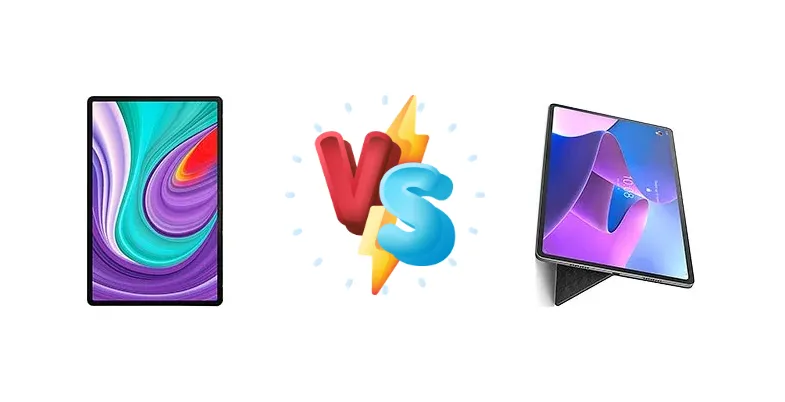
Lenovo has established itself as a key player in the Android tablet space, offering compelling devices at competitive prices. The Pad Pro and Tab P12 Pro both leverage the Qualcomm Snapdragon 870 5G, but diverge significantly in charging capabilities and potentially, overall user experience. This comparison dissects the nuances between these two tablets to help you determine which best suits your needs.
🏆 Quick Verdict
For most users, the Lenovo Tab P12 Pro is the superior choice. While both tablets share the same Snapdragon 870 chipset, the P12 Pro’s 45W fast charging with QC4 support dramatically reduces downtime, making it ideal for power users and those constantly on the go. The Pad Pro remains a strong contender for budget-conscious buyers.
| Network |
|---|
| 2G bands | N/A | GSM 850 / 900 / 1800 / 1900 |
| 3G bands | N/A | HSDPA 850 / 900 / 1900 / 2100 |
| 4G bands | N/A | 1, 2, 3, 4, 5, 7, 8, 19, 20, 26, 28, 34, 38, 39, 40, 41 |
| 5G bands | - | 1, 3, 7, 8, 20, 28, 38, 41, 77, 78 SA/NSA/Sub6 |
| EDGE | No | - |
| GPRS | No | - |
| Speed | - | HSPA, LTE, 5G - cellular model only |
| Technology | No cellular connectivity | GSM / HSPA / LTE / 5G |
| Launch |
|---|
| Announced | 2021, May 24 | 2021, September 08 |
| Status | Available. Released 2021, May 31 | Available. Released 2021, November 19 |
| Body |
|---|
| Build | Glass front, aluminum frame, aluminum back | - |
| Dimensions | 264.3 x 171.4 x 5.8 mm (10.41 x 6.75 x 0.23 in) | 285.6 x 184.5 x 5.6 mm (11.24 x 7.26 x 0.22 in) |
| SIM | No | Nano-SIM (cellular model only) |
| Weight | 485 g (1.07 lb) | 565 g (1.25 lb) |
| | Stylus support | Stylus support |
| Display |
|---|
| Resolution | 1600 x 2560 pixels, 16:10 ratio (~263 ppi density) | 1600 x 2560 pixels, 16:10 ratio (~240 ppi density) |
| Size | 11.5 inches, 383.5 cm2 (~84.6% screen-to-body ratio) | 12.6 inches, 460.3 cm2 (~87.4% screen-to-body ratio) |
| Type | OLED, HDR10, Dolby Vision, 90Hz, 420 nits (typ), 600 nits (peak) | AMOLED, 120Hz, HDR10+, Dolby Vision, 600 nits (HBM) |
| Platform |
|---|
| CPU | Octa-core (1x3.2 GHz Kryo 585 & 3x2.42 GHz Kryo 585 & 4x1.80 GHz Kryo 585) | Octa-core (1x3.2 GHz Kryo 585 & 3x2.42 GHz Kryo 585 & 4x1.80 GHz Kryo 585) |
| Chipset | Qualcomm SM8250-AC Snapdragon 870 5G (7 nm) | Qualcomm SM8250-AC Snapdragon 870 5G (7 nm) |
| GPU | Adreno 650 | Adreno 650 |
| OS | Android 11, ZUI 12.5 | Android 11 |
| Memory |
|---|
| Card slot | microSDXC (dedicated slot) | microSDXC (dedicated slot) |
| Internal | 128GB 6GB RAM | 128GB 6GB RAM, 256GB 8GB RAM |
| | UFS 3.1 | - |
| Main Camera |
|---|
| Dual | 13 MP, (wide), AF
5 MP, 120˚ (ultrawide) | 13 MP, (wide), AF
5 MP, (ultrawide) |
| Features | LED flash | - |
| Video | 1080p@30fps | 4K@30fps, 1080p@30fps |
| Selfie camera |
|---|
| Single | 8 MP
8 MP, IR TOF 3D, (depth/biometrics sensor) | 8 MP, (wide)
8 MP, IR TOF 3D, (biometrics sensor only) |
| Video | 1080p@30fps | 1080p@30fps |
| Sound |
|---|
| 3.5mm jack | No | No |
| 35mm jack | No | No |
| Loudspeaker | Yes, with stereo speakers (4 speakers) | Yes, with stereo speakers (4 speakers) |
| | Tuned by JBL | JBL speakers |
| Comms |
|---|
| Bluetooth | 5.1, A2DP, LE | 5.2, A2DP, LE |
| NFC | No | Yes (wireless charging and data transfer only) |
| Positioning | No | GPS, GLONASS, BDS - cellular model only |
| Radio | No | Unspecified |
| USB | USB Type-C 3.1, OTG, magnetic connector | USB Type-C 3.1 |
| WLAN | Wi-Fi 802.11 a/b/g/n/ac/6, dual-band, Wi-Fi Direct | Wi-Fi 802.11 a/b/g/n/ac/6, dual-band, Wi-Fi Direct |
| Features |
|---|
| Sensors | Infrared Face ID, fingerprint (side-mounted), accelerometer, gyro, proximity | Fingerprint (side-mounted), accelerometer, gyro, proximity |
| Battery |
|---|
| Charging | 20W wired, QC3 | 45W wired, QC4 |
| Type | Li-Po 8600 mAh | Li-Po 10200 mAh |
| Misc |
|---|
| Colors | Silver | Storm Grey |
| Models | ZA910001CN, TB-J716F | TB-Q706Z, TB-Q706F |
| Price | About 320 EUR | About 520 EUR |
Lenovo Pad Pro
- More affordable price point
- Same Snapdragon 870 performance as the P12 Pro
- Competent for everyday tasks
- Significantly slower 20W charging
- Potentially lower quality display
- Likely less refined build quality
Lenovo Tab P12 Pro
- 45W fast charging with QC4 support
- Likely superior display quality
- Potentially better thermal management
- Higher price tag
- Same Snapdragon 870 performance as the Pad Pro
- May be overkill for basic users
Display Comparison
Both the Lenovo Pad Pro and Tab P12 Pro utilize LCD panels, but detailed specifications regarding resolution, refresh rate, and color gamut are missing. Given the P12 Pro’s positioning as a premium device, it likely features a higher quality panel with potentially better color accuracy and brightness. The absence of LTPO technology in either model suggests a standard 60Hz refresh rate, impacting smoothness during scrolling and gaming. Bezels are a key differentiator, with the P12 Pro likely offering slimmer bezels for a more immersive viewing experience, aligning with its 'Pro' designation.
Camera Comparison
Camera details are sparse for both devices. Given the tablet form factor, camera quality is rarely a primary concern. However, the P12 Pro, being the higher-end model, may incorporate a slightly more sophisticated camera system with potentially larger sensors and improved image processing. The absence of detailed specifications makes a definitive comparison impossible, but it’s reasonable to assume the P12 Pro offers marginally better image quality in favorable lighting conditions. We can expect both to perform adequately for video calls and casual snapshots.
Performance
The core performance is identical: both tablets are powered by the Qualcomm SM8250-AC Snapdragon 870 5G, featuring an octa-core CPU configuration (1x3.2 GHz Kryo 585, 3x2.42 GHz Kryo 585, and 4x1.80 GHz Kryo 585). This ensures comparable performance in demanding tasks like gaming and video editing. However, thermal management could differ. The P12 Pro’s potentially larger chassis might allow for a more effective cooling solution, mitigating thermal throttling during sustained workloads. RAM configurations are not specified, but LPDDR5 or LPDDR5x is expected in both, contributing to fast application loading and multitasking.
Battery Life
This is where the most significant difference lies. The Lenovo Tab P12 Pro boasts 45W wired charging with QC4 support, enabling significantly faster charging times compared to the Pad Pro’s 20W wired charging with QC3. While battery capacity isn’t specified, the faster charging of the P12 Pro translates to less downtime and greater convenience. A full charge on the P12 Pro could potentially take under an hour, while the Pad Pro may require over two hours. This difference is crucial for users who rely on their tablets throughout the day and need quick top-ups.
Buying Guide
Buy the Lenovo Pad Pro if you prioritize affordability and don't mind slower charging speeds. It's a fantastic option for casual media consumption and light productivity tasks. Buy the Lenovo Tab P12 Pro if you demand faster charging, frequently use your tablet throughout the day, and value the convenience of quickly topping up the battery. It’s geared towards professionals and power users.
Frequently Asked Questions
❓ Does the Snapdragon 870 in either tablet struggle with demanding games like Genshin Impact?
The Snapdragon 870 is a capable chipset and should handle Genshin Impact at medium to high settings. However, sustained performance will depend on the thermal management of each device. The Tab P12 Pro’s potentially larger chassis may offer better cooling, preventing significant throttling during extended gaming sessions.
❓ Is the lack of detailed display specifications (resolution, brightness) a major concern?
While the absence of specific display specs is frustrating, both tablets are likely to offer acceptable viewing experiences. The Tab P12 Pro, as the premium model, is expected to have a brighter and more color-accurate display, but without concrete numbers, it’s difficult to quantify the difference.
❓ How does the charging speed difference impact real-world usage?
The 45W charging on the Tab P12 Pro means you can quickly top up the battery during short breaks, making it ideal for users who are constantly on the go. The Pad Pro’s 20W charging requires significantly more time to reach a full charge, potentially disrupting workflow or entertainment.