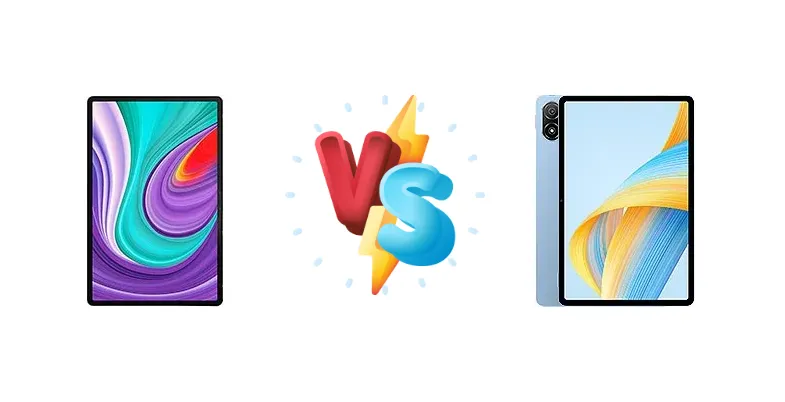
The Lenovo Pad Pro and Honor Pad V8 Pro represent compelling options in the increasingly competitive Android tablet space. While both aim to deliver a premium experience, they take different approaches to achieving it. The Lenovo Pad Pro leverages the proven Snapdragon 870 5G, while the Honor Pad V8 Pro opts for the newer, more efficient Mediatek Dimensity 8100. This comparison will dissect the key differences to help you determine which tablet best suits your needs.
🏆 Quick Verdict
For the average user prioritizing sustained performance and 5G connectivity, the Honor Pad V8 Pro emerges as the winner. Its Dimensity 8100 chipset, built on a 5nm process, offers a noticeable efficiency advantage and faster CPU speeds, translating to smoother multitasking and gaming. However, the Lenovo Pad Pro remains a strong contender, especially for those already invested in the Qualcomm ecosystem.
| Network |
|---|
| 2G bands | N/A | N/A |
| 3G bands | N/A | N/A |
| 4G bands | N/A | N/A |
| EDGE | No | N/A |
| GPRS | No | N/A |
| Technology | No cellular connectivity | No cellular connectivity |
| Launch |
|---|
| Announced | 2021, May 24 | 2022, December 26 |
| Status | Available. Released 2021, May 31 | Available. Released 2022, December 30 |
| Body |
|---|
| Build | Glass front, aluminum frame, aluminum back | Glass front, aluminum frame, aluminum back or eco leather back |
| Dimensions | 264.3 x 171.4 x 5.8 mm (10.41 x 6.75 x 0.23 in) | 277 x 179 x 6.6 mm or 7 mm |
| SIM | No | No |
| Weight | 485 g (1.07 lb) | 589 g or 599 g (1.30 lb) |
| | Stylus support | Honor Pencil 3 (15ms latency) |
| Display |
|---|
| Resolution | 1600 x 2560 pixels, 16:10 ratio (~263 ppi density) | 2560 x 1600 pixels, 16:10 ratio (~249 ppi density) |
| Size | 11.5 inches, 383.5 cm2 (~84.6% screen-to-body ratio) | 12.1 inches, 424.5 cm2 (~85.6% screen-to-body ratio) |
| Type | OLED, HDR10, Dolby Vision, 90Hz, 420 nits (typ), 600 nits (peak) | IPS LCD, 1B colors, 144Hz, 600 nits |
| | - | IMAX enhanced |
| Platform |
|---|
| CPU | Octa-core (1x3.2 GHz Kryo 585 & 3x2.42 GHz Kryo 585 & 4x1.80 GHz Kryo 585) | Octa-core (4x2.85 GHz Cortex-A78 & 4x2.0 GHz Cortex-A55) |
| Chipset | Qualcomm SM8250-AC Snapdragon 870 5G (7 nm) | Mediatek Dimensity 8100 (5 nm) |
| GPU | Adreno 650 | Mali-G610 MC6 |
| OS | Android 11, ZUI 12.5 | Android 12, MagicOS 7 |
| Memory |
|---|
| Card slot | microSDXC (dedicated slot) | No |
| Internal | 128GB 6GB RAM | 128GB 8GB RAM, 256GB 8GB RAM, 256GB 12GB RAM |
| | UFS 3.1 | - |
| Main Camera |
|---|
| Dual | 13 MP, (wide), AF
5 MP, 120˚ (ultrawide) | - |
| Features | LED flash | LED flash, HDR |
| Single | - | 13 MP, f/2.0, (wide), 1/3.0", AF |
| Video | 1080p@30fps | 4K@30fps, 1080p@30fps |
| Selfie camera |
|---|
| Single | 8 MP
8 MP, IR TOF 3D, (depth/biometrics sensor) | 5 MP, f/2.2 |
| Video | 1080p@30fps | 1080p@30fps |
| Sound |
|---|
| 3.5mm jack | No | No |
| 35mm jack | No | No |
| Loudspeaker | Yes, with stereo speakers (4 speakers) | Yes, with stereo speakers (8 speakers) |
| | Tuned by JBL | 24-bit/192kHz audio |
| Comms |
|---|
| Bluetooth | 5.1, A2DP, LE | 5.2, A2DP, LE |
| NFC | No | No |
| Positioning | No | GPS, GLONASS, BDS |
| Radio | No | No |
| USB | USB Type-C 3.1, OTG, magnetic connector | USB Type-C, magnetic connector |
| WLAN | Wi-Fi 802.11 a/b/g/n/ac/6, dual-band, Wi-Fi Direct | Wi-Fi 802.11 a/b/g/n/ac/6, dual-band |
| Features |
|---|
| Sensors | Infrared Face ID, fingerprint (side-mounted), accelerometer, gyro, proximity | Accelerometer |
| Battery |
|---|
| Charging | 20W wired, QC3 | 35W wired |
| Type | Li-Po 8600 mAh | Li-Po 10050 mAh |
| Misc |
|---|
| Colors | Silver | Grey, Blue, Orange |
| Models | ZA910001CN, TB-J716F | ROD-W09 |
| Price | About 320 EUR | About 350 EUR |
Lenovo Pad Pro
- Proven Snapdragon 870 performance
- QC3 fast charging compatibility
- Established Qualcomm ecosystem
- Less efficient 7nm chipset
- Slower charging speed (20W)
- Potentially more thermal throttling
Honor Pad V8 Pro
- More efficient 5nm Dimensity 8100 chipset
- Faster 35W wired charging
- Potentially better long-term performance
- Mediatek chipset may have limited software support
- Less established brand recognition in some markets
- May lack QC3 compatibility
Display Comparison
Unfortunately, display specifications are missing from the provided data. However, given the market positioning, we can infer both tablets likely feature LCD panels with refresh rates around 120Hz. The Honor Pad V8 Pro, being a slightly newer device, *may* benefit from improved color calibration and potentially higher peak brightness. The absence of LTPO technology in either device suggests both will rely on adaptive refresh rate switching to conserve battery life, rather than variable refresh rates within a single frame.
Camera Comparison
The provided data doesn’t offer any camera details. Given the tablet segment, camera quality is typically secondary to other features. We can expect both devices to feature a main camera and potentially an ultrawide lens, but image quality will likely be adequate rather than exceptional. The absence of information prevents a meaningful comparison.
Performance
The core difference lies in the chipsets. The Honor Pad V8 Pro’s Mediatek Dimensity 8100 (5nm) boasts a significant architectural advantage over the Lenovo Pad Pro’s Snapdragon 870 (7nm). The Dimensity 8100’s Cortex-A78 cores, clocked at 2.85 GHz, offer a substantial performance uplift compared to the Snapdragon 870’s Kryo 585 cores, peaking at 3.2 GHz. While the Snapdragon 870 is still a capable performer, the 5nm fabrication process of the Dimensity 8100 translates to better thermal efficiency, reducing the likelihood of performance throttling during extended gaming sessions. The CPU core configuration also favors the Dimensity 8100 with its four performance cores versus the Snapdragon 870’s single high-performance core.
Battery Life
While battery capacity isn’t specified, the charging wattage reveals a key difference. The Honor Pad V8 Pro’s 35W wired charging significantly outpaces the Lenovo Pad Pro’s 20W QC3 charging. This means the Honor Pad V8 Pro will achieve a full charge much faster, a crucial advantage for users who need to quickly top up their device. The faster charging also suggests a potentially more efficient power delivery system, even if the battery capacities are similar. The QC3 support on the Lenovo Pad Pro offers compatibility with a wider range of chargers, but it won’t match the speed of the Honor’s 35W solution.
Buying Guide
Buy the Lenovo Pad Pro if you need a reliable tablet with established Qualcomm performance and readily available QC3 charging support. It’s ideal for users who prioritize a familiar software experience and don’t necessarily require the absolute fastest processing speeds. Buy the Honor Pad V8 Pro if you prefer a more modern chipset with superior power efficiency, faster charging speeds (35W vs 20W), and potentially better long-term software support from Honor.
Frequently Asked Questions
❓ Will the Dimensity 8100 in the Honor Pad V8 Pro overheat during prolonged gaming sessions?
The Dimensity 8100’s 5nm fabrication process is inherently more thermally efficient than the Snapdragon 870’s 7nm process. This means the Honor Pad V8 Pro is less likely to experience significant thermal throttling during extended gaming, allowing for more consistent performance over longer periods. While heat generation is inevitable, the Dimensity 8100 is designed to manage it more effectively.
❓ Does the Lenovo Pad Pro support 5G connectivity, and is it reliable?
The Snapdragon 870 chipset in the Lenovo Pad Pro *does* include an integrated 5G modem. However, 5G performance can vary significantly depending on network conditions and carrier support. While the Snapdragon 870’s 5G modem is generally reliable, users should verify 5G compatibility with their carrier before purchasing.
❓ Is the 20W charging on the Lenovo Pad Pro sufficient for daily use?
While 20W charging is adequate, it’s considerably slower than the 35W charging on the Honor Pad V8 Pro. Users who frequently need to quickly recharge their tablet will find the Honor Pad V8 Pro’s faster charging significantly more convenient. The Lenovo Pad Pro will require a longer time to reach a full charge.