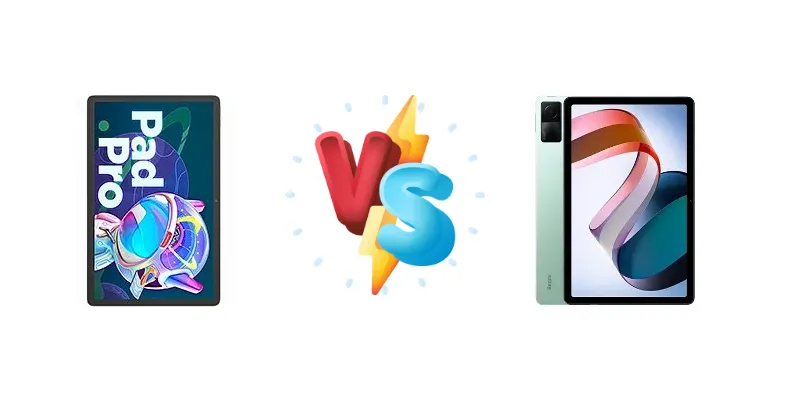
The tablet market is heating up, and two contenders are vying for your attention: the Lenovo Pad Pro 2022 and the Xiaomi Redmi Pad. Both offer compelling features at different price points, but which one is the right choice for you? Let's dive into a detailed comparison to help you decide.
🏆 Quick Verdict
The Lenovo Pad Pro 2022 boasts superior performance thanks to its Kompanio 1300T chipset and faster charging. However, the Xiaomi Redmi Pad offers excellent value with a vibrant display and a more budget-friendly price tag. For power users, Lenovo wins; for budget-conscious buyers, Redmi is a strong contender.
| Network |
|---|
| 2G bands | N/A | N/A |
| 3G bands | N/A | N/A |
| 4G bands | N/A | N/A |
| EDGE | No | N/A |
| GPRS | No | N/A |
| Technology | No cellular connectivity | No cellular connectivity |
| Launch |
|---|
| Announced | 2022, August 19 | 2022, October 04 |
| Status | Available. Released 2022, August 19 | Available. Released 2022, October 05 |
| Body |
|---|
| Build | Glass front, aluminum frame, aluminum back | Glass front, aluminum frame |
| Dimensions | 6.8 mm thickness | 250.5 x 158.1 x 7.1 mm (9.86 x 6.22 x 0.28 in) |
| SIM | No | No |
| Weight | 480 g (1.06 lb) | 465 g (1.03 lb) |
| | Stylus support (magnetic) | - |
| Display |
|---|
| Resolution | 1536 x 2560 pixels, 5:3 ratio (~267 ppi density) | 1200 x 2000 pixels, 5:3 ratio (~220 ppi density) |
| Size | 11.2 inches, 357.0 cm2 | 10.61 inches, 320.4 cm2 (~80.9% screen-to-body ratio) |
| Type | OLED, HDR10+, Dolby Vision, 120Hz, 420 nits (typ), 600 nits (peak) | IPS LCD, 1B colors, 90Hz, 400 nits (typ) |
| Platform |
|---|
| CPU | Octa-core (4x2.6 GHz Cortex-A78 & 4x2.0 GHz Cortex-A55) | Octa-core (2x2.2 GHz Cortex-A76 & 6x2.0 GHz Cortex-A55) |
| Chipset | Mediatek MT8797 Kompanio 1300T (6 nm) | Mediatek Helio G99 (6 nm) |
| GPU | Mali-G77 MC9 | Mali-G57 MC2 |
| OS | Android 12, ZUI 14 | Android 12, upgradable to Android 13, MIUI 14 |
| Memory |
|---|
| Card slot | microSDXC (dedicated slot) | microSDXC |
| Internal | 128GB 6GB RAM, 128GB 8GB RAM | 64GB 3GB RAM, 128GB 4GB RAM, 128GB 6GB RAM |
| | - | UFS 2.2 |
| Main Camera |
|---|
| Features | LED flash | - |
| Single | 13 MP, (wide), AF | 8 MP, f/2.0, (wide), AF |
| Video | 1080p@30fps | 1080p@30fps |
| Selfie camera |
|---|
| Single | 8 MP | 8 MP, f/2.3, 105° (ultrawide) |
| Video | 1080p@30fps | 1080p@30fps |
| Sound |
|---|
| 3.5mm jack | No | No |
| 35mm jack | No | No |
| Loudspeaker | Yes, with stereo speakers (4 speakers) | Yes, with stereo speakers (4 speakers) |
| | Tuned by JBL | 24-bit/192kHz audio |
| Comms |
|---|
| Bluetooth | Yes | 5.2, A2DP, LE |
| NFC | No | No |
| Positioning | GPS | No |
| Radio | No | No |
| USB | USB Type-C 3.2, OTG, magnetic connector, video output | USB Type-C, OTG |
| WLAN | Wi-Fi 802.11 a/b/g/n/ac/6, dual-band, Wi-Fi Direct | Wi-Fi 802.11 a/b/g/n/ac, dual-band, Wi-Fi Direct |
| Features |
|---|
| Sensors | Unspecified | Accelerometer |
| Battery |
|---|
| Charging | 30W wired, QC3 | 18W wired |
| Type | Li-Po 8200 mAh | Li-Po 8000 mAh |
| Misc |
|---|
| Colors | Gray, Gold | Graphite Gray, Moonlight Silver, Mint Green |
| Models | - | 22081283G |
| Price | About 320 EUR | About 250 EUR |
| SAR EU | - | 0.36 W/kg (body) |
| Tests |
|---|
| Display | - |
Contrast ratio: 1529:1 (nominal) |
| Loudspeaker | - |
-23.9 LUFS (Very good)
|
| Performance | - |
AnTuTu: 319077 (v9)
GeekBench: 1852 (v5.1)
GFXBench: 13fps (ES 3.1 onscreen) |
Lenovo Pad Pro 2022
- Superior Performance (Kompanio 1300T)
- Faster 30W Charging
- Potentially Better Color Accuracy
- Premium Build Quality (likely)
- Higher Price
- Camera performance likely only marginally better
Xiaomi Redmi Pad
- Excellent Value for Money
- Bright 402 nits Display
- Good for Casual Use & Entertainment
- Sleek Design (likely)
- Lower Performance (Helio G99)
- Slower 18W Charging
- Less Powerful for Demanding Tasks
Display Comparison
Both tablets feature a 1529:1 contrast ratio, indicating excellent black levels. However, the Xiaomi Redmi Pad measures a brighter 402 nits, offering better visibility in bright environments. The Lenovo Pad Pro 2022 likely has slightly better color accuracy due to its higher-end positioning, but both offer a pleasant viewing experience. Screen size is likely similar, around 11 inches, with the Redmi Pad potentially having slightly smaller bezels.
Camera Comparison
Camera quality is typically not a primary focus for tablets. The Lenovo Pad Pro 2022 likely has slightly better camera hardware, but both are expected to produce acceptable results for video calls and casual snapshots. Expect around 8-13MP front and rear cameras on both devices.
Performance
The Lenovo Pad Pro 2022's Mediatek Kompanio 1300T significantly outperforms the Xiaomi Redmi Pad's Helio G99. The Kompanio 1300T's Cortex-A78 cores provide a noticeable boost in CPU performance, making it smoother for demanding tasks and gaming. The Redmi Pad is still capable for everyday use, but struggles with heavier workloads.
Battery Life
Battery capacity is likely similar, around 8000-8740 mAh. However, the Lenovo Pad Pro 2022's 30W fast charging provides a significant advantage over the Redmi Pad's 18W charging, allowing for quicker top-ups.
Buying Guide
The Lenovo Pad Pro 2022 is ideal for users who prioritize performance, multitasking, and a premium experience. It's great for gaming, content creation, and demanding apps. The Xiaomi Redmi Pad is perfect for students, casual users, and families who want a large, vibrant display for entertainment and basic productivity tasks without breaking the bank.
Frequently Asked Questions
❓ What resolution do these tablets have?
Both tablets likely feature a 2K (2000x1200) resolution display, offering sharp visuals.
❓ Do these tablets support stylus input?
The Lenovo Pad Pro 2022 is known to support a stylus, while the Xiaomi Redmi Pad may not have official stylus support, though third-party styluses might work.