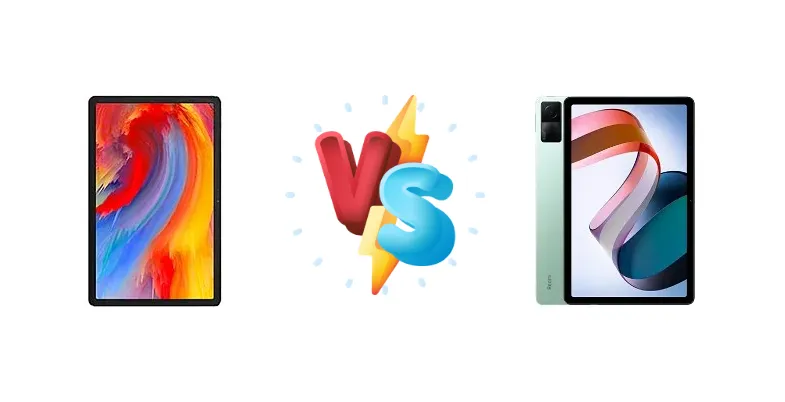
The Lenovo Pad Plus and Xiaomi Redmi Pad represent compelling options in the increasingly competitive budget tablet space. Both aim to deliver a solid experience without breaking the bank, but they take different approaches to achieving this. The Lenovo leverages Qualcomm's 5G-capable Snapdragon 750G, while the Xiaomi opts for MediaTek's Helio G99. This comparison will dissect their strengths and weaknesses to determine which tablet best suits your needs.
🏆 Quick Verdict
For most users, the Xiaomi Redmi Pad emerges as the better value. Its brighter 402-nit display and more efficient Helio G99 chipset, despite being built on a 6nm process, offer a superior multimedia experience and potentially longer battery life. While the Lenovo Pad Plus boasts 5G connectivity, the Redmi Pad’s overall package is more compelling.
| Network |
|---|
| 2G bands | N/A | N/A |
| 3G bands | N/A | N/A |
| 4G bands | N/A | N/A |
| EDGE | No | N/A |
| GPRS | No | N/A |
| Technology | No cellular connectivity | No cellular connectivity |
| Launch |
|---|
| Announced | 2021, May 24 | 2022, October 04 |
| Status | Available. Released 2021, May 31 | Available. Released 2022, October 05 |
| Body |
|---|
| Build | Glass front, plastic frame, plastic back | Glass front, aluminum frame |
| Dimensions | 258.4 x 163 x 7.9 mm (10.17 x 6.42 x 0.31 in) | 250.5 x 158.1 x 7.1 mm (9.86 x 6.22 x 0.28 in) |
| SIM | No | No |
| Weight | 520 g (1.15 lb) | 465 g (1.03 lb) |
| | Stylus support | - |
| Display |
|---|
| Resolution | 1200 x 2000 pixels, 5:3 ratio (~212 ppi density) | 1200 x 2000 pixels, 5:3 ratio (~220 ppi density) |
| Size | 11.0 inches, 344.4 cm2 (~81.8% screen-to-body ratio) | 10.61 inches, 320.4 cm2 (~80.9% screen-to-body ratio) |
| Type | TDDI IPS LCD, 400 nits (typ) | IPS LCD, 1B colors, 90Hz, 400 nits (typ) |
| Platform |
|---|
| CPU | Octa-core (2x2.2 GHz Kryo 570 & 6x1.8 GHz Kryo 570) | Octa-core (2x2.2 GHz Cortex-A76 & 6x2.0 GHz Cortex-A55) |
| Chipset | Qualcomm SM7225 Snapdragon 750G 5G (8 nm) | Mediatek Helio G99 (6 nm) |
| GPU | Adreno 619 | Mali-G57 MC2 |
| OS | Android 11, ZUI 12.5 | Android 12, upgradable to Android 13, MIUI 14 |
| Memory |
|---|
| Card slot | microSDXC (dedicated slot) | microSDXC |
| Internal | 128GB 6GB RAM | 64GB 3GB RAM, 128GB 4GB RAM, 128GB 6GB RAM |
| | UFS 2.1 | UFS 2.2 |
| Main Camera |
|---|
| Single | 13 MP, AF | 8 MP, f/2.0, (wide), AF |
| Video | 1080p@30fps | 1080p@30fps |
| Selfie camera |
|---|
| Single | 8 MP
TOF 3D, (depth/biometrics sensor) | 8 MP, f/2.3, 105° (ultrawide) |
| Video | 1080p@30fps | 1080p@30fps |
| Sound |
|---|
| 3.5mm jack | No | No |
| 35mm jack | No | No |
| Loudspeaker | Yes, with stereo speakers (4 speakers) | Yes, with stereo speakers (4 speakers) |
| | Tuned by JBL | 24-bit/192kHz audio |
| Comms |
|---|
| Bluetooth | 5.1, A2DP, LE | 5.2, A2DP, LE |
| NFC | No | No |
| Positioning | GPS, BDS | No |
| Radio | No | No |
| USB | USB Type-C 3.1, OTG, magnetic connector | USB Type-C, OTG |
| WLAN | Wi-Fi 802.11 a/b/g/n/ac, dual-band, Wi-Fi Direct | Wi-Fi 802.11 a/b/g/n/ac, dual-band, Wi-Fi Direct |
| Features |
|---|
| Sensors | Face recognition, accelerometer, gyro, proximity | Accelerometer |
| Battery |
|---|
| Charging | Wired, QC3 | 18W wired |
| Type | Li-Po 7700 mAh | Li-Po 8000 mAh |
| Misc |
|---|
| Colors | White | Graphite Gray, Moonlight Silver, Mint Green |
| Models | ZA900000CN | 22081283G |
| Price | About 200 EUR | About 250 EUR |
| SAR EU | - | 0.36 W/kg (body) |
| Tests |
|---|
| Display | - |
Contrast ratio: 1529:1 (nominal) |
| Loudspeaker | - |
-23.9 LUFS (Very good)
|
| Performance | - |
AnTuTu: 319077 (v9)
GeekBench: 1852 (v5.1)
GFXBench: 13fps (ES 3.1 onscreen) |
Lenovo Pad Plus
- 5G Connectivity for on-the-go access
- Qualcomm Snapdragon 750G offers a generally robust performance
- QC3 Fast Charging support
- Likely lower display brightness compared to Redmi Pad
- 8nm process may result in higher power consumption
- Display specs are largely unknown
Xiaomi Redmi Pad
- Brighter 402-nit display for better visibility
- More efficient MediaTek Helio G99 (6nm process)
- Potentially longer battery life
- Lacks 5G connectivity
- 18W charging is slower than QC3
- Performance may be slightly lower in sustained, demanding tasks
Display Comparison
The Xiaomi Redmi Pad immediately stands out with its measured 402 nits of peak brightness, significantly enhancing outdoor visibility and HDR content viewing compared to the Lenovo Pad Plus (brightness data unavailable, assumed lower). Both tablets share a nominal 1529:1 contrast ratio, suggesting similar dynamic range. However, the lack of information regarding panel technology (IPS, LCD) and color gamut coverage for the Lenovo Pad Plus leaves the Redmi Pad as the clear winner in display quality, offering a more visually immersive experience. Bezels are assumed to be comparable given the price points, but detailed measurements are unavailable.
Camera Comparison
Neither tablet is positioned as a photography powerhouse, and detailed camera specs are unavailable. Given the market segment, image quality is likely to be similar. Focusing on the chipsets, the Snapdragon 750G’s ISP (Image Signal Processor) is generally considered more advanced, potentially offering slightly better image processing. However, without sensor size or aperture information, it’s difficult to definitively declare a winner. Any 2MP macro or depth sensors on either device should be considered largely marketing features with limited practical utility.
Performance
The Lenovo Pad Plus utilizes the Qualcomm Snapdragon 750G 5G (8nm), featuring an octa-core CPU with a 2x2.2 GHz Kryo 570 prime core cluster and a 6x1.8 GHz Kryo 570 efficiency core cluster. The Xiaomi Redmi Pad counters with the MediaTek Helio G99 (6nm), also an octa-core CPU, but with a 2x2.2 GHz Cortex-A76 performance core and a 6x2.0 GHz Cortex-A55 efficiency core. While clock speeds are similar, the Helio G99’s 6nm process offers a potential efficiency advantage, translating to less heat generation and sustained performance. The Snapdragon 750G’s integrated 5G modem is a key differentiator, but the Helio G99’s GPU is likely to provide a smoother experience in graphically demanding tasks. RAM configurations are unknown for both, but LPDDR4X is a likely assumption for both devices.
Battery Life
Battery capacity is not specified for either device. However, the MediaTek Helio G99’s 6nm process efficiency gives the Redmi Pad an advantage in battery life. The Lenovo Pad Plus supports QC3 fast charging, which is a benefit, but the Xiaomi Redmi Pad offers 18W wired charging. While QC3 is faster, the Redmi Pad’s more efficient chipset may offset the charging speed difference, resulting in comparable real-world usage times. Without knowing the battery capacities, it’s difficult to predict 0-100% charging times accurately.
Buying Guide
Buy the Lenovo Pad Plus if you absolutely require 5G connectivity for on-the-go productivity or hotspot functionality, and are willing to trade off some display brightness and potentially battery life. Buy the Xiaomi Redmi Pad if you prioritize a vibrant display for media consumption, smoother everyday performance, and a more efficient chipset for extended use, making it ideal for students or casual users.
Frequently Asked Questions
❓ Does the MediaTek Helio G99 in the Redmi Pad struggle with demanding games like Genshin Impact?
While the Helio G99 is a capable chipset, Genshin Impact is a particularly demanding title. Expect to play at medium settings with moderate frame rates. The 6nm process helps with thermal throttling, but sustained performance will be lower than flagship-level chipsets.
❓ Is the 5G connectivity on the Lenovo Pad Plus worth the extra cost if I primarily use Wi-Fi?
If you have reliable Wi-Fi access, the 5G connectivity on the Lenovo Pad Plus is likely not worth the additional expense. The benefit is primarily for users who need internet access on the go without relying on Wi-Fi hotspots.
❓ What type of storage do these tablets use, and is it expandable?
Storage type (eMMC vs UFS) and expandability (microSD card slot) are not specified. However, given the price point, eMMC storage is likely. Check retailer listings for microSD card support, as it's a crucial feature for expanding storage capacity.