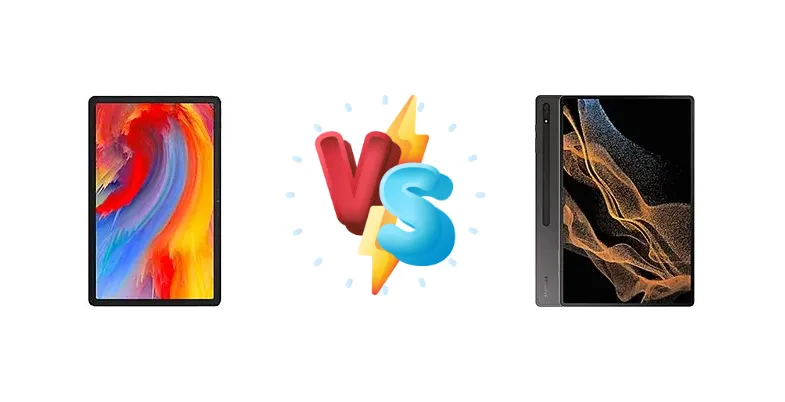
The Android tablet market offers a wide spectrum of choices, from affordable 5G options like the Lenovo Pad Plus to the no-compromise premium experience of the Samsung Galaxy Tab S8 Ultra. This comparison dissects these two devices, focusing on how their core hardware – specifically the Snapdragon 750G and Snapdragon 8 Gen 1 – translate into real-world performance and value.
🏆 Quick Verdict
For the average user prioritizing affordability and 5G connectivity, the Lenovo Pad Plus offers a compelling package. However, the Samsung Galaxy Tab S8 Ultra dominates in raw power, display quality, and overall feature set, making it the clear winner for demanding users and professionals willing to pay the premium.
| Network |
|---|
| 2G bands | N/A | GSM 850 / 900 / 1800 / 1900 |
| 3G bands | N/A | HSDPA 850 / 900 / 1700(AWS) / 1900 / 2100 |
| 4G bands | N/A | LTE |
| 5G bands | - | SA/NSA |
| EDGE | No | - |
| GPRS | No | - |
| Speed | - | HSPA, LTE, 5G - cellular model only |
| Technology | No cellular connectivity | GSM / HSPA / LTE / 5G |
| Launch |
|---|
| Announced | 2021, May 24 | 2022, February 09 |
| Status | Available. Released 2021, May 31 | Available. Released 2022, April 30 |
| Body |
|---|
| Build | Glass front, plastic frame, plastic back | - |
| Dimensions | 258.4 x 163 x 7.9 mm (10.17 x 6.42 x 0.31 in) | 326.4 x 208.6 x 5.5 mm (12.85 x 8.21 x 0.22 in) |
| SIM | No | Nano-SIM (cellular model only) |
| Weight | 520 g (1.15 lb) | 726 g (Wi-Fi), 728 g (5G) (1.60 lb) |
| | Stylus support | Stylus, 2.8ms latency (Bluetooth integration, accelerometer, gyro) |
| Display |
|---|
| Protection | - | Corning Gorilla Glass 5 |
| Resolution | 1200 x 2000 pixels, 5:3 ratio (~212 ppi density) | 1848 x 2960 pixels, 16:10 ratio (~240 ppi density) |
| Size | 11.0 inches, 344.4 cm2 (~81.8% screen-to-body ratio) | 14.6 inches, 612.6 cm2 (~90.0% screen-to-body ratio) |
| Type | TDDI IPS LCD, 400 nits (typ) | Super AMOLED, 120Hz, HDR10+ |
| Platform |
|---|
| CPU | Octa-core (2x2.2 GHz Kryo 570 & 6x1.8 GHz Kryo 570) | Octa-core (1x3.00 GHz Cortex-X2 & 3x2.50 GHz Cortex-A710 & 4x1.80 GHz Cortex-A510) |
| Chipset | Qualcomm SM7225 Snapdragon 750G 5G (8 nm) | Qualcomm SM8450 Snapdragon 8 Gen 1 (4 nm) |
| GPU | Adreno 619 | Adreno 730 |
| OS | Android 11, ZUI 12.5 | Android 12, up to 4 major Android upgrades, One UI 6.1.1 |
| Memory |
|---|
| Card slot | microSDXC (dedicated slot) | microSDXC (dedicated slot) |
| Internal | 128GB 6GB RAM | 128GB 8GB RAM, 256GB 8GB RAM, 256GB 12GB RAM, 256GB 16GB RAM, 512GB 12GB RAM, 512GB 16GB RAM |
| | UFS 2.1 | UFS |
| Main Camera |
|---|
| Dual | - | 13 MP, f/2.0, 26mm (wide), 1/3.4", 1.0µm, AF
6 MP, f/2.2, (ultrawide) |
| Features | - | LED flash, HDR, panorama |
| Single | 13 MP, AF | - |
| Video | 1080p@30fps | 4K@30/60fps, 1080p@30fps |
| Selfie camera |
|---|
| Dual | - | 12 MP, f/2.2, 26mm (wide)
12 MP, f/2.4, 120˚ (ultrawide) |
| Features | - | HDR |
| Single | 8 MP
TOF 3D, (depth/biometrics sensor) | - |
| Video | 1080p@30fps | 4K@30/60fps, 1080p@30fps |
| Sound |
|---|
| 3.5mm jack | No | No |
| 35mm jack | No | No |
| Loudspeaker | Yes, with stereo speakers (4 speakers) | Yes, with stereo speakers (4 speakers) |
| | Tuned by JBL | Tuned by AKG |
| Comms |
|---|
| Bluetooth | 5.1, A2DP, LE | 5.2, A2DP, LE |
| NFC | No | No |
| Positioning | GPS, BDS | GPS, GLONASS, BDS, GALILEO - cellular model only |
| Radio | No | No |
| USB | USB Type-C 3.1, OTG, magnetic connector | USB Type-C 3.2, magnetic connector |
| WLAN | Wi-Fi 802.11 a/b/g/n/ac, dual-band, Wi-Fi Direct | Wi-Fi 802.11 a/b/g/n/ac/6e, dual-band, Wi-Fi Direct |
| Features |
|---|
| Sensors | Face recognition, accelerometer, gyro, proximity | Fingerprint (under display, optical), accelerometer, gyro, proximity, compass |
| | - | Wireless Samsung DeX |
| Battery |
|---|
| Charging | Wired, QC3 | 45W wired, 100% in 82 min |
| Type | Li-Po 7700 mAh | Li-Po 11200 mAh |
| Misc |
|---|
| Colors | White | Graphite |
| Models | ZA900000CN | SM-X900, SM-X906, SM-X906B, SM-X906U, SM-X906N |
| Price | About 200 EUR | About 1150 EUR |
| SAR EU | - | 0.69 W/kg (body) |
Lenovo Pad Plus
- Affordable price point
- Integrated 5G connectivity
- Suitable for everyday tasks
- Less powerful processor
- Likely lower quality display
- Limited camera capabilities
Samsung Galaxy Tab S8 Ultra
- Flagship-level performance
- Stunning Super AMOLED display
- Fast 45W charging
- Significantly higher price
- Larger size may be less portable
- Potential for thermal throttling under sustained load (though mitigated by 4nm process)
Display Comparison
While specific display specs for the Lenovo Pad Plus are unavailable, its market positioning suggests an LCD panel. The Samsung Galaxy Tab S8 Ultra, however, boasts a 14.6-inch Super AMOLED display. This difference is significant; AMOLED offers superior contrast, color accuracy, and viewing angles. The Snapdragon 8 Gen 1’s powerful GPU can fully leverage the Tab S8 Ultra’s display for vibrant gaming and video playback. The Tab S8 Ultra’s larger screen size also impacts usability for multitasking and creative work. The absence of LTPO in the Pad Plus likely means a fixed refresh rate, while the Tab S8 Ultra likely features adaptive refresh rate technology for improved battery efficiency.
Camera Comparison
Given the tablet form factor, camera quality isn’t a primary concern for most users. However, the Tab S8 Ultra likely features a more sophisticated camera system, benefiting from the Snapdragon 8 Gen 1’s improved image signal processor (ISP). While specific details are missing for both devices, the Tab S8 Ultra’s higher price point suggests a more capable main sensor and potentially optical image stabilization (OIS). The Lenovo Pad Plus likely features a more basic camera setup focused on video calls and casual snapshots.
Performance
The core difference lies in the chipsets. The Lenovo Pad Plus utilizes the Qualcomm SM7225 Snapdragon 750G 5G (8nm), an octa-core processor geared towards efficiency and 5G connectivity. The Samsung Galaxy Tab S8 Ultra is powered by the Qualcomm SM8450 Snapdragon 8 Gen 1 (4nm), a flagship-level processor built on a more advanced 4nm process. This smaller node translates to significantly improved power efficiency and thermal performance. The Snapdragon 8 Gen 1’s Cortex-X2 prime core (3.00 GHz) provides a substantial performance boost over the Kryo 570 cores (2.2 GHz) in the Pad Plus. The Tab S8 Ultra’s likely use of faster LPDDR5X RAM further enhances performance, especially in memory-intensive tasks. This means smoother multitasking, faster app loading times, and a better gaming experience on the Tab S8 Ultra.
Battery Life
The Lenovo Pad Plus supports QC3 wired charging, but specific battery capacity and charging time are unknown. The Samsung Galaxy Tab S8 Ultra boasts 45W wired charging, achieving a 100% charge in approximately 82 minutes. While the Tab S8 Ultra’s battery capacity is not provided, the more efficient Snapdragon 8 Gen 1 (4nm) and potential software optimizations likely result in comparable or better real-world battery life despite the larger, higher-resolution display. The faster charging speed of the Tab S8 Ultra is a significant convenience factor.
Buying Guide
Buy the Lenovo Pad Plus if you need a portable, 5G-connected tablet for everyday tasks like streaming, browsing, and light productivity, and are on a strict budget. It’s ideal for students or travelers who need connectivity on the go. Buy the Samsung Galaxy Tab S8 Ultra if you prioritize top-tier performance for demanding applications like video editing, gaming, or multitasking, and value a stunning display and premium build quality. This is the tablet for creative professionals and power users.
Frequently Asked Questions
❓ Is the Snapdragon 750G in the Lenovo Pad Plus sufficient for playing demanding games like Genshin Impact?
While the Snapdragon 750G can handle Genshin Impact, you'll likely need to lower the graphics settings to achieve a smooth frame rate. It's not designed for consistently high-end gaming like the Snapdragon 8 Gen 1 in the Tab S8 Ultra.
❓ Does the Samsung Galaxy Tab S8 Ultra support DeX mode for a desktop-like experience?
Yes, the Samsung Galaxy Tab S8 Ultra fully supports DeX mode, allowing you to connect a monitor, keyboard, and mouse for a desktop-like productivity experience. This is a significant advantage for users who want to use their tablet as a laptop replacement.
❓ How does the 5G connectivity on the Lenovo Pad Plus compare to Wi-Fi 6E on the Tab S8 Ultra in terms of real-world speeds?
While 5G offers convenience, Wi-Fi 6E on the Tab S8 Ultra, when connected to a compatible router, generally provides faster and more stable speeds. 5G speeds are dependent on network coverage and congestion.