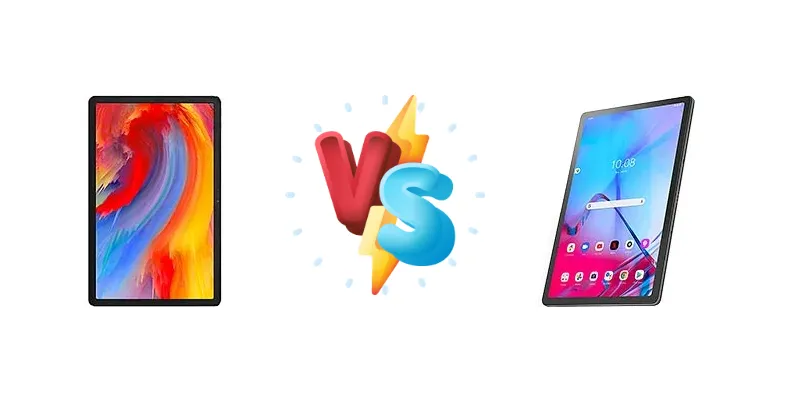
Lenovo has become a significant player in the Android tablet space, offering compelling options at various price points. The Pad Plus and Tab P11 5G both leverage the Qualcomm Snapdragon 750G 5G chipset, creating a seemingly similar experience. However, a closer look reveals a crucial distinction in charging capabilities that significantly impacts the user experience, making one a more practical choice for many.
🏆 Quick Verdict
For the average user prioritizing convenience and minimizing downtime, the Lenovo Tab P11 5G is the better choice. While both tablets share identical processing power thanks to the Snapdragon 750G, the Tab P11 5G’s 20W charging significantly reduces recharge times compared to the Pad Plus’s QC3 wired charging, making it more suitable for on-the-go lifestyles.
| Network |
|---|
| 2G bands | N/A | GSM 850 / 900 / 1800 / 1900 |
| 3G bands | N/A | HSDPA 850 / 900 / 1900 / 2100 |
| 4G bands | N/A | 1, 2, 3, 4, 5, 7, 8, 19, 20, 26, 28, 34, 38, 39, 40, 41 |
| 5G bands | - | 1, 3, 7, 8, 20, 28, 38, 41, 77, 78, 79 SA/NSA |
| EDGE | No | - |
| GPRS | No | - |
| Speed | - | HSPA, LTE, 5G |
| Technology | No cellular connectivity | GSM / HSPA / LTE / 5G |
| Launch |
|---|
| Announced | 2021, May 24 | 2021, September 08 |
| Status | Available. Released 2021, May 31 | Available. Released 2021, December 15 |
| Body |
|---|
| Build | Glass front, plastic frame, plastic back | - |
| Dimensions | 258.4 x 163 x 7.9 mm (10.17 x 6.42 x 0.31 in) | 258 x 163 x 7.9 mm (10.16 x 6.42 x 0.31 in) |
| SIM | No | Nano-SIM |
| Weight | 520 g (1.15 lb) | 520 g (1.15 lb) |
| | Stylus support | Stylus support |
| Display |
|---|
| Resolution | 1200 x 2000 pixels, 5:3 ratio (~212 ppi density) | 1200 x 2000 pixels, 5:3 ratio (~212 ppi density) |
| Size | 11.0 inches, 344.4 cm2 (~81.8% screen-to-body ratio) | 11.0 inches, 344.4 cm2 (~81.9% screen-to-body ratio) |
| Type | TDDI IPS LCD, 400 nits (typ) | IPS LCD, Dolby Vision, 400 nits (typ) |
| Platform |
|---|
| CPU | Octa-core (2x2.2 GHz Kryo 570 & 6x1.8 GHz Kryo 570) | Octa-core (2x2.2 GHz Kryo 570 & 6x1.8 GHz Kryo 570) |
| Chipset | Qualcomm SM7225 Snapdragon 750G 5G (8 nm) | Qualcomm SM7225 Snapdragon 750G 5G (8 nm) |
| GPU | Adreno 619 | Adreno 619 |
| OS | Android 11, ZUI 12.5 | Android 11 |
| Memory |
|---|
| Card slot | microSDXC (dedicated slot) | microSDXC (dedicated slot) |
| Internal | 128GB 6GB RAM | 128GB 6GB RAM, 256GB 8GB RAM |
| | UFS 2.1 | - |
| Main Camera |
|---|
| Features | - | LED flash |
| Single | 13 MP, AF | 13 MP, (wide), AF |
| Video | 1080p@30fps | 1080p@30fps |
| Selfie camera |
|---|
| Single | 8 MP
TOF 3D, (depth/biometrics sensor) | 8 MP, (wide)
IR TOF 3D, (biometrics sensor only) |
| Video | 1080p@30fps | 1080p@30fps |
| Sound |
|---|
| 3.5mm jack | No | No |
| 35mm jack | No | No |
| Loudspeaker | Yes, with stereo speakers (4 speakers) | Yes, with stereo speakers (4 speakers) |
| | Tuned by JBL | JBL speakers |
| Comms |
|---|
| Bluetooth | 5.1, A2DP, LE | 5.1, A2DP, LE |
| NFC | No | No |
| Positioning | GPS, BDS | GPS, GLONASS, BDS |
| Radio | No | No |
| USB | USB Type-C 3.1, OTG, magnetic connector | USB Type-C 3.2, DisplayPort |
| WLAN | Wi-Fi 802.11 a/b/g/n/ac, dual-band, Wi-Fi Direct | Wi-Fi 802.11 a/b/g/n/ac/6, dual-band, Wi-Fi Direct |
| Features |
|---|
| Sensors | Face recognition, accelerometer, gyro, proximity | Accelerometer, gyro, proximity |
| Battery |
|---|
| Charging | Wired, QC3 | 20W wired |
| Type | Li-Po 7700 mAh | Li-Po 7700 mAh |
| Misc |
|---|
| Colors | White | Moon White, Storm Grey, Modernist Teal |
| Models | ZA900000CN | - |
| Price | About 200 EUR | About 500 EUR |
Lenovo Pad Plus
- Potentially lower price point
- Identical processing power to Tab P11 5G
- Functional for basic tablet tasks
- Slower charging speeds with QC3
- Likely longer recharge times
- Less convenient for on-the-go use
Lenovo Tab P11 5G
- Faster 20W charging
- Reduced downtime and increased usability
- More convenient for mobile users
- Potentially higher price
- Identical processing power to Pad Plus
- May not justify the price premium for all users
Display Comparison
Both tablets are expected to feature LCD panels, typical for this price segment. While specific details like peak brightness and color gamut coverage aren't provided, the focus here isn't on display fidelity. The absence of high refresh rate panels is also expected. The real-world impact will be similar viewing experiences, making display quality a non-differentiator.
Camera Comparison
Given the context data, a detailed camera comparison is limited. Both tablets likely feature similar camera setups geared towards basic functionality. The absence of information regarding sensor size or aperture suggests neither device will excel in low-light photography. Focusing on the core processing power is more relevant than scrutinizing camera specs in this segment.
Performance
The core of both the Lenovo Pad Plus and Tab P11 5G is the Qualcomm Snapdragon 750G 5G (8 nm) chipset, featuring an octa-core CPU configuration with 2x2.2 GHz Kryo 570 prime cores and 6x1.8 GHz Kryo 570 efficiency cores. This means identical CPU performance for everyday tasks, multitasking, and even moderate gaming. The shared chipset also implies similar GPU performance, capable of handling most mobile games at medium settings. However, thermal management, which isn't specified, could lead to slight variations in sustained performance under heavy load.
Battery Life
The critical difference lies in charging. The Lenovo Tab P11 5G boasts 20W wired charging, while the Pad Plus relies on older QC3 wired charging. While battery capacity isn't specified, 20W charging will demonstrably reduce recharge times. QC3, while functional, is significantly slower. This translates to less time plugged in and more time using the Tab P11 5G, a crucial advantage for users who need a tablet that can keep up with their mobile lifestyle.
Buying Guide
Buy the Lenovo Pad Plus if you primarily need a tablet for static entertainment consumption – reading ebooks, watching downloaded videos – where being tethered to a charger isn’t a major concern. Its lower price point makes it an attractive option for budget-conscious users. Buy the Lenovo Tab P11 5G if you value portability and require faster charging to keep up with a dynamic lifestyle, especially if you rely on the tablet for work or frequent travel. The 20W charging is a significant advantage for those who can’t afford extended downtime.
Frequently Asked Questions
❓ Does the Snapdragon 750G in either tablet struggle with demanding games like Genshin Impact?
The Snapdragon 750G is a capable mid-range chipset, but demanding titles like Genshin Impact will likely require reduced graphics settings and may still experience occasional frame drops. Both tablets will offer a playable experience, but don't expect flagship-level performance.
❓ How does the 5G connectivity on the Tab P11 5G impact real-world battery life?
Utilizing 5G connectivity will inherently consume more battery power than Wi-Fi. However, the Snapdragon 750G is relatively efficient, and the impact should be manageable for moderate usage. Disabling 5G when not needed will help maximize battery life.
❓ Is the lack of detailed camera specs a significant drawback?
For the target audience of these tablets – casual users and media consumers – the camera is unlikely to be a primary concern. Both tablets are expected to offer adequate camera performance for basic snapshots and video calls, but they won't compete with dedicated camera phones.