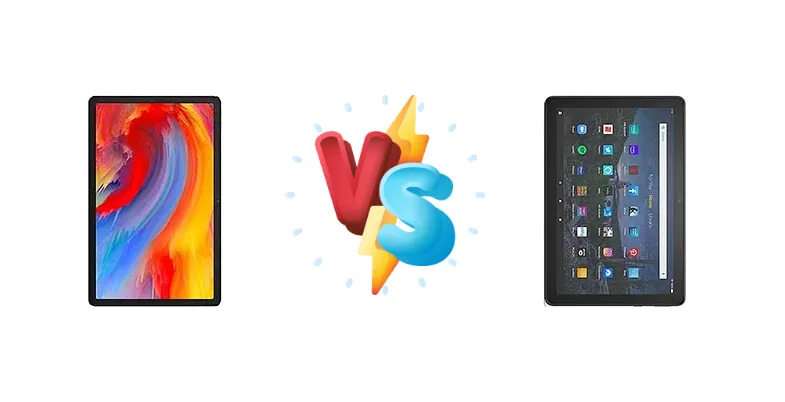
The Lenovo Pad Plus and Amazon Fire HD 10 Plus (2021) represent distinct approaches to the budget tablet market. The Lenovo Pad Plus aims for a more versatile Android experience powered by a modern Snapdragon chipset, while the Fire HD 10 Plus prioritizes Amazon’s ecosystem and convenience features. This comparison dissects their core components to determine which tablet best suits your needs.
🏆 Quick Verdict
For users prioritizing performance and a cleaner Android experience, the Lenovo Pad Plus emerges as the stronger choice. Its Snapdragon 750G chipset offers a significant performance advantage over the Fire HD 10 Plus’s Helio P60T, making it better suited for multitasking and demanding applications. However, the Fire HD 10 Plus’s wireless charging and deeper Amazon integration are compelling features for specific users.
| Network |
|---|
| 2G bands | N/A | N/A |
| 3G bands | N/A | - |
| 4G bands | N/A | - |
| EDGE | No | No |
| GPRS | No | No |
| Technology | No cellular connectivity | No cellular connectivity |
| Launch |
|---|
| Announced | 2021, May 24 | 2021, April 27. Released 2021, May 26 |
| Status | Available. Released 2021, May 31 | Discontinued |
| Body |
|---|
| Build | Glass front, plastic frame, plastic back | - |
| Dimensions | 258.4 x 163 x 7.9 mm (10.17 x 6.42 x 0.31 in) | 247 x 166 x 9.2 mm (9.72 x 6.54 x 0.36 in) |
| SIM | No | No |
| Weight | 520 g (1.15 lb) | 468 g (1.03 lb) |
| | Stylus support | - |
| Display |
|---|
| Protection | - | Aluminosilicate glass |
| Resolution | 1200 x 2000 pixels, 5:3 ratio (~212 ppi density) | 1920 x 1200 pixels, 16:10 ratio (~224 ppi density) |
| Size | 11.0 inches, 344.4 cm2 (~81.8% screen-to-body ratio) | 10.1 inches, 295.8 cm2 (~72.1% screen-to-body ratio) |
| Type | TDDI IPS LCD, 400 nits (typ) | IPS LCD |
| Platform |
|---|
| CPU | Octa-core (2x2.2 GHz Kryo 570 & 6x1.8 GHz Kryo 570) | Octa-core (4x2.0 GHz Cortex-A73 & 4x2.0 GHz Cortex-A53) |
| Chipset | Qualcomm SM7225 Snapdragon 750G 5G (8 nm) | Mediatek MT8183 Helio P60T (12 nm) |
| GPU | Adreno 619 | Mali-G72 MP3 |
| OS | Android 11, ZUI 12.5 | Android 9.0 (Pie), Fire OS 7 |
| Memory |
|---|
| Card slot | microSDXC (dedicated slot) | microSDXC (dedicated slot) |
| Internal | 128GB 6GB RAM | 32GB 4GB RAM, 64GB 4GB RAM |
| | UFS 2.1 | eMMC 5.1 |
| Main Camera |
|---|
| Single | 13 MP, AF | 5 MP |
| Video | 1080p@30fps | 720p |
| Selfie camera |
|---|
| Single | 8 MP
TOF 3D, (depth/biometrics sensor) | 2 MP |
| Video | 1080p@30fps | 720p |
| Sound |
|---|
| 3.5mm jack | No | Yes |
| 35mm jack | No | Yes |
| Loudspeaker | Yes, with stereo speakers (4 speakers) | Yes, with stereo speakers |
| | Tuned by JBL | - |
| Comms |
|---|
| Bluetooth | 5.1, A2DP, LE | 5.0, A2DP, LE |
| NFC | No | No |
| Positioning | GPS, BDS | No |
| Radio | No | No |
| USB | USB Type-C 3.1, OTG, magnetic connector | USB Type-C 2.0, OTG |
| WLAN | Wi-Fi 802.11 a/b/g/n/ac, dual-band, Wi-Fi Direct | Wi-Fi 802.11 a/b/g/n/ac, dual-band |
| Features |
|---|
| Sensors | Face recognition, accelerometer, gyro, proximity | Accelerometer |
| | - | Text-to-Speech English-language content reader |
| Battery |
|---|
| Charging | Wired, QC3 | Wireless |
| Type | Li-Po 7700 mAh | Li-Ion |
| Misc |
|---|
| Colors | White | Slate |
| Models | ZA900000CN | T76N2P |
| Price | About 200 EUR | About 150 EUR |
Lenovo Pad Plus
- Significantly faster processor (Snapdragon 750G)
- More efficient 8nm manufacturing process
- 5G connectivity
- Cleaner Android experience
- Lacks wireless charging
- Potentially less optimized software experience compared to Amazon's Fire OS
Amazon Fire HD 10 Plus (2021)
- Wireless charging convenience
- Deep Amazon ecosystem integration
- Alexa hands-free support
- Generally lower price point
- Slower and less efficient Helio P60T processor
- 12nm manufacturing process leads to more heat
- Fire OS is heavily customized and may not appeal to all users
Display Comparison
Neither device boasts a particularly standout display. While specific display specs (resolution, panel type) are missing for both, the focus here is on the underlying processing power impacting UI smoothness. The Lenovo Pad Plus’s Snapdragon 750G will likely deliver a more responsive experience when navigating the interface and rendering graphics, even if the panels themselves are comparable. Bezels are likely similar given the price points, and color accuracy is unlikely to be a strong suit for either.
Camera Comparison
Camera performance is unlikely to be a deciding factor for either tablet. Both are positioned as budget devices, and camera quality is typically sacrificed. Without specific sensor details, it’s safe to assume both feature modest camera setups suitable for casual snapshots. The focus should not be on image quality, but rather on the chipset’s image signal processor (ISP) – the Snapdragon 750G’s ISP will likely offer faster processing and better noise reduction compared to the Helio P60T’s.
Performance
The core difference lies in the chipsets. The Lenovo Pad Plus’s Qualcomm SM7225 Snapdragon 750G 5G (8nm) is a significantly more modern and powerful processor than the Amazon Fire HD 10 Plus’s MediaTek MT8183 Helio P60T (12nm). The Snapdragon 750G utilizes newer Kryo CPU cores and a more efficient manufacturing process, resulting in superior CPU and GPU performance. The 8nm process node translates to better thermal efficiency, meaning the Lenovo Pad Plus is less likely to throttle under sustained load. The Helio P60T, while capable for basic tasks, will struggle with more demanding applications and multitasking. The Snapdragon 750G also benefits from 5G connectivity, a feature absent in the Fire HD 10 Plus.
Battery Life
Battery life will depend heavily on usage patterns. While specific battery capacities are not provided, the Snapdragon 750G’s superior efficiency could offset a potentially smaller battery in the Lenovo Pad Plus. The Amazon Fire HD 10 Plus offers the convenience of wireless charging, a feature absent on the Lenovo Pad Plus. However, the slower charging speeds of wireless charging mean a full charge will take considerably longer than the Lenovo Pad Plus’s QC3 wired charging, which will likely deliver faster 0-100% times.
Buying Guide
Buy the Lenovo Pad Plus if you need a tablet capable of handling more demanding tasks like light gaming, video editing, or running multiple apps simultaneously, and you prefer a standard Android experience. Buy the Amazon Fire HD 10 Plus (2021) if you are heavily invested in the Amazon ecosystem, prioritize media consumption, and value the convenience of wireless charging and Alexa integration, even at the cost of raw processing power.
Frequently Asked Questions
❓ Will the Helio P60T in the Fire HD 10 Plus struggle with graphically intensive games like PUBG Mobile?
Yes, the MediaTek Helio P60T is likely to struggle with demanding games like PUBG Mobile, even at lower settings. The Snapdragon 750G in the Lenovo Pad Plus offers a significantly better gaming experience due to its more powerful GPU and efficient architecture.
❓ How much does the Amazon Fire OS customization impact the user experience compared to standard Android on the Lenovo Pad Plus?
Amazon Fire OS is heavily customized, replacing the Google Play Store with the Amazon Appstore. This means access to a smaller app selection and a different user interface. The Lenovo Pad Plus offers a more standard Android experience with access to the full Google Play Store and a more familiar interface.
❓ Does the Lenovo Pad Plus support expandable storage via microSD card?
While not explicitly stated in the provided specs, Lenovo tablets often include microSD card slots for expandable storage. This is a potential advantage over the Fire HD 10 Plus, which may or may not offer this feature depending on the specific model.
❓ Is the wireless charging on the Fire HD 10 Plus Qi-compatible, allowing me to use chargers from other devices?
Yes, the Amazon Fire HD 10 Plus (2021) supports Qi wireless charging, meaning it is compatible with most standard Qi wireless chargers.