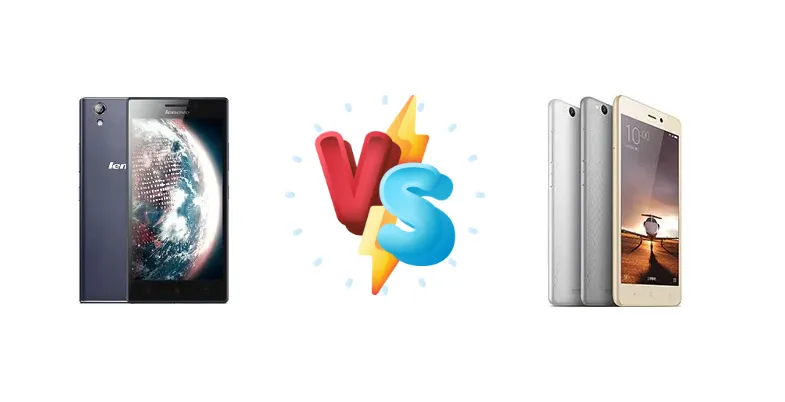
The Lenovo P70 and Xiaomi Redmi 3 were popular budget contenders, both boasting impressive battery life. But which one offered the better overall package? This comprehensive comparison dives deep into their specs, performance, and features to help you decide.
🏆 Quick Verdict
The Xiaomi Redmi 3 edges out the Lenovo P70 thanks to its slightly better performance and more modern design. While the P70's battery is legendary, the Redmi 3 provides a more well-rounded experience for the price.
| Network |
|---|
| 2G bands | GSM 850 / 900 / 1800 / 1900 - SIM 1 & SIM 2 | GSM 900 / 1800 / 1900 - SIM 1 & SIM 2 |
| 3G bands | HSDPA 900 / 2100 | HSDPA 850 / 900 / 1900 / 2100 |
| 4G bands | 1, 3, 7, 20 - Data only, no voice | 1, 3, 7, 38, 39, 40, 41 |
| 5G bands | - | 1, 28, 41, 77, 78 SA/NSA |
| Speed | HSPA 21.1/5.76 Mbps, LTE Cat4 150/50 Mbps | HSPA, LTE, EV-DO Rev.A 3.1 Mbps |
| Technology | GSM / HSPA / LTE | GSM / CDMA / HSPA / EVDO / LTE |
| | - | CDMA2000 1xEV-DO |
| Launch |
|---|
| Announced | 2015, January. Released 2015, February | 2016, January. Released 2016, January |
| Status | Discontinued | Discontinued |
| Body |
|---|
| Build | - | Glass front, aluminum back, aluminum frame |
| Dimensions | 142 x 71.8 x 8.9 mm (5.59 x 2.83 x 0.35 in) | 139.3 x 69.6 x 8.5 mm (5.48 x 2.74 x 0.33 in) |
| SIM | Dual SIM (Micro-SIM, dual stand-by) | Nano-SIM + Micro-SIM |
| Weight | 149 g (5.26 oz) | 144 g (5.08 oz) |
| Display |
|---|
| Resolution | 720 x 1280 pixels, 16:9 ratio (~294 ppi density) | 720 x 1280 pixels, 16:9 ratio (~294 ppi density) |
| Size | 5.0 inches, 68.9 cm2 (~67.6% screen-to-body ratio) | 5.0 inches, 68.9 cm2 (~71.1% screen-to-body ratio) |
| Type | IPS LCD | IPS LCD |
| Platform |
|---|
| CPU | Octa-core 1.7 GHz Cortex-A53 | Octa-core (4x1.5 GHz Cortex-A53 & 4x1.2 GHz Cortex-A53) |
| Chipset | Mediatek MT6752 (28 nm) | Qualcomm MSM8939v2 Snapdragon 616 (28 nm) |
| GPU | Mali-T760MP2 | Adreno 405 |
| OS | Android 4.4 (KitKat) | Android 5.1 (Lollipop), MIUI 7 |
| Memory |
|---|
| Card slot | microSDHC (dedicated slot) | microSDXC (uses shared SIM slot) |
| Internal | 16GB 2GB RAM | 16GB 2GB RAM, 32GB 3GB RAM |
| | - | eMMC 4.5 |
| Main Camera |
|---|
| Dual | - | 48 MP, f/1.8, 25mm (wide), 1/2.0", 0.8µm, PDAF
2 MP, f/2.4, (depth) |
| Features | LED flash, HDR, panorama | LED flash, HDR, panorama |
| Single | 13 MP, f/2.0, AF | 13 MP, f/2.0, PDAF |
| Video | 1080p@30fps | 1080p@30fps |
| Selfie camera |
|---|
| Features | - | HDR |
| Single | 5 MP | 5 MP, f/2.2 |
| Video | - | 1080p@30fps |
| Sound |
|---|
| 3.5mm jack | Yes | Yes |
| 35mm jack | Yes | Yes |
| Loudspeaker | Yes | Yes |
| Comms |
|---|
| Bluetooth | 4.0, A2DP | 4.1, A2DP |
| Infrared port | - | Yes |
| NFC | No | No |
| Positioning | GPS | GPS, GLONASS, BDS |
| Radio | FM radio | FM radio |
| USB | microUSB 2.0, OTG | microUSB 2.0 |
| WLAN | Wi-Fi 802.11 b/g/n, hotspot | Wi-Fi 802.11 b/g/n, Wi-Fi Direct, hotspot |
| Features |
|---|
| Sensors | Accelerometer, proximity | Accelerometer, gyro, proximity, compass |
| Battery |
|---|
| Charging | - | 10W wired |
| Stand-by | Up to 816 h (2G) / Up to 696 h (3G) | - |
| Talk time | Up to 46 h (2G) / Up to 18 h (3G) | - |
| Type | Li-Po 4000 mAh, non-removable | Li-Ion 4100 mAh, non-removable |
| Misc |
|---|
| Colors | Midnight Blue | Gold, Dark Gray, Silver, Classic Gold |
| Models | P70-A | 2015816 |
| Price | About 240 EUR | About 160 EUR |
| SAR | - | 0.90 W/kg (head) 0.56 W/kg (body) |
| SAR EU | - | 1.33 W/kg (head) |
| Tests |
|---|
| Battery life | - |
Endurance rating 107h
|
| Camera | - |
Photo / Video |
Lenovo P70
- Exceptional battery life
- Expandable storage (microSD)
- Affordable price
- Outdated design
- Slower performance
- Mediocre camera
Xiaomi Redmi 3
- Better performance
- Improved camera
- More modern design
- Good value for money
- Plastic build quality
- Charging speed could be faster
Display Comparison
Both phones feature 5-inch 720p displays. The Redmi 3's screen generally receives slightly better reviews for color accuracy and viewing angles, though both are adequate for everyday use. The P70's display is functional but lacks the vibrancy of the Redmi 3.
Camera Comparison
The Redmi 3's camera generally produces better images with more detail and accurate colors. The P70's camera is acceptable in good lighting conditions but struggles in low light. Both offer basic video recording capabilities.
Performance
The Xiaomi Redmi 3's Snapdragon 616 chipset offers a noticeable performance advantage over the Lenovo P70's Mediatek MT6752. The Redmi 3's big.LITTLE architecture allows for smoother multitasking and better gaming performance. The P70 can feel sluggish at times.
Battery Life
The Lenovo P70 is renowned for its massive 4000mAh battery, achieving an endurance rating of 107 hours. The Redmi 3 also boasts excellent battery life with a 4100mAh battery and a similar endurance rating. Both easily last a full day or more.
Buying Guide
The Lenovo P70 is ideal for users prioritizing extreme battery life above all else. The Xiaomi Redmi 3 is a better choice for those seeking a balance of performance, camera quality, and a more contemporary design, without breaking the bank.
Frequently Asked Questions
❓ Which phone has better gaming performance?
The Xiaomi Redmi 3's Snapdragon 616 chipset provides significantly better gaming performance than the Lenovo P70's Mediatek MT6752.
❓ Is the Lenovo P70's battery really that good?
Yes, the Lenovo P70's battery is exceptional, offering incredible longevity. However, the Redmi 3's battery is comparable and combined with better performance, makes it a more compelling choice.