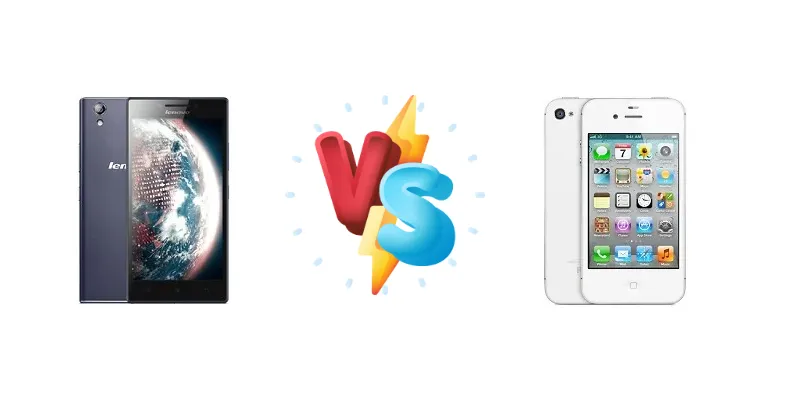
Remember a time when smartphones were simpler, yet still packed a punch? We're revisiting two devices from that era: the Lenovo P70, known for its massive battery, and the Apple iPhone 4s, a classic in Apple's history. Let's see how these phones stack up today.
🏆 Quick Verdict
The Lenovo P70 wins on battery life and offers a more modern chipset, though performance is still dated. The iPhone 4s boasts iOS and a more refined user experience, but its age shows. Ultimately, the P70 is better for longevity, while the 4s offers a taste of Apple history.
| Network |
|---|
| 2G bands | GSM 850 / 900 / 1800 / 1900 - SIM 1 & SIM 2 | GSM 850 / 900 / 1800 / 1900 |
| 3G bands | HSDPA 900 / 2100 | HSDPA 850 / 900 / 1900 / 2100 |
| 4G bands | 1, 3, 7, 20 - Data only, no voice | - |
| Speed | HSPA 21.1/5.76 Mbps, LTE Cat4 150/50 Mbps | HSPA 14.4/5.76 Mbps |
| Technology | GSM / HSPA / LTE | GSM / CDMA / HSPA / EVDO |
| | - | CDMA2000 1xEV-DO |
| Launch |
|---|
| Announced | 2015, January. Released 2015, February | 2011, October 04. Released 2011, October 14 |
| Status | Discontinued | Discontinued |
| Body |
|---|
| Build | - | Glass front (Corning-made glass), glass back, stainless steel frame |
| Dimensions | 142 x 71.8 x 8.9 mm (5.59 x 2.83 x 0.35 in) | 115.2 x 58.6 x 9.3 mm (4.54 x 2.31 x 0.37 in) |
| SIM | Dual SIM (Micro-SIM, dual stand-by) | Micro-SIM |
| Weight | 149 g (5.26 oz) | 140 g (4.94 oz) |
| | - | Scratch-resistant glass back panel |
| Display |
|---|
| Protection | - | Corning Gorilla Glass, oleophobic coating |
| Resolution | 720 x 1280 pixels, 16:9 ratio (~294 ppi density) | 640 x 960 pixels, 3:2 ratio (~330 ppi density) |
| Size | 5.0 inches, 68.9 cm2 (~67.6% screen-to-body ratio) | 3.5 inches, 36.5 cm2 (~54.0% screen-to-body ratio) |
| Type | IPS LCD | IPS LCD |
| Platform |
|---|
| CPU | Octa-core 1.7 GHz Cortex-A53 | Dual-core 1.0 GHz Cortex-A9 |
| Chipset | Mediatek MT6752 (28 nm) | Apple A5 (45 nm) |
| GPU | Mali-T760MP2 | PowerVR SGX543MP2 |
| OS | Android 4.4 (KitKat) | iOS 5, upgradable to iOS 9.3.6 |
| Memory |
|---|
| Card slot | microSDHC (dedicated slot) | No |
| Internal | 16GB 2GB RAM | 8GB 512MB RAM, 16GB 512MB RAM, 32GB 512MB RAM, 64GB 512MB RAM |
| Main Camera |
|---|
| Features | LED flash, HDR, panorama | LED flash, panorama, HDR |
| Single | 13 MP, f/2.0, AF | 8 MP, f/2.4, 35mm (standard), 1/3.2", 1.4µm, AF |
| Video | 1080p@30fps | 1080p@30fps |
| Selfie camera |
|---|
| Single | 5 MP | VGA, videocalling over Wi-Fi and 3G |
| Video | - | 480p@30fps |
| Sound |
|---|
| 3.5mm jack | Yes | Yes |
| 35mm jack | Yes | Yes |
| Loudspeaker | Yes | Yes |
| Comms |
|---|
| Bluetooth | 4.0, A2DP | 4.0, A2DP, LE |
| NFC | No | - |
| Positioning | GPS | GPS, A-GPS, GLONASS |
| Radio | FM radio | No |
| USB | microUSB 2.0, OTG | 2.0 |
| WLAN | Wi-Fi 802.11 b/g/n, hotspot | Wi-Fi 802.11 b/g/n, hotspot |
| Features |
|---|
| Sensors | Accelerometer, proximity | Accelerometer, gyro, proximity, compass |
| Battery |
|---|
| Stand-by | Up to 816 h (2G) / Up to 696 h (3G) | Up to 200 h (3G) |
| Talk time | Up to 46 h (2G) / Up to 18 h (3G) | Up to 8 h (3G) |
| Type | Li-Po 4000 mAh, non-removable | Li-Po 1432 mAh, non-removable (5.3 Wh) |
| Misc |
|---|
| Colors | Midnight Blue | Black, White |
| Models | P70-A | A1431, A1387, iPhone4,1 |
| Price | About 240 EUR | About 190 EUR |
| SAR | - | 1.18 W/kg (head) 0.98 W/kg (body) |
| SAR EU | - | 0.99 W/kg (head) 0.99 W/kg (body) |
| Tests |
|---|
| Audio quality | - |
Noise -91.2dB / Crosstalk -93.0dB |
| Battery life | - |
Endurance rating 45h
|
| Camera | - |
Photo / Video |
| Display | - |
Contrast ratio: 1261:1 (nominal) / 2.269:1 (sunlight) |
| Loudspeaker | - |
Voice 65dB / Noise 64dB / Ring 74dB
|
Lenovo P70
- Exceptional battery life
- Larger screen
- More modern chipset (though still dated)
- Generally more affordable
- Android experience can be clunky
- Build quality may be lower
- Camera performance not top-tier
Apple iPhone 4s
- iOS ecosystem
- Refined user experience (for its time)
- Good camera for its era
- Iconic design
- Very slow performance by today's standards
- Small screen
- Outdated technology
- Limited app support
Display Comparison
Both phones feature displays with a respectable contrast ratio (1261:1 nominal, 2.269:1 sunlight). The Lenovo P70 likely has a larger screen size (around 5.5 inches) compared to the iPhone 4s (3.5 inches), offering more viewing real estate. Color accuracy and resolution are likely better on the P70, though both are dated by today's standards.
Camera Comparison
The iPhone 4s was known for its decent camera for its time, featuring a 8MP main camera. The Lenovo P70 likely has a higher megapixel count (around 13MP), but image quality will depend heavily on software and sensor size. Expect better low-light performance from the iPhone 4s due to Apple's image processing.
Performance
The iPhone 4s's dual-core A5 chip, while efficient, is significantly slower than the Lenovo P70's octa-core MT6752. While iOS is optimized, the P70's chipset offers a theoretical performance advantage, though real-world usage will still feel sluggish on both devices. Multitasking will be noticeably better on the P70.
Battery Life
This is where the Lenovo P70 truly shines. It's renowned for its massive 5000mAh battery, offering exceptional endurance. The iPhone 4s, while boasting a respectable 45h endurance rating, simply can't compete with the P70's capacity. The P70 will easily last multiple days on a single charge.
Buying Guide
The Lenovo P70 is for those prioritizing battery life and a larger screen on a tight budget. The iPhone 4s is for Apple enthusiasts wanting a nostalgic experience or a very basic, secondary device, understanding its limitations.
Frequently Asked Questions
❓ Are these phones still usable in 2024?
Yes, but with significant limitations. Both phones are outdated and won't receive software updates. They can handle basic tasks, but performance will be slow, and app compatibility may be an issue.
❓ Which phone is better for gaming?
Neither is ideal for modern gaming. The Lenovo P70's chipset is slightly better, but both will struggle with demanding games. Expect low frame rates and potential overheating.