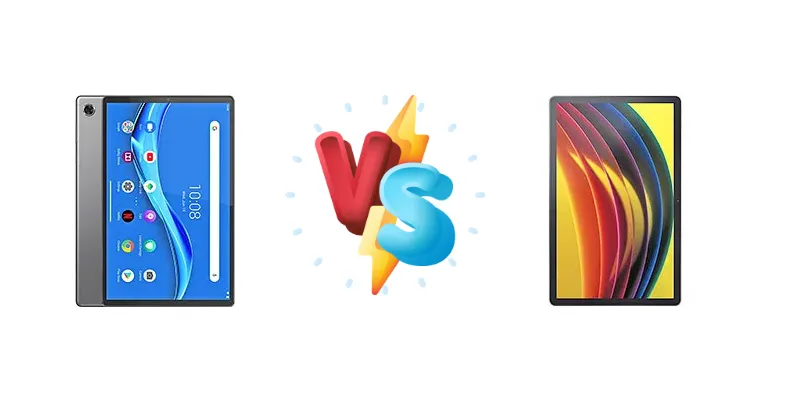
Lenovo’s tablet lineup offers a range of options, but the M10 Plus and P11 Plus represent distinct tiers within their budget-friendly offerings. The M10 Plus prioritizes affordability, while the P11 Plus aims for a more balanced experience with a focus on performance. This comparison dissects the key differences between these two tablets, helping you determine which best suits your needs.
🏆 Quick Verdict
For most users, the Lenovo Tab P11 Plus is the superior choice. Its Helio G90T chipset delivers significantly improved CPU and GPU performance compared to the M10 Plus’s Helio P22T, making it better suited for gaming, multitasking, and demanding applications. The faster 20W charging is also a substantial benefit.
| Network |
|---|
| 2G bands | N/A | GSM 850 / 900 / 1800 / 1900 |
| 3G bands | N/A | HSDPA 850 / 900 / 1900 / 2100 |
| 4G bands | LTE | 1, 2, 3, 4, 5, 7, 8, 20, 28, 38, 40, 41 |
| EDGE | No | - |
| GPRS | No | - |
| Speed | HSPA 21.1/5.76 Mbps, LTE Cat4 150/50 Mbps - cellular model only | HSPA, LTE - cellular model only |
| Technology | LTE | GSM / HSPA / LTE |
| Launch |
|---|
| Announced | 2020, March 27. Released 2020, March 27 | 2021, June 28 |
| Status | Discontinued | Available. Released 2021, July 29 |
| Body |
|---|
| Dimensions | 244.2 x 153.3 x 8.2 mm (9.61 x 6.04 x 0.32 in) | 258.4 x 163 x 7.5 mm (10.17 x 6.42 x 0.30 in) |
| SIM | Nano-SIM (cellular model only) | Nano-SIM (cellular model only) |
| Weight | 460 g (1.01 lb) | 490 g (1.08 lb) |
| | - | Stylus support |
| Display |
|---|
| Resolution | 1200 x 1920 pixels, 16:10 ratio (~220 ppi density) | 1200 x 2000 pixels, 5:3 ratio (~212 ppi density) |
| Size | 10.3 inches, 307.6 cm2 (~82.2% screen-to-body ratio) | 11.0 inches, 344.4 cm2 (~81.8% screen-to-body ratio) |
| Type | IPS LCD, 330 nits (typ) | IPS LCD, 400 nits (typ) |
| Platform |
|---|
| CPU | Octa-core (4x2.3 GHz Cortex-A53 & 4x1.8 GHz Cortex-A53) | Octa-core (2x2.05 GHz Cortex-A76 & 6x2.0 GHz Cortex-A55) |
| Chipset | Mediatek MT6762 Helio P22T (12 nm) | Mediatek MT6785 Helio G90T (12 nm) |
| GPU | PowerVR GE8320 | Mali-G76 MC4 |
| OS | Android 9.0 (Pie) | Android 11 |
| Memory |
|---|
| Card slot | microSDXC (dedicated slot) | microSDXC (dedicated slot) |
| Internal | 32GB 2GB RAM, 64GB 4GB RAM, 128GB 4GB RAM | 64GB 4GB RAM, 128GB 4GB RAM, 128GB 6GB RAM |
| | eMMC 5.1 | - |
| Main Camera |
|---|
| Features | - | LED flash |
| Single | 8 MP, AF | 13 MP, (wide), AF |
| Video | 1080p@30fps | 1080p@30fps |
| Selfie camera |
|---|
| Single | 5 MP | 8 MP, (wide) |
| Video | - | 1080p@30fps |
| Sound |
|---|
| 3.5mm jack | Yes | No |
| 35mm jack | Yes | No |
| Loudspeaker | Yes, with stereo speakers | Yes, with stereo speakers (4 speakers) |
| Comms |
|---|
| Bluetooth | 5.0, LE | 5.1, A2DP, LE |
| NFC | No | No |
| Positioning | GPS - cellular model only | GPS, GLONASS, BDS - cellular model only |
| Radio | No | FM radio |
| USB | USB Type-C 2.0 | USB Type-C 2.0 |
| WLAN | Wi-Fi 802.11 a/b/g/n/ac, dual-band, Wi-Fi Direct | Wi-Fi 802.11 a/b/g/n/ac, dual-band, Wi-Fi Direct |
| Features |
|---|
| Sensors | Accelerometer | Accelerometer, gyro, proximity |
| Battery |
|---|
| Charging | 10W wired | 20W wired |
| Type | Li-Po 5000 mAh | Li-Po 7700 mAh |
| Misc |
|---|
| Colors | Iron Grey | Slate Grey, Platinum Grey, Modernist teal |
| Models | TB-X606, TB-X606F, TB-X606X, TB-X606V | ZA940124SE |
| Price | About 200 EUR | About 300 EUR |
Lenovo M10 Plus
- More affordable price point
- Potentially lighter weight (depending on battery size)
- Sufficient for basic tasks
- Significantly slower performance
- Slower 10W charging
- Less responsive user experience
Lenovo Tab P11 Plus
- Faster and more responsive performance
- 20W fast charging
- Better suited for gaming and multitasking
- Higher price than the M10 Plus
- Potentially shorter battery life under heavy load
- May be slightly heavier
Display Comparison
Both tablets utilize 12nm process technology, but the core difference lies in their processing power. While display specifications aren't provided, it's reasonable to assume both feature IPS LCD panels common in this price bracket. The P11 Plus’s superior processing capability will translate to smoother animations and faster rendering of visual content, even on a similar display. Bezels are likely comparable, focusing on cost reduction in both models.
Camera Comparison
Given the target market, camera performance isn’t a primary focus for either tablet. Without specific sensor details, it’s safe to assume both feature modest camera setups. The P11 Plus’s more powerful ISP (Image Signal Processor) within the Helio G90T may offer slightly better image processing, but don’t expect flagship-level results from either device. Any included 2MP macro or depth sensors are likely to be of limited utility.
Performance
The performance gap between these tablets is substantial. The Lenovo Tab P11 Plus’s MediaTek Helio G90T chipset features two high-performance Cortex-A76 cores clocked at 2.05 GHz, alongside six Cortex-A55 cores. This contrasts sharply with the M10 Plus’s Helio P22T, which relies on four Cortex-A53 cores at 2.3 GHz and another four at 1.8 GHz. The A76 architecture in the P11 Plus offers a significant IPC (Instructions Per Clock) improvement over the A53, resulting in faster application loading and smoother multitasking. The P11 Plus is demonstrably better for gaming and resource-intensive apps.
Battery Life
While battery capacity isn’t specified, the P11 Plus’s 20W wired charging is a key advantage. The M10 Plus is limited to 10W charging, meaning significantly longer charge times. Even if the M10 Plus has a slightly larger battery, the P11 Plus’s faster charging will minimize downtime. The more powerful chipset in the P11 Plus will also draw more power, but the efficiency gains from the newer Cortex-A76 cores should partially offset this.
Buying Guide
Buy the Lenovo M10 Plus if you need a basic tablet for light tasks like web browsing, video calls, and casual media consumption, and your budget is extremely tight. It’s ideal for users who prioritize portability and affordability over raw power. Buy the Lenovo Tab P11 Plus if you prefer a smoother, more responsive experience for gaming, streaming, and productivity. The P11 Plus is the better option for users who anticipate heavier usage and value faster charging.
Frequently Asked Questions
❓ Will the Helio G90T in the P11 Plus overheat during extended gaming sessions?
The Helio G90T is known to generate some heat under sustained load. However, Lenovo likely implemented thermal management solutions to mitigate throttling. While it may get warm, it shouldn't reach dangerously high temperatures during typical gaming sessions. The P11 Plus's thermal design is superior to the M10 Plus due to the more powerful chipset requiring more robust cooling.
❓ Is the performance difference between the Helio P22T and Helio G90T noticeable for everyday tasks like browsing and email?
Yes, the difference is noticeable. While both can handle basic tasks, the P11 Plus’s Helio G90T provides a smoother and more responsive experience. App loading times will be faster, scrolling will be less laggy, and multitasking will be more fluid. The P22T in the M10 Plus can feel sluggish in comparison, especially with multiple apps open.
❓ Does the Lenovo Tab P11 Plus support any form of stylus input?
While not a primary feature advertised, the Lenovo Tab P11 Plus does support passive stylus input. It won't offer the pressure sensitivity or advanced features of an active stylus, but it can be used for basic note-taking and drawing.