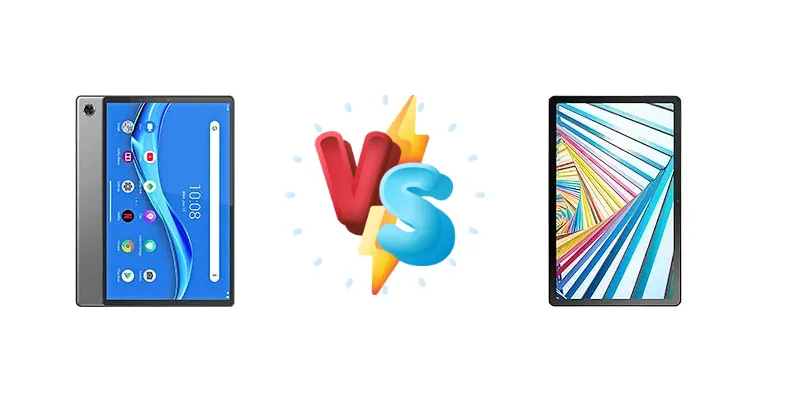
Lenovo's M10 Plus series offers accessible Android tablets, but the jump to the 3rd generation introduces significant internal changes. We dissect the differences between the original M10 Plus, powered by the MediaTek Helio P22T, and the newer M10 Plus (3rd Gen), which offers both Snapdragon 680 and Helio G80 variants, to determine which tablet delivers the best value and performance for your needs.
🏆 Quick Verdict
For most users, the Lenovo Tab M10 Plus (3rd Gen) is the superior choice. The Snapdragon 680 (LTE model) provides a substantial performance uplift over the Helio P22T in the original M10 Plus, coupled with faster 20W charging. Even the Wi-Fi only G80 variant offers a noticeable improvement. The increased efficiency of the 6nm Snapdragon also translates to better battery life.
| Network |
|---|
| 2G bands | N/A | GSM 850 / 900 / 1800 / 1900 |
| 3G bands | N/A | HSDPA 800 / 850 / 900 / 1900 / 2100 |
| 4G bands | LTE | 1, 2, 3, 4, 5, 7, 8, 19, 20, 26, 28, 28, 38, 40, 41 |
| EDGE | No | - |
| GPRS | No | - |
| Speed | HSPA 21.1/5.76 Mbps, LTE Cat4 150/50 Mbps - cellular model only | HSPA 42.2/5.76 Mbps, LTE Cat13 390/75 Mbps - cellular model only |
| Technology | LTE | GSM / HSPA / LTE |
| Launch |
|---|
| Announced | 2020, March 27. Released 2020, March 27 | 2022, May |
| Status | Discontinued | Available. Released 2022, May |
| Body |
|---|
| Dimensions | 244.2 x 153.3 x 8.2 mm (9.61 x 6.04 x 0.32 in) | 251.2 x 158.8 x 7.5 mm (9.89 x 6.25 x 0.30 in) |
| SIM | Nano-SIM (cellular model only) | Nano-SIM (cellular model only) |
| Weight | 460 g (1.01 lb) | 465 g (1.03 lb) |
| | - | Stylus support |
| Display |
|---|
| Resolution | 1200 x 1920 pixels, 16:10 ratio (~220 ppi density) | 1200 x 2000 pixels, 5:3 ratio (~220 ppi density) |
| Size | 10.3 inches, 307.6 cm2 (~82.2% screen-to-body ratio) | 10.61 inches, 320.4 cm2 (~80.3% screen-to-body ratio) |
| Type | IPS LCD, 330 nits (typ) | IPS LCD, 400 nits (typ) |
| Platform |
|---|
| CPU | Octa-core (4x2.3 GHz Cortex-A53 & 4x1.8 GHz Cortex-A53) | Octa-core (4x2.4 GHz Kryo 265 Gold & 4x1.9 GHz Kryo 265 Silver) - LTE model Octa-core (2x2.0 GHz Cortex-A75 & 6x1.8 GHz Cortex-A55) - Wi-Fi only model |
| Chipset | Mediatek MT6762 Helio P22T (12 nm) | Qualcomm SM6225 Snapdragon 680 4G (6 nm) - LTE model Mediatek MT6769V/CU Helio G80 (12 nm) - Wi-Fi only model |
| GPU | PowerVR GE8320 | Adreno 610 - LTE model Mali-G52 MC2 - Wi-Fi only model |
| OS | Android 9.0 (Pie) | Android 12 |
| Memory |
|---|
| Card slot | microSDXC (dedicated slot) | microSDXC (dedicated slot) |
| Internal | 32GB 2GB RAM, 64GB 4GB RAM, 128GB 4GB RAM | 32GB 3GB RAM, 64GB 4GB RAM, 128GB 4GB RAM, 128GB 6GB RAM |
| | eMMC 5.1 | eMCP/uMCP |
| Main Camera |
|---|
| Single | 8 MP, AF | 8 MP, AF |
| Video | 1080p@30fps | 1080p |
| Selfie camera |
|---|
| Single | 5 MP | 8 MP |
| Sound |
|---|
| 3.5mm jack | Yes | Yes |
| 35mm jack | Yes | Yes |
| Loudspeaker | Yes, with stereo speakers | Yes, with stereo speakers (4 speakers) |
| Comms |
|---|
| Bluetooth | 5.0, LE | 5.0, A2DP, LE |
| NFC | No | No |
| Positioning | GPS - cellular model only | GPS, GLONASS, BDS - cellular model only |
| Radio | No | FM Radio |
| USB | USB Type-C 2.0 | USB Type-C 2.0 |
| WLAN | Wi-Fi 802.11 a/b/g/n/ac, dual-band, Wi-Fi Direct | Wi-Fi 802.11 a/b/g/n/ac, dual-band, Wi-Fi Direct |
| Features |
|---|
| Sensors | Accelerometer | Accelerometer, proximity, gyro |
| Battery |
|---|
| Charging | 10W wired | 20W wired |
| Type | Li-Po 5000 mAh | Li-Po 7700 mAh |
| Misc |
|---|
| Colors | Iron Grey | Storm Grey, Frost Blue |
| Models | TB-X606, TB-X606F, TB-X606X, TB-X606V | - |
| Price | About 200 EUR | About 260 EUR |
Lenovo M10 Plus
- Lower price point (likely)
- Sufficient for basic tasks
- Functional for light use
- Outdated chipset
- Slow charging (10W)
- Limited multitasking capabilities
Lenovo Tab M10 Plus (3rd Gen)
- Significantly faster performance (Snapdragon 680)
- Faster charging (20W)
- Improved power efficiency (Snapdragon 680)
- More responsive user experience
- Higher price point
- Helio G80 variant less efficient than Snapdragon 680
Display Comparison
Both tablets share a similar 10.1-inch display size, but detailed display specs like resolution, brightness, and color gamut are not provided. However, the chipset improvements in the 3rd Gen suggest a potentially more fluid user interface, especially during scrolling and animations. The lack of information on panel technology prevents a deeper analysis of color accuracy or viewing angles.
Camera Comparison
Camera specifications are not detailed enough to draw meaningful conclusions. Given the target market of these tablets, camera quality is unlikely to be a primary differentiator. It's safe to assume both tablets offer basic camera functionality suitable for casual snapshots and video calls, but not for serious photography.
Performance
The core difference lies in the chipsets. The original M10 Plus utilizes the Mediatek MT6762 Helio P22T, a 12nm process chip with an octa-core CPU configuration split between 2.3 GHz and 1.8 GHz Cortex-A53 cores. This is a relatively basic processor designed for efficiency. The M10 Plus (3rd Gen) offers two options: the Qualcomm Snapdragon 680 (6nm) and the MediaTek Helio G80 (12nm). The Snapdragon 680, with its Kryo 265 Gold and Silver cores clocked at 2.4 GHz and 1.9 GHz respectively, represents a significant leap in performance and efficiency due to its smaller 6nm fabrication process. The Helio G80, while still a 12nm chip, features more powerful Cortex-A75 cores (2.0 GHz) and A55 cores (1.8 GHz) offering a performance boost over the P22T. The 6nm Snapdragon 680 will exhibit less thermal throttling under sustained load, making it ideal for gaming and demanding applications.
Battery Life
While battery capacity isn't specified, the 3rd Gen's 20W wired charging is a major advantage over the original M10 Plus's 10W charging. This translates to significantly faster charging times, reducing downtime. The Snapdragon 680's 6nm process also contributes to improved power efficiency, potentially extending battery life even with similar capacity. The Helio G80, while less efficient than the Snapdragon, still benefits from the faster charging speed.
Buying Guide
Buy the Lenovo M10 Plus if your primary use case is light tasks like e-reading, basic web browsing, and occasional video streaming, and you're on a very tight budget. It's a functional device for minimal demands. Buy the Lenovo Tab M10 Plus (3rd Gen) if you prioritize smoother multitasking, faster app loading times, a more responsive user experience, and quicker charging. The 3rd Gen is the better investment for anyone planning to use their tablet for more than just basic consumption.
Frequently Asked Questions
❓ Will the Snapdragon 680 in the M10 Plus (3rd Gen) handle demanding games like Genshin Impact?
While the Snapdragon 680 isn't a high-end gaming chip, it's capable of running Genshin Impact at lower settings. Expect playable frame rates with reduced graphics quality. The 6nm process helps mitigate thermal throttling, providing a more consistent experience than the Helio P22T would.
❓ Is the Wi-Fi only Helio G80 version of the M10 Plus (3rd Gen) a worthwhile upgrade over the original M10 Plus?
Yes, even the Wi-Fi only Helio G80 variant offers a noticeable performance improvement over the Helio P22T. The more powerful CPU cores in the G80 result in faster app loading times and smoother multitasking. The 20W charging is also a significant benefit.
❓ How much faster is the 20W charging on the M10 Plus (3rd Gen) compared to the 10W charging on the original M10 Plus?
The 20W charging can reduce full charge times by approximately 50-60%, depending on the battery capacity. This means a full charge could take around 2-3 hours with 20W, compared to 4-6 hours with 10W.